Reconstruction notes
A Nano update
August 21, 2026
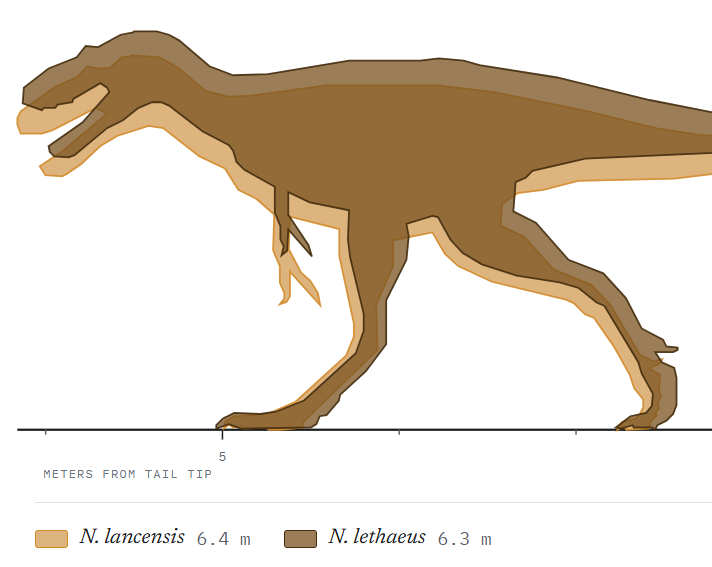
Since fall of 2025, Nanotyrannus is back. For those who don’t know, Nanotyrannus was long a controversial taxon; it was named in 1988, but by the mid-1990s many researchers were questioning whether the scrappy material was really a smaller tyrannosaur, or just juvenile specimens of T. rex, which was found in the same environments. The issue was never resolved, but the larger number of theropod workers generally felt there needed to be an “adult” Nanotyrannus specimen found to resolve the issue (the type specimen was just a skull, the Jane specimen was still growing when she died, and the Bloody Mary specimen had long been in private-ownership limbo).
After a legal battle for ownership of the Bloody Mary specimen in 2018 (itself one half of the “dueling dinosaurs” specimens), a light finally formed at the end of the taxonomic tunnel when the North Carolina Museum of Natural Sciences was able to acquire the specimen in 2020. Of course there was more prep work to be done, and good science (and good science writing) takes time, but the existence of Nanotyrannus was conclusively resolved last year, when Lindsay Zanno and James Napoli published on Bloody Mary.
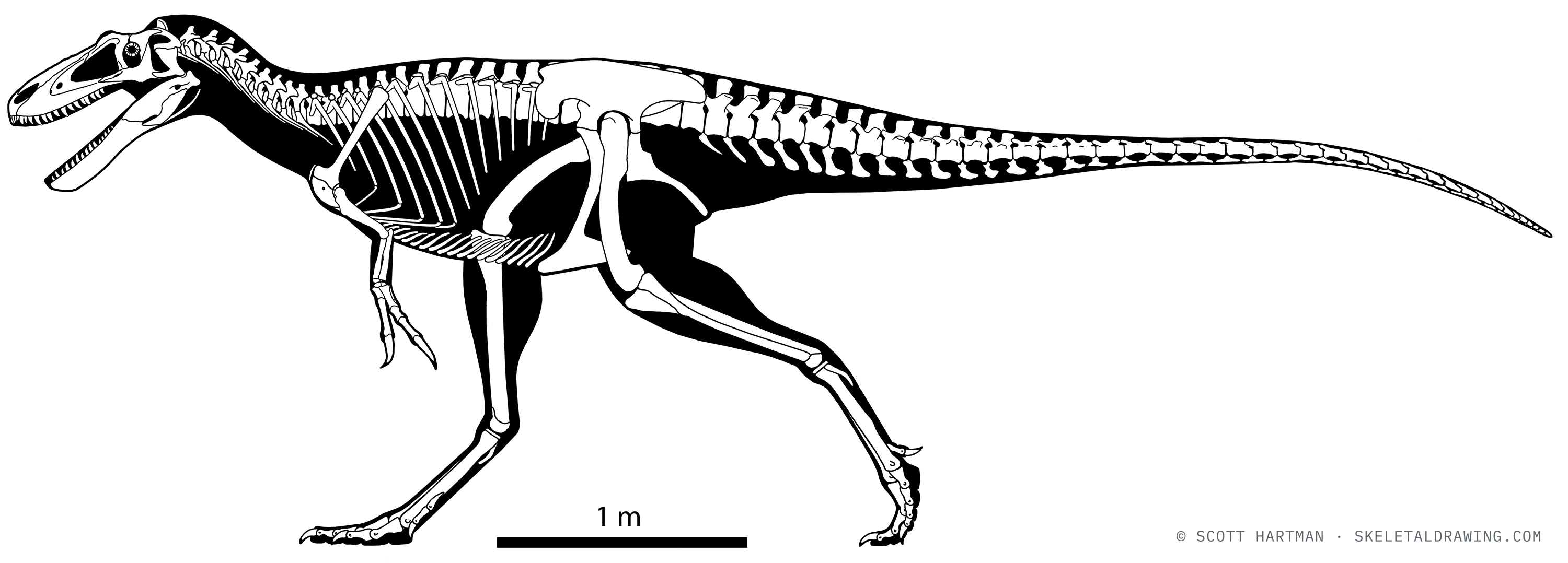
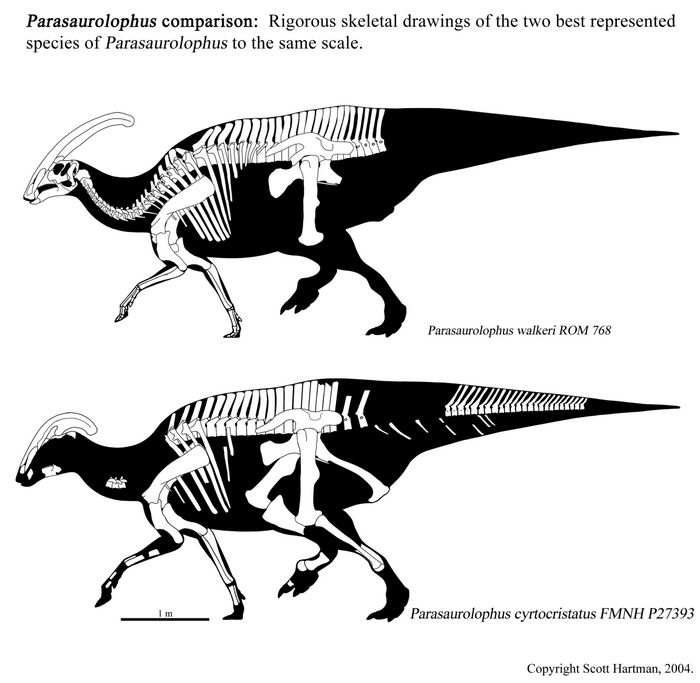
There is much more that could be written about the saga of Nanotyrannus, and I did in fact write more about it! If you head to the Nanotyrannus genus hub, I’ve written quite a bit more about it there, plus you get the full size comparison between it and the Jane specimen (seen in part at the top of this post). Which is also a good time to introduce the idea of genus hubs! In past versions of the website I’d either just have multiple species of the same genus in a row in a skeletal gallery, or sometimes I’d drop them into a comparison image with some text embedded in the image. I did this for the two species of Parasaurolophus, for example.
But this was sort of a hack, so now genera that have multiple species, whether Nanotyrannus, Diplodocus or Apatosaurus, have a new type of landing hub that not only shows skeletals and links to each species, but also has a size comparison between them, data tables, and more in-depth entries about the history of discovery, which species are considered valid, etc.
It’s not perfect - I haven’t done skeletals of every dinosaur species (yet)! So for example Psittacosaurus does not have a genus hub, despite quite a few valid species. And some hubs don’t yet have full entries written (there’s only so many hours in a day!), although I have a list of them I’m working through. I’m doing similar things with species where I’ve restored more than one specimen (Tyrannosaurus rex, for example). Want to explore more genus hubs? When you are browsing the galleries and click on a genus, you will automatically get taken to the hub so you can disambiguate which species you want. If you are using the search page, genus hubs can be identified as they don’t come up with the second (trivial) portion of the species name. Of course the species names also come up with the search tool, so feel free to jump right to a specific species if that’s what you’re searching for!
What’s in a name?
I also wanted to point out that I’ve changed the way I handle names in the galleries. In the past I often went with the names I was an advocate for (e.g. putting the Seismosaurus specimen into Diplodocus longus, rather than D. hallorum). And as someone who prefers taxonomic stability over revised names, I also sometimes held onto names too long after they had been revised (e.g. Plateosaurus engelhardti over P. trossingensis). With this overhaul I’ve attempted to remove my taxonomic biases; as a result, if a newly revised name makes a prima facie argument that seems to gain some traction, I’ll try to switch to the current names.
Of course this still has an inherent judgment call requirement (as all taxonomy does). For example, I’ve heard rumblings that not everyone thinks there are two species of Nanotyrannus (and others that think Jane is a different genus, etc.). But given the importance of Zanno & Napoli (2025) to resurrecting Nanotyrannus, I’m going to stick with their two species until such time as rebuttal papers are published.
Likewise, so far Greg Paul and coauthors have published two papers suggesting Tyrannosaurus rex be split into three species, but so far it hasn’t gotten much traction with other professionals (and does have a rebuttal paper), so I’m currently leaving the names out, although depending on how it persists I may at least add some discussion about it to the T. rex specimen hub at some point in the future.
Regardless, I want to emphasize that taxonomy is always somewhat subjective. Any biological grouping above the species level is an artificial construct made by humans so that our brains can put things into mental categories we can handle (so “felids” indicate close relatives of cats, for example). Worse, as paleontologists we are unable to test for reproductive compatibility in fossil species, so we must rely instead on various morphospecies concepts.
3 comments
Loving the revamped site and the entire set of utility updates; the omnipresent scale bars have been of great use, as working around femoral length when trying to get a sense of the relative size of charts without said bars had been a bit of a hassle in the past.
Wondering if a revisit of Jane would merit a reevaluation of the restored forelimb proportions, as the current restoration is based on tyrannosaurid proportions for its distal end, rather than the unknown until last year lancensis proportions.
Your work has been consistently great and useful for close to 2 decades in my experience, so thanks for all you've been doing! Hoping to see further work in the coming months!
Thanks Emilio - Jane's skeletal does actually have the larger hands now, I just need to update the silhouette tool to reflect it.
Hello Dr Scott I hope you are doing well, Will you ever revisit the Spinosuars hind limb controversy or has it been already settled? Has Dr Nizar reached out to you again
Many thanks as always
DS
Join the discussion
Thanks — your comment is in the queue!
It'll appear here in about 5–10 minutes, once I've approved it — you'll need to refresh the page to see it. (Comments don't post instantly anymore.)