Apatosaurus
Two documented skeletals across two species of Apatosaurus, each drawn in left lateral view.
- Skeletals shown
- 2
- Species
- 2
- Size range
- 18–23 m
Skeletals
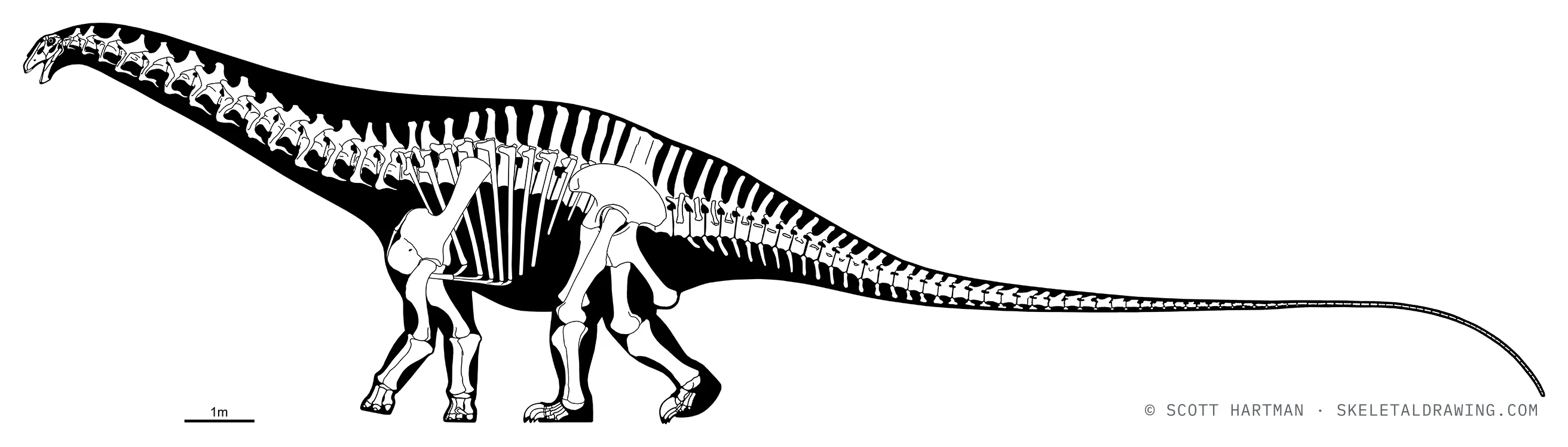
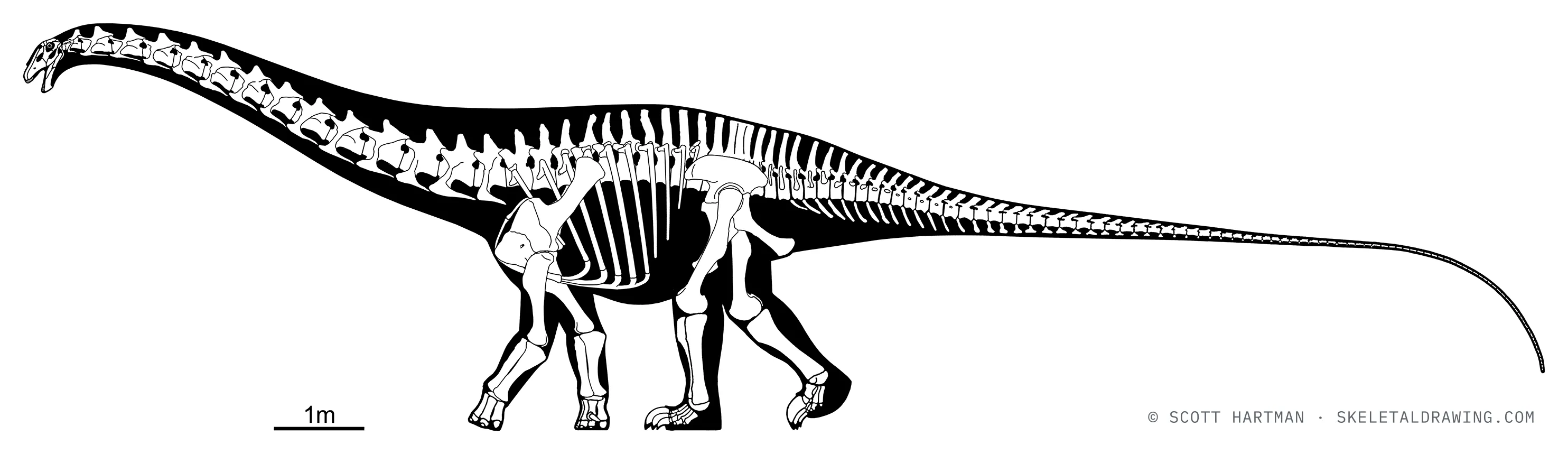
Scale comparison
Apatosaurus is one of the famous long-necked sauropod dinosaurs that lived during the Late Jurassic, in the Morrison Formation of western North America. With some species growing to over 23 meters (70+ feet) and weighing over 20 tonnes, a fully-grown apatosaur may have been immune to predation from all but the largest mobs of theropod dinosaurs.
Named during the infamous Bone Wars era of paleontology, and owing to the fact that no skulls were found with early specimens, the popular appearance and the proper name of Apatosaurus were disputed for much of the 20th century. In the 1870s, paleontologists Cope and Marsh were smack dab in the middle of an ongoing feud, where they childishly competed to see who could name more extinct animals than the other. The incentive to name as many animals as possible predictably resulted in names being applied to fossils that didn’t deserve them, while other times the same type of animal was given several different names. This resulted in a mess that paleontologists spent over a century unraveling…with some names still being disputed up to the present day.
In late 1877 Marsh described a subadult sauropod specimen which he named Apatosaurus ajax. Apatosaurus translates as “deceptive reptile”, presumably because he suspected as an adult it would be even larger. Not long after, a larger and more complete specimen of a related animal was found, that for a brief time was the largest land animal ever discovered. Marsh gave this new specimen the name Brontosaurus excelsus - the “excellent thunder reptile.” Another species of Brontosaurus was added in 1902, and another species of Apatosaurus (A. louisae) was added in 1916.
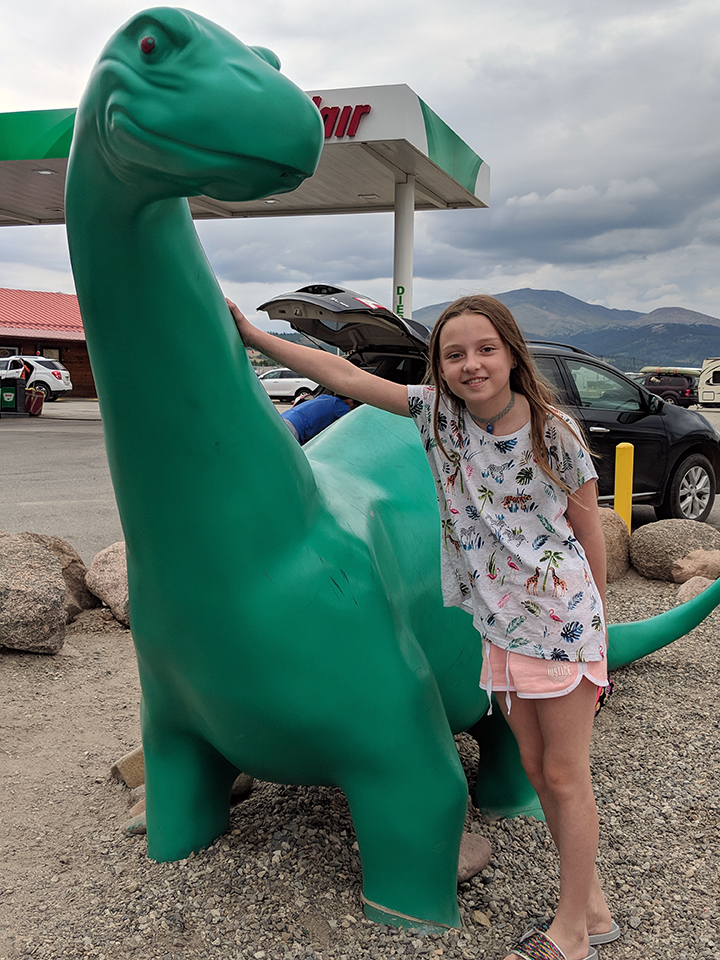
By the early 1900s, a new generation of paleontologists were just starting to pick up the nomenclatural pieces left over from the Bone Wars, and Elmer Riggs argued that all these species were such close relatives that they all belonged in Apatosaurus. This was occasionally disputed (the AMNH in New York used Brontosaurus for a mount in their halls for years), but throughout the 20th century most paleontologists adopted Riggs’ recommendation. This was often missed by the general public, however, as the Sinclair Oil Company staged a series of outreach projects in which Brontosaurus was the star (because it looks like their logo…and apparently they preferred Brontosaurus).
So by the 1970s-1990s, we hit a situation where casual observers had usually heard the name Brontosaurus, while more devoted dinosaur fans knew the name was supposed to be Apatosaurus. The problem has always been that there are multiple species involved, and there’s no such thing as a “genericometer” (hat tip to Tom Holtz) - there’s not an obvious, objective way of looking at different animals and decide if they should share the genus name, or be given separate ones.
An attempt to address the “genus question” more rigorously was put forward by Emanuel Tschopp and colleagues in 2015. They did a specimen by specimen study of phylogeny (who is related to whom), and measured how many character changes there were between different groups, species and genera. Based on their analysis, it was defensible to split Brontosaurus from Apatosaurus. Not everyone agrees, but in general their results have been adopted and seem to have significant scientific momentum.
And that’s still not all: Because there’s also the fact that early mounts used the wrong skull! This had nothing to do with the Apatosaurus vs. Brontosaurus naming issue, but rather stemmed from the fact that there weren’t any skulls found with the earliest apatosaurine specimens. Because apatosaurs are much more robust than the lightly built Diplodocus, some paleontologists of the time felt the skull should be more robust than the lightly-built, tapering skulls of diplodocines. So in New York a robust skull was sculpted based on disarticulated bones and teeth (which turned out to come from other types of sauropods) and placed on their mount.
Ironically, the correct skull was found with the type specimen of Apatosaurus louisae in 1909, but it was found a few feet away from the end of the preserved neck. The paleontologists who found it wrote that it was likely the correct skull, but there was loud dissent (again from New York), and so no head was placed on their specimen for years, and when someone finally got around to it, they placed a cast of the macronarian sauropod Camarasaurus on it instead. Despite this being definitely wrong, several other museums then copied this mis-skulling. Apatosaurs didn’t get their heads on straight until the 1970s, when paleontologists redescribed all of these skulls, and realized the mistake.
All documented skeletals — tap a column to sort
| Taxon | Author | Length | Specimen | |
|---|---|---|---|---|
| Apatosaurus louisae | Holland, 1916 | ~23 m | CM 3018 | View → |
| Apatosaurus ajax | Marsh, 1877 | ~18 m | NMST-PV 20375 | View → |