Triceratops
Three documented skeletals across three species of Triceratops, each drawn in left lateral view.
- Skeletals shown
- 3
- Species
- 3
- Size range
- 5.5–8.2 m
Skeletals
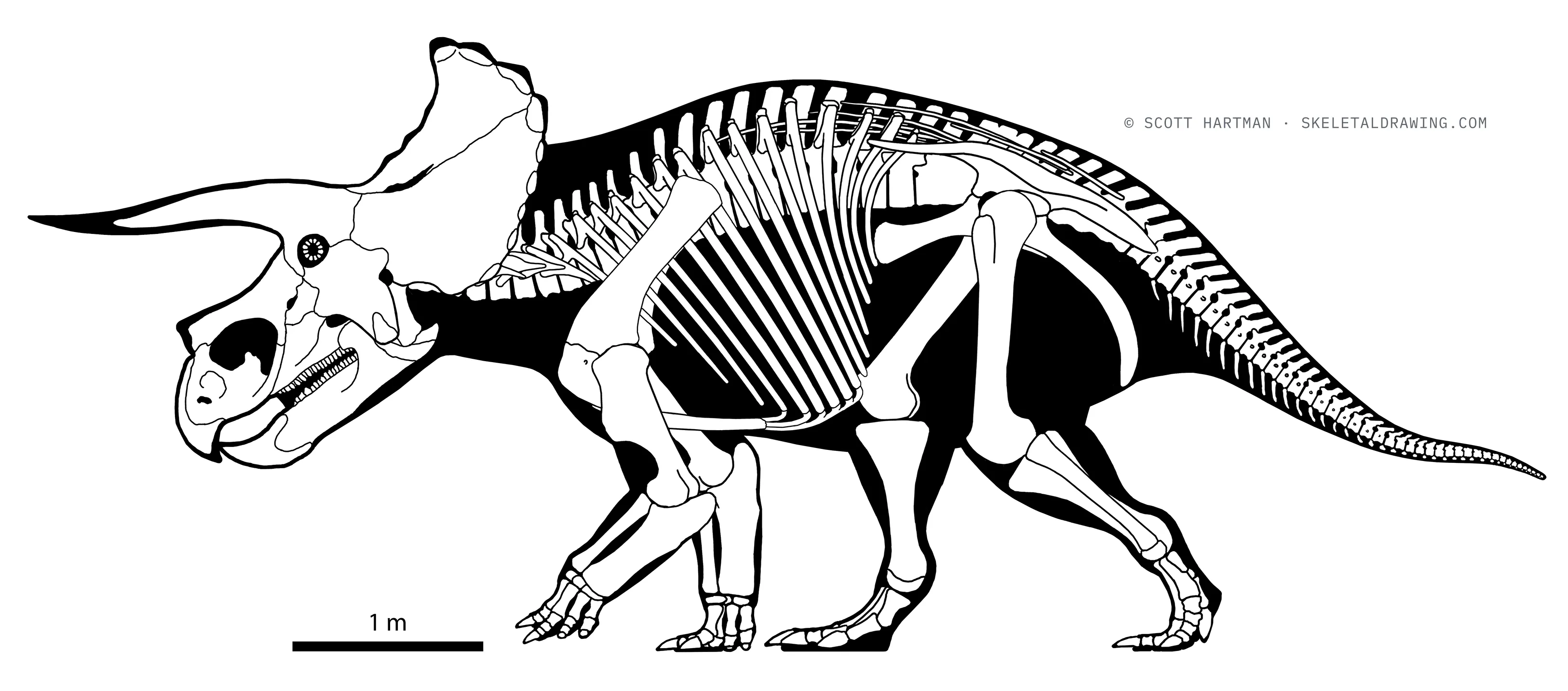
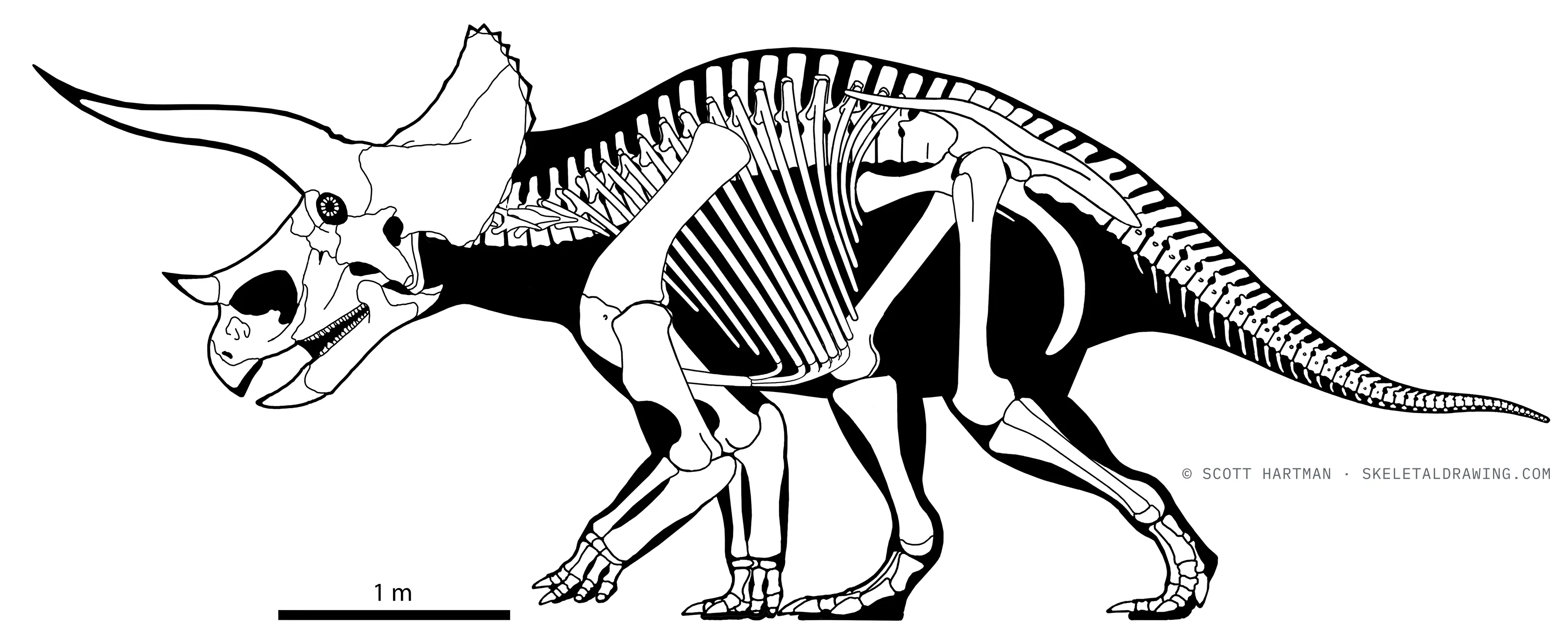
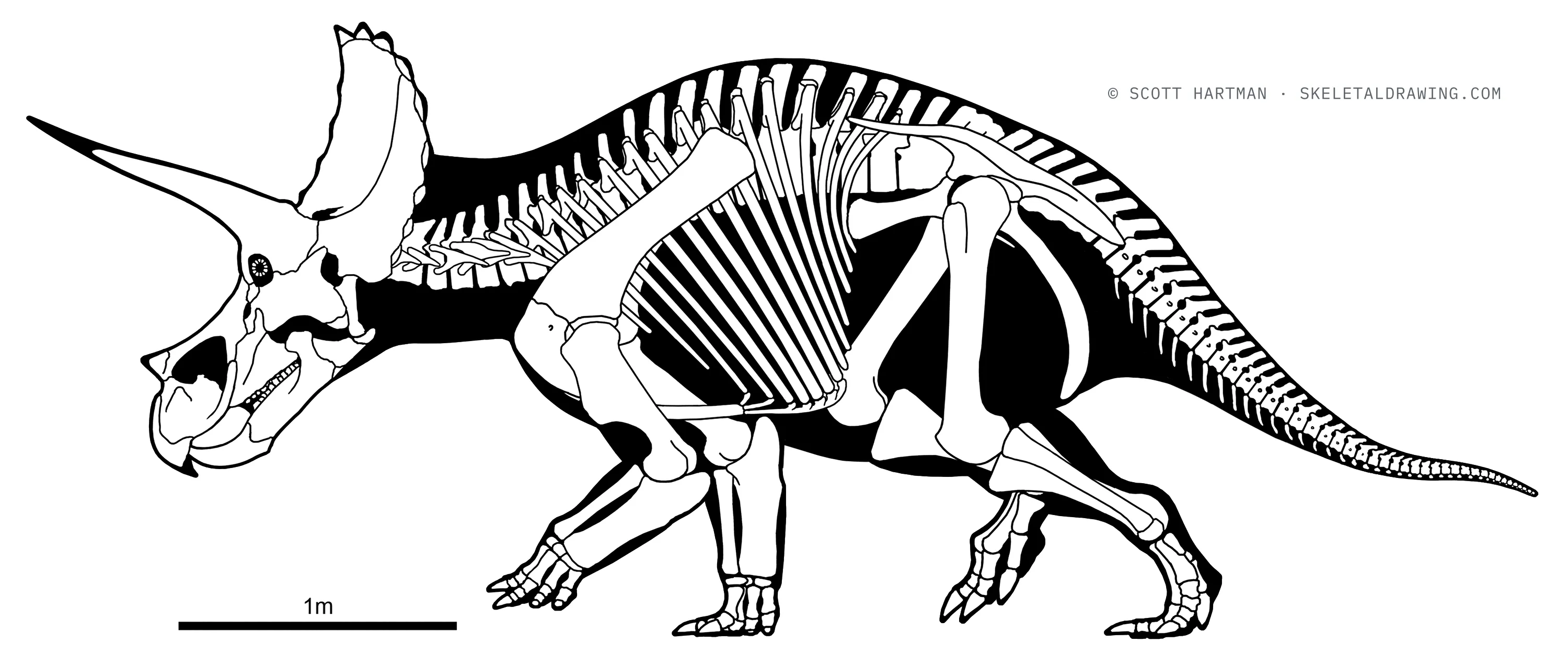
Scale comparison
Triceratops is the most iconic horned dinosaur, one of the most famous of any type of dinosaur, and my childhood favorite. But as a North American dinosaur named during the Bone Wars era, it did have a bit of naming chicanery. And its 20th century history reflects changing attempts to understand how we interpret species and variation in the fossil record. For such a classic genus, it’s worth a deeper dive.
When Othniel Charles Marsh saw the first fossils of what we now call Triceratops, he thought the two horn cores were from rocks younger than the Mesozoic. So he named them Bison alticornis. Realizing soon after that there were horned dinosaurs, he named a specimen from Montana Ceratops, which provides us with the group name Ceratopsia that is still in use today. His rival, E.D. Cope, also named material that is probably Triceratops, creating the names Agathaumas and Polyonax. None of these scrappy remains have been considered diagnostic, and so Marsh’s third try stuck; when the first reasonably complete skull was brought to him and he saw it had a third horn over the nose, he dubbed it Triceratops horridus.
Of course Marsh and Cope were locked in a brutal ego-struggle to see who could name the most extinct animals, so with horned dinosaurs looking promising, Marsh sent out his field team to collect more, and they obliged, finding dozens of skulls of Triceratops. Marsh decided many of these skulls deserved their own species designation, and so we got T. prorsus, T. hatcheri, T. elatus and many others. Since the original 1889 description, 18 species of Triceratops have been named.
Several attempts to understand this large number of species were undertaken, but it wasn’t until the 1980s that John Ostrom and Peter Wellnhofer published a landmark study, in which they placed all of the existing species back into the type species, T. horridus, with much of the variation being attributable to different life stages. A follow-up study suggested that some of the variation might also be due to sexual dimorphism.
These attempts to wrestle with variation in fossils were only made possible because so many specimens were found. Similar studies occurred with hadrosaurs and other dinosaurs that had enough known specimens to start sorting out different sources of variation. Sexual dimorphism (differences between males and females of the same species) is a common source of this variation in mammals and pterosaurs, but over time early attempts to find clear sexual dimorphism in non-avian dinosaurs have largely failed once statistical tools could test for it.
But that’s what we know today - in the 1990s there was still ongoing debate about whether we might have two valid species of Triceratops (now whittled down to T. horridus and T. prorsus), or whether those two were actually males and females of the same species. This was eventually settled when detailed stratigraphic work revealed that T. horridus specimens all came from older layers of rocks than T. prorsus, which lived right at the very end of the final epoch of the age of dinosaurs.
All documented skeletals — tap a column to sort
| Taxon | Author | Length | Specimen | |
|---|---|---|---|---|
| Triceratops horridus | (Marsh, 1889) | ~8.2 m | — | View → |
| Triceratops sp. | Marsh, 1889 | ~6.8 m | MOR 3027 | View → |
| Triceratops prorsus | Marsh, 1890 | ~5.5 m | — | View → |