Edmontosaurus
Two documented skeletals across two species of Edmontosaurus, each drawn in left lateral view.
- Skeletals shown
- 2
- Species
- 2
- Size range
- 12–13 m
Skeletals
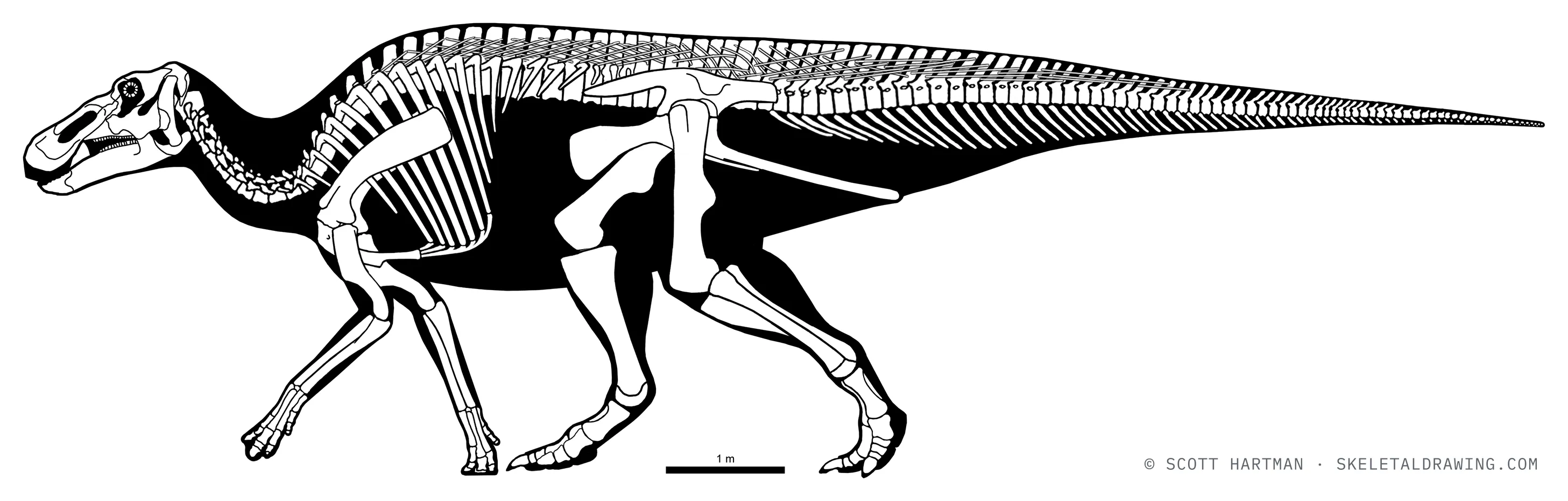
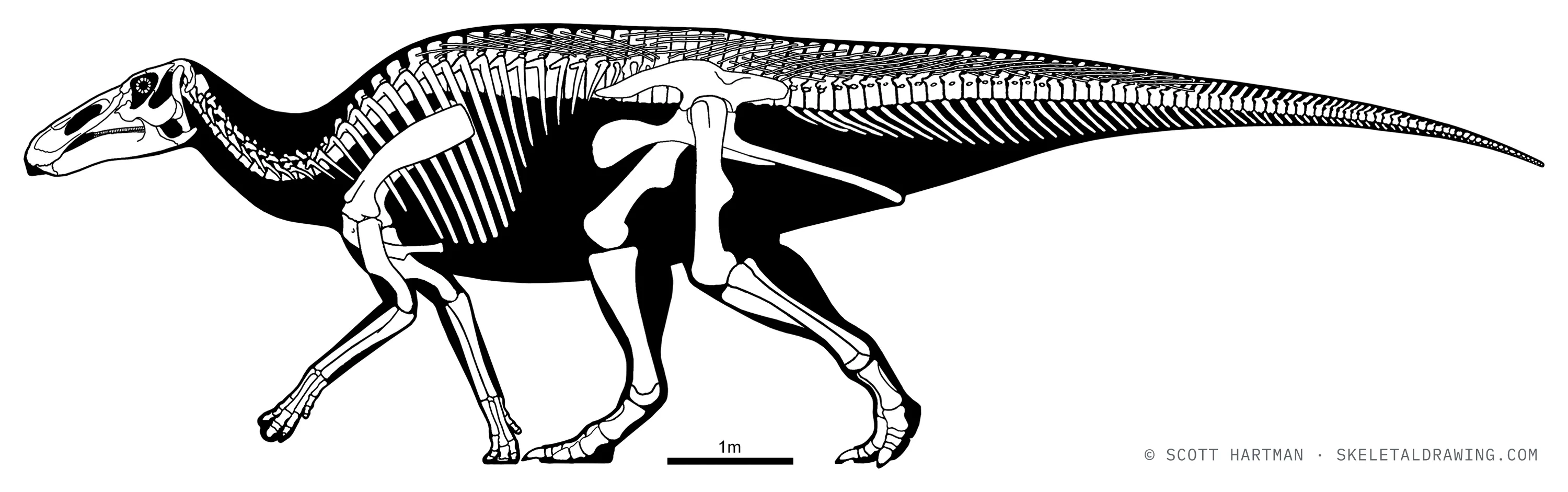
Scale comparison
While Edmontosaurus might be one of the best known hadrosaurs, it’s another one of those names that has a winding historical story before it came to its modern usage. Several different generic names have been applied, starting with Claosaurus annectens, named by Bone Wars alumnus Othniel Charles Marsh in 1892. There were fewer hadrosaurs in the late 19th and earliest 20th century to work with than sauropods or horned dinosaurs, and so for a while researchers lumped many species into one or two genera. Thus Claosaurus annectens became Trachodon annectens in 1902, when John Hatcher swept more than half a dozen different taxa into Trachodon.
In Canada in the early 20th century, new specimens were given the name Edmontosaurus regalis, although other specimens that would eventually be referred to Edmontosaurus were dumped into the genus Thespesius. Quite a few hadrosaurs were excavated in the opening decades of the 20th century, and so in 1942 the classic Lull & Wright monograph on hadrosaurs was published, trying to make sense of all of the new data. And they dumped all of these taxa into Anatosaurus.
This did finally lump the modern species of Edmontosaurus into one genus (Anatosaurus annectens, A. regalis, etc.), and Anatosaurus would go on to be one of the most commonly portrayed uncrested hadrosaurs for decades. Work in the late 1970s and early 1980s brought back the name Edmontosaurus, deciding that Anatosaurus was a junior synonym of the older genus name. Work done more recently helped shrink the number of valid species down to just two: E. annectens and E. regalis. It was even suggested that perhaps the two species are actually males and females of a single species, but better stratigraphy (measuring of rock layers) has shown that Edmontosaurus regalis comes from slightly older rocks than Edmontosaurus annectens. It’s quite possible that E. regalis evolved directly into E. annectens, although the fossil record makes this hard to test.
All documented skeletals — tap a column to sort
| Taxon | Author | Length | Specimen | |
|---|---|---|---|---|
| Edmontosaurus regalis | Lambe, 1917 | ~13 m | — | View → |
| Edmontosaurus annectens | (Marsh, 1892) | ~12 m | — | View → |