Anatomy guide
A visual glossary of skeletal anatomy
Updated June 28, 2026
How to read a skeletal
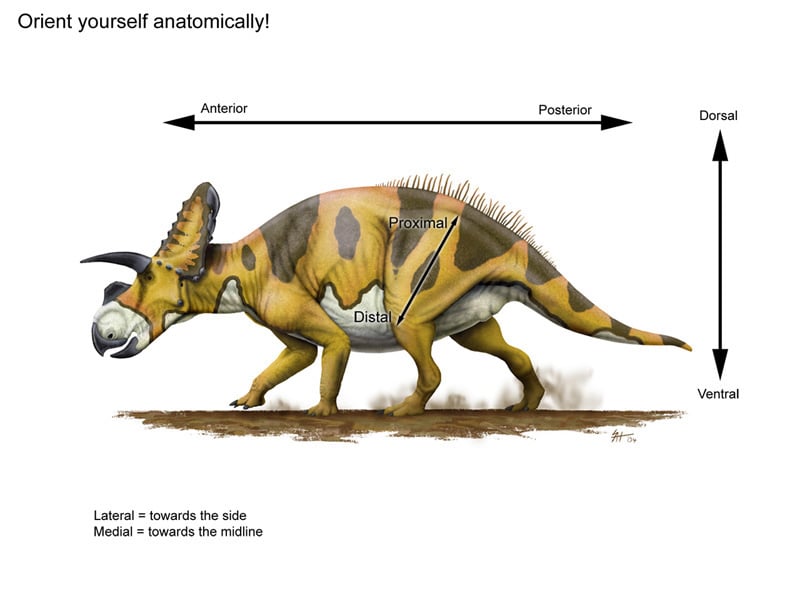
Anatomy involves a lot of directional words to convey what part of an animal we are talking about (or which way a specific bone or muscle is pointed). Many of us may intuitively understand that the rear of the animal is posterior, but not as many know the front end is anterior. The belly-side of an animal is ventral, while the back side (towards the back…not towards its posterior) is dorsal. The last set of body directions refers to the side of an animal (lateral) or towards the midline (medial).
We also want to talk about whether something is further out on a limb (distal) or closer to the body (proximal). Now there are some optional terms as well, and human medicine has flipped some of these terms due to our upright stance, but this is just a primer, not a full blown comparative anatomy course! To visualize the basic orientation terms, you can use the image below:
The skull
There are actually two sets of anatomical terms that apply to the skull, starting with the names of individual bones.
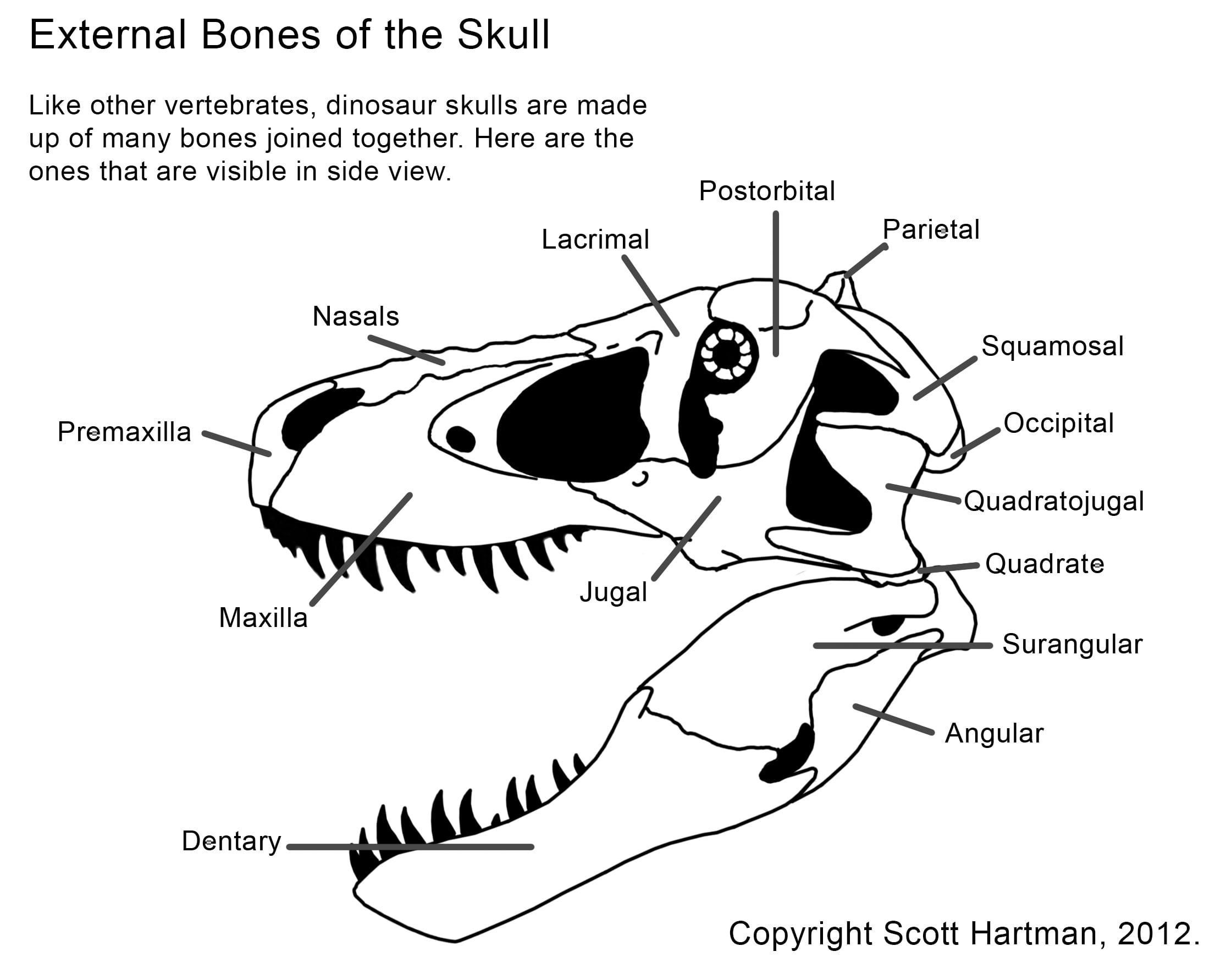
Of course the orientation terms still apply! The premaxilla is anterior to the maxilla, while the postorbital bone is dorsal to the jugal.
Remember that other set of anatomical terms I mentioned? Well (especially for dinosaurs) you may also want to learn the names of the holes between the skull bones:
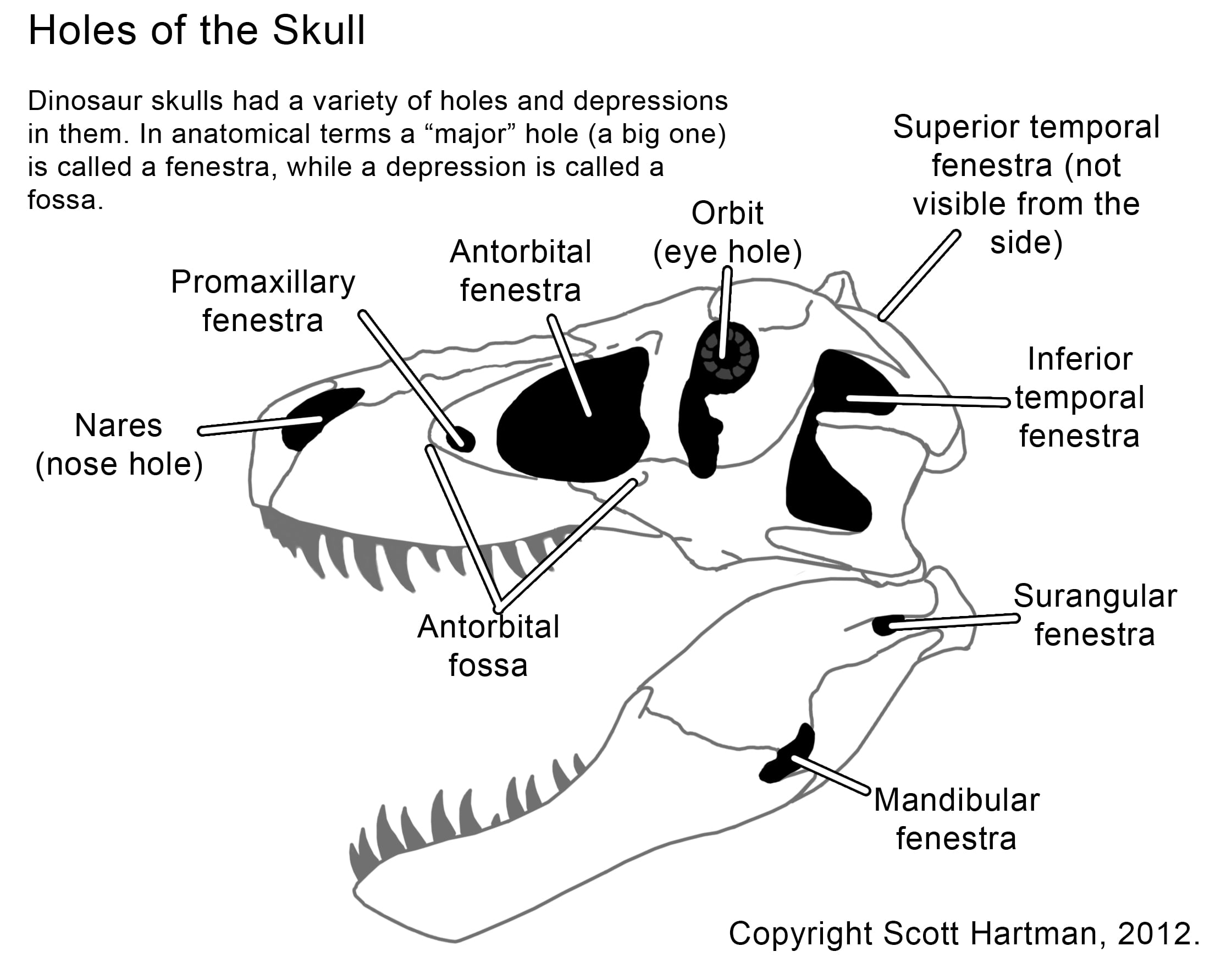
These large holes are actually called fenestra, and you can apply our anatomy orientation words to them as well, since e.g. the orbit is posterior to the antorbital and promaxillary fenestrae, but anterior to the inferior temporal (aka infratemporal) fenestra. Now you know your fenestra from a hole in the ground!
The rest of the skeleton
Vertebrate skeletons are broken into two groups of bones:
The axial skeleton refers to the head and all of the vertebrae, plus their ribs, while the appendicular skeleton refers to the shoulders, hips and all of the limb bones. Of course whichever part of the skeleton we are looking at, those bones also have names, like in the diagram below:
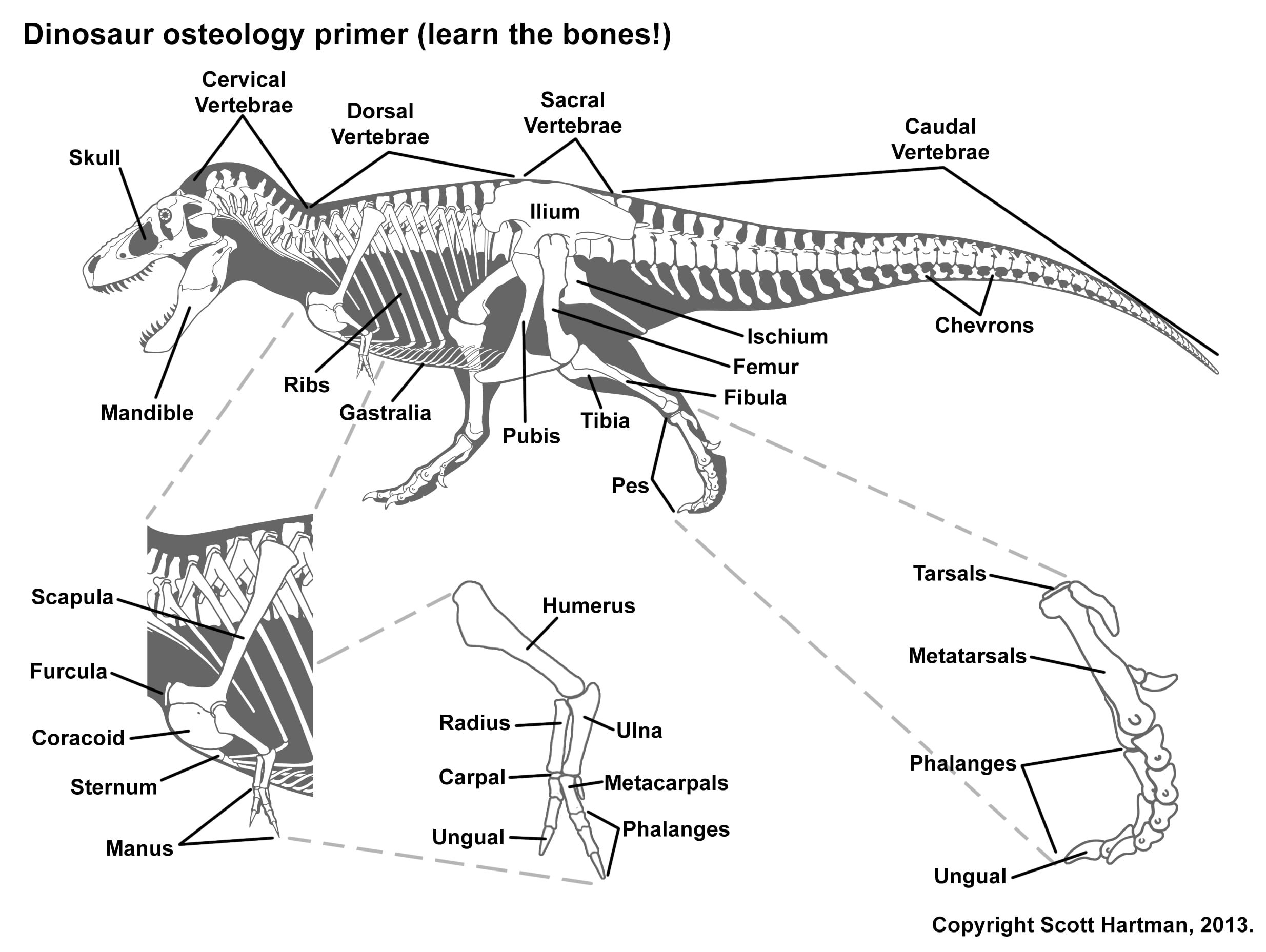
The rib bones are connected to the dorsal vertebrae…unless they are cervical ribs, then they’re part of the neck (which is anterior to the dorsal vertebrae), etc.
Boning up on soft-tissue anatomy
Of course bones don’t do much on their own! You need muscles to move your skeleton, and so did Mesozoic dinosaurs. If you want to stretch your knowledge of anatomy even further, you can check out the names of the superficial muscles (that means they are the ones you can see from the outside, not that the muscles lack a rich interior monologue or complex feelings). For ease of familiarity, many of these are named according to human muscle terminology - there are actually many different ways muscles can be named, but again, this is just a primer to get you going in the right direction!
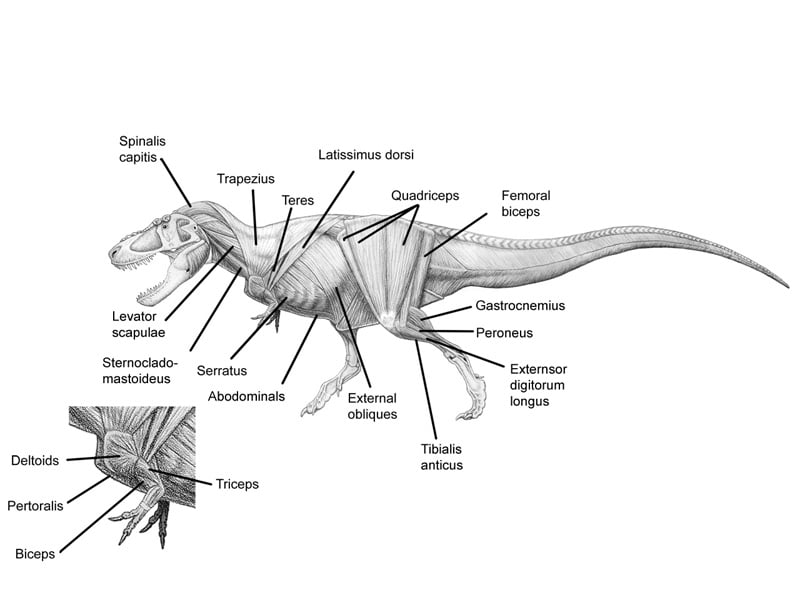
Moving deeper into soft-tissue anatomy
There are many layers of muscles, but it would take an entire dissection guide to go over all of them, and it’s notoriously difficult to get a large theropod in for dissection these days (the best you can usually do is an ostrich, if you know a guy who knows a guy…). But that doesn’t mean there isn’t interesting soft-tissue anatomy lurking in there. In the diagram below, you can see a cut-away of the more interesting deep-muscles and organ systems we’d expect to see in a large theropod (in this case Allosaurus, for a change of pace):