When journalists attack!
April 3, 2012
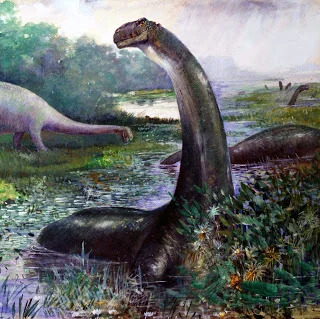
As recently reported on several apparently legitimate news sources, a new interpretation of dinosaur biology has been proposed that is “so revolutionary it stands the whole world of palaeontology on its head.” What is this landmark new idea that has set paleontologists agog? It’s being termed the “Aquatic Dinosaur” hypothesis, and as the name implies it suggests that the Charles Knight painting you see above isn’t out of date, it was just ahead of its time. And not just for sauropods, but all large dinosaurs.
If something smells fishy to you, it’s not just the swamp water; something is very wrong here. First, to be clear, there is no such controversy, or even an idea that you need to take seriously. To be sure, some guy wrote an article in Laboratory News, so I’ve listed the evidence below in a handy tabulated format:
Literally, no data was provided in the article. The author makes references to “calculations” that were run, but they never make it into print. The article is mostly long-winded hyperbole, filled with such gems as “Dinosaurs look more convincing in water, and the physics stands up more soundly.”
So the author’s main point appears to be “See??! They look better in the water, so it must be true! Also, I have some secret calculations I won’t bother to share with you support my aesthetic preference!” The fact that it was in the April edition might give us pause to wonder if this isn’t a big joke, but alas there are reasons to suspect otherwise (see below).
Two general claims seem to permeate the article, that dinosaurs were just really big so water would help, and that dinosaur footprints aren’t as deep as you’d expect from such big animals. Of course how deep a footprint sinks is only partially related to the mass of an animal. The surface area of the foot must be taken into account, as smaller feet concentrate the weight while large feet spread it out. That’s why a woman in high heels can dent substrates that elephants won’t. And of course the substrate itself matters - no animals leave tracks on concrete, while people easily get bogged down in viscous mud.
The “they’re just so big” meme is also painfully wrong; there’s an entire literature of biomechanics that shows that dinosaur limbs are strong enough to support terrestrial locomotion. And of course dinosaurs lack the aquatic features seen in animals such as hippos or crocodiles, which actually spend most of their time in water. Running your mouth off (err, running your text editor off?) without even bothering to read the literature is one of those “the stupid, it hurts!” sorts of moments.

Ok, enough ragging on “professor” Ford; he’s either a crank or a practical joker (perhaps those aren’t mutually exclusive?), but he’s not the first person to have a loony idea and not support it with any evidence. Heck, the internet is littered with such people.
The real problem here is that his personal speculation somehow got reported as news by the mainstream press. First, if this isn’t an April Fools prank, it calls the editorial judgement of Laboratory News into serious question (and if it IS somehow a prank, why was it allowed to be spread pre- and post-April 1st to other media outlets?). Amusingly, on page 17 of the same issue of Laboratory News there is an article lamenting the state of science reporting in the news (seriously, I couldn’t make this stuff up if I tried).
If you or your lab has a subscription to Lab News, I’d seriously consider making inquiries, or simply dropping it. If they allow this sort of thing to happen, how can you trust the rest of their articles?
More importantly, why on Earth was this story picked up and repeated by serious news outlets? Does BBC Radio 4 do any sort of review at all before they put someone on the air? Have journalistic standards sunk that low at the British Broadcasting Company? A quick listen to the audio shows the show starting out as mildly skeptical, but concluding by comparing Ford to Galileo freakin’ Galilei!
W. T. F.?!!
Galileo, you may recall, did actual science and was being silenced by non-scientists due to the (presumed) theological implications of his findings. Mr. Ford (who the BBC charitably refers to as a “cell biologist” despite being more of a media gadfly and author of popular books and articles, not a publishing scientist) is not doing science - he in fact seems intent on ignoring science at all costs - and was simply being refuted by an actual, you know, paleontologist. Yet they whipped out the Galileo reference!

Which honestly begs the question of whether anyone should bother listening to BBC Radio 4. To be fair, actual paleontology has been covered on Radio 4 and it seems to otherwise have solid programming, but the BBC should move swiftly to clear this up if they don’t want a permanent stain on their credibility.
Most of the web and print articles are based on the BBC interview, but that doesn’t exonerate them; not a single one of them bothered to inquire as to whether there was any real science here, and when they did contact paleontologists, they presented it as another “side” in a debate, rather than the debunking of junk Science.
Regular readers have already seen that sources like Scientific American can get even basic anatomical facts wrong, but this goes well beyond an incorrect fact in an otherwise solid story; it’s misleading through and through. In a follow up article the Telegraph directly compares the aquatic dinosaur nonsense with actual research, in the process repeatedly mutilating the concept of a scientific theory.

This stuff really matters. We live in a world where huge swaths of people don’t understand basic scientific concepts, and this sort of nonsense just makes it harder to teach. Worse, listeners that were sympathetic to the reporting will become disillusioned when they find out the reality of the situation, possibly making them view all science more cynically (or simply avoiding science altogether).
We deserve better science reporting than this. The BBC and everyone else who carried this story should be ashamed. Perhaps the best way to sum this up is in grand internet fashion:

9 comments
You forgot to copy the alt-text for the xkcd comic.
Great coverage of this bit of reporting horror, Scott. I took a look at Ford's website via the link you posted. It made me shudder a bit in horror, of course, but then it occurred to me that some folks out there might actually be curious about the supposedly "tough" questions he posed at the end. I've posted quick replies to these difficult mechanical questions (sarcasm intended) over at h2vp: http://h2vp.blogspot.com/
Cheers!
Wow, this idea sounds even worse than the Aquatic Ape hypothesis. I didn't think that was possible.
It's like the author of this doesn't know more on dinosaurs besides they're giant, sluggish creatures. He probably read dinosaur books as a kid and nothing more until coming with this.
It's like Laboratory News had an open day for internet crackpots.
I am now collecting palaeontologists’ signatures for a letter to BBC Radio 4 requesting a formal retraction. For details, see http://www.miketaylor.org.u...
Mike has the right idea - I'd encourage all appropriately qualified individuals to get a hold of Mike so we can try to straighten this brouhaha out.
sounds as bad as dinosaurs in Hollywood
I guess you wouldnt agree with this hypothesis either:
Thick atmosphere solution:
http://www.dinosaurtheory.c...
http://www.dinosaurtheory.c...
Join the discussion
Thanks — your comment is in the queue!
It'll appear here in about 5–10 minutes, once I've approved it — you'll need to refresh the page to see it. (Comments don't post instantly anymore.)