Theropods
Um hey, Scientific American? Bird knees bend the same way as everyone else.
October 1, 2011
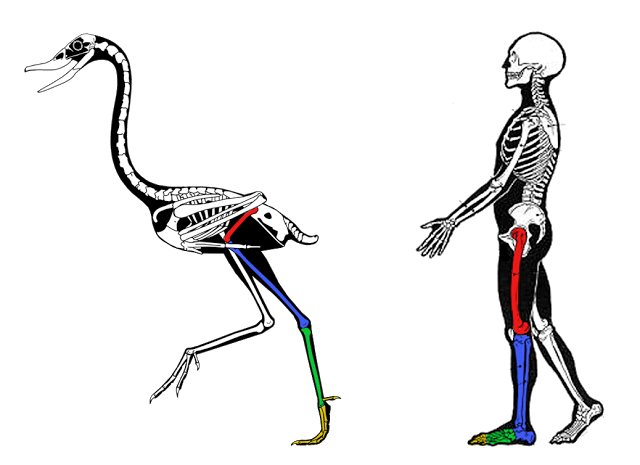
Ok, time for a quick anatomy lesson: Despite what you may have heard, bird knees do not bend backward. Nor, in fact, do the knees of any tetrapod perform this trick. Given the role of the knee in locomotion, it’s not even clear how such a reversal could evolve after the initial “knee bend” direction was settled upon several hundred million years ago.
Why bring the anatomical equivalent of a fairy tale? Well, it’s a fairly common misconception. So common, in fact, that it was recently enshrined by none other than Scientific American. So let’s see if we can clear this up with some simple diagrams:
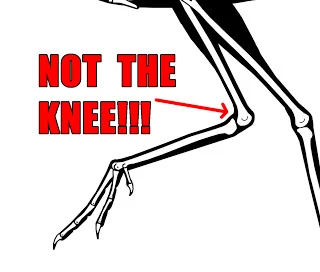
Really, it’s not.
It’s a surprisingly common mistake. When looking at living birds many people fail to realize that part of the leg is hidden on a bird; the upper leg barely moves, and along with the knee it is actually buried up under the feathers of the wing and body. Birds also have quite long ankles, leaving their ankle joints in roughly the position we’d expect the knees to be on a human. Like this:
The key here is that people are plantigrade animals, while all theropods (including birds) are digitigrade. That means that human ankles are flat on the ground, and in our case our knees are roughly in the middle of our legs. In birds and other digitigrade animals (most dinosaurs and many mammals, like dogs, deer, and horses) it’s only the toes that contact the ground. The ankle joint is well up off the ground, and the knee is actually in the upper 1/3rd of the leg. And in birds the thigh is actually even a smaller part of the leg, and as mentioned above is also mostly hidden under feathers. Here’s a look comparing the same leg portions of a human (in two poses), a dog, and an extinct bird:
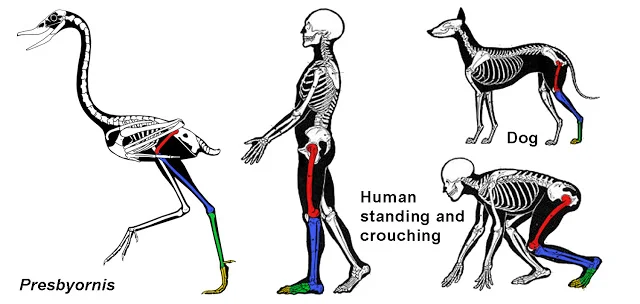
In the diagram the thigh bones (femora) are all colored red, the shin bones and proximal ankle bones are colored blue, the “foot bones” (the distal tarsals and the metatarsals) are green, and the individual toe bones are yellow. Notice that the femur of the extinct bird Presbyornis is small and very high, and the knee (the joint between the red and blue bones) is up where it would be hidden by the body and wings. But please also notice…the knee is bending the same way as ours. And the same way as everything else that has a spine and walks on land.
Which brings us back to the article posted by Scientific American. I don’t want to go too far with “gotcha” blogging, but Scientific American is generally one of the more highly regarded popularizers of science on the web and in print. I took a look the other pieces published by the author, and she seems like a solid reporter that just happens to have made a mistake. Journalists don’t get science degrees (and even if they did that would only be one subject), so this should not be construed as an attack.
But at the same time, this is a serious error. It’s like reporting that September has 32 days in it, or that the Red Sox clinched a playoff spot this week. Only worse, as it’s perpetuating a myth that gets passed around as “common knowledge”. I attempted to bring this to the attention of the relevant parties shortly after it was reported, both on Google+, where SciAm blog editor Bora Zivkovic has been making effective use of the new social network, and the author’s Twitter account (which is frequently used).
Despite near real-time feedback, days have gone by with no correction. Making a mistake is understandable, but failing to correct it is not. Scientific American has written hundreds of articles on the state of science education, and has often been an effective advocate for ways to improve it. But the authority they derive comes from their attention to scientific detail, so I hope we will now see a quick correction without further delay.
25 comments
Interesting that you used an image of a bird called a thick knee! XD
Nice article Scott.
This makes me crazy when talking with animators who want to learn how to rig dogs legs because they're "backwards"...
@Albertonykus: Shhh, you spoil the fun!
@optimistic: Thanks, and I agree. I've worked with quite a few animators on projects now, and this fundamental misunderstanding seems to crop up all the time.
Have just added a comment to the Observations blog to alert them to this post. I was surprised by this peculiar error as well.
Wow! Anatomy fail on SA's part!!
This is actually how I begin every basics of anatomy/homology lecture. I ask students "which barnyard animals have knees that point backwards." (In fact, I use the same thing in the dino encyclopedia, too.)
Following an excellent presentation by Stuart Sumida I saw back around 2000, I now use pictures by Chuck Jones from Chuck Amok which show cartoon dogs, horses, kangaroos, sloths, etc., all wearing the same (distorted) sneaker and thigh-high sock as a cartoon human.
Thanks Darren; this article is going out to the social interwebs today as well.
@Tom: That's a good idea. This summer I put the knee bit in as a throw-away to the day one introduction to dinosaurs (while looking at general anatomy and characters).
The Planet Dinosaur guys fell for the same thing once, too - we all had a good laugh :)
Ah, I love those Chuck Jones anatomy studies!
This kind of reminds me of an article I read very recently where the author mentioned "did you know elephants do not have kneecaps in all four knees?"
Wut?
..."did you know elephants do not have kneecaps in all four knees?"
Ahh, the stupid, it hurts!
Thanks for this, Scott. I went there today (Oct 26, 2011) and it still says bird knees bend backwards! They really need to fix that.
I've left comments directly to the author and to the blog editor with no response. It's really disconcerting action from a publication that has been a pillar of popular science reporting.
YES!! I've been telling people all of this for so long it hurts!!! oh the diagrams I've scratched out trying to explain bird anatomy!! THANK YOU!!
Hey Scott-
I once had a heated debate with a veteranarian (is that spelled correctly) about horse knees... she of course claiming that they bend backwards, me explaining what you've said above. I looked into it a bit and it seems that horse people actually call that backward-facing ankle joint... the knee! And there's a pair of them on the front legs, too!
go ahead... google "horse knee"
WTF?
I've run into that before - I think the onus is on horse breeders to change their terminology - if they all got together and decided to refer to the tail as the "head" we'd all laugh at them until they stopped.
Obviously there are many smaller fields where terms have uses that don't parallel what comparative anatomists use, but I think that average, normal people would expect the term knee to be applied consistently as well.
I came to this realization myself several years ago after spending some time with my dog, examining his legs.
Um, what is clearly functionally the "knee" bends backwards... this is much ado about nothing.
No, that's the ankle. It's not even biomechanically possible for the knee to work that way. This is basic anatomy 101, and there's no excuse for a science publication to make such an obvious error.
"Bird knees bend the same way as everyone else."
"Why bring the anatomical equivalent of a fairy tale?"
"Making a mistake is understandable, but failing to correct it is not"
Scott,
Thank you!
I try to explain this to my family, but they don't believe me. It's just as bad as my mother's refusal to believe in evolution, even though paleontology (my favorite subject) and the fossils that she bought me say otherwise.
It is 2022 and SA is proving a bit slow to correct this -- the article is still there, saying that turkey legs bend opposite to ours.
I think the reality is that their blog content has not always had the same editorial oversight as their magazine content, hence the lack of a correction (and frankly, the errors getting through in the first place).
Bat's knees do pretty much point backwards, but sprawl much more than point back
Image showing the weird knee position: https://qph.cf2.quoracdn.ne...
It is caused more by the legs pointing out backwards rather than the knee folding backwards though.
Right, bats have highly mobile femoral heads in their acetabulum, which allows the entire hind leg to rotate to the point that all of the joints appear to be facing the other way, but they joints themselves are still folding up the same way they always have.
Dear Scott,
I have to make a drawing of a flying crane and I have been unable to find a reference of how the legs (the legs skeleton) would look while the bird is flying. I read that the bird would have the legs completely stretched out, but looking at photos of flying cranes, it seems to me that the knees would be bent and only the rest of the legs would be stretched out. If the knees were not bent, I think the legs would be even longer in these photos. I am wondering if you could tell me the correct information so that I can finish my illustration. Thanks in advance
I know this comment is REALLY late to the party, but is it possible for a tetrapod to evolve a reversed knee? I know seemed to be predominantly settled upon by the evolution of early tetrapods but could any pressure make a tetrapod leg work in reverse or some new tetrapod in the fat future to evolve that and would it be efficient enough to work for a tetrapod?
Join the discussion
Thanks — your comment is in the queue!
It'll appear here in about 5–10 minutes, once I've approved it — you'll need to refresh the page to see it. (Comments don't post instantly anymore.)