There's something fishy about the new Spinosaurus
September 12, 2014
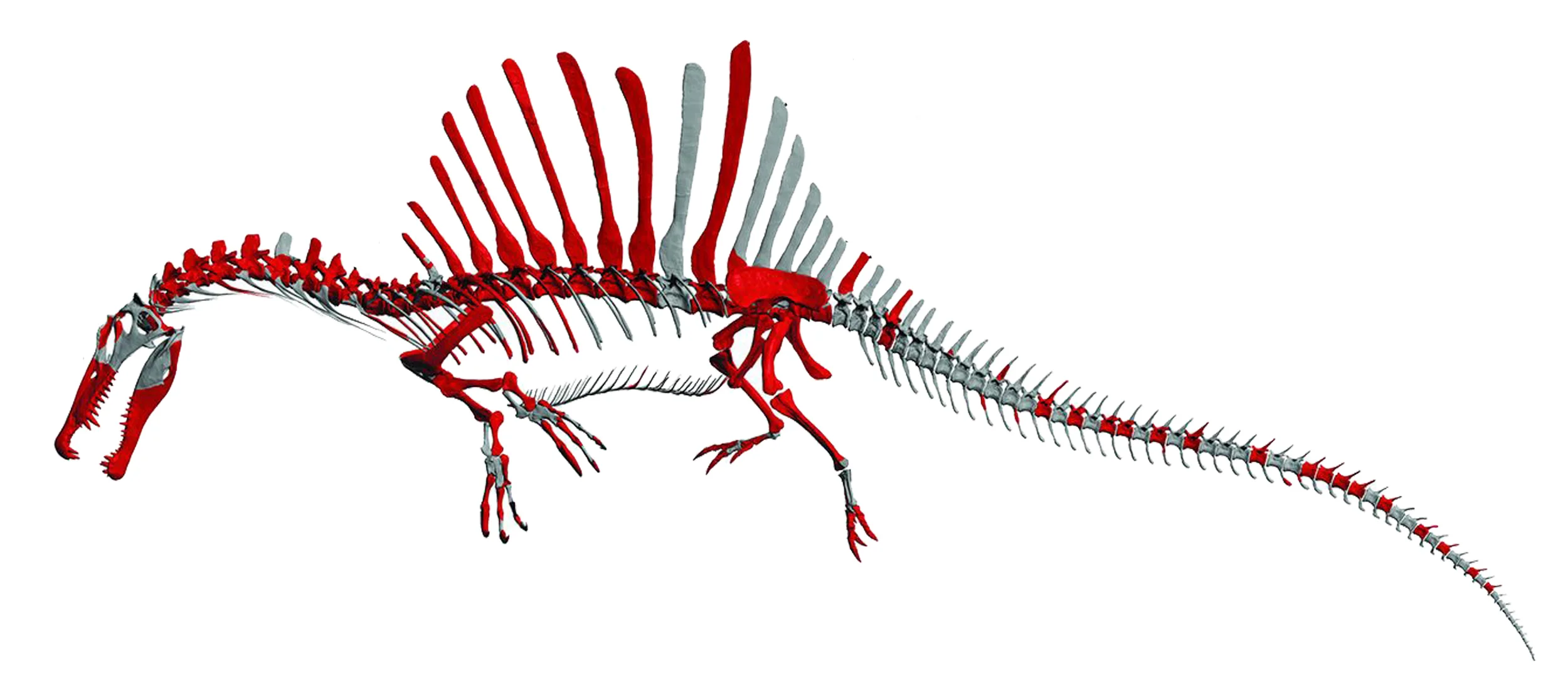
Today, after weeks of rampant internet speculation the new-look Spinosaurus was revealed. It certainly didn’t disappoint: the paper by Ibrahim et al. musters a wide range of evidence from bone density, isotope data, facial innervation, osteology, etc., to suggest that Spinosaurus not only was a fish-eater (i.e. piscivorous) but was adaptive to that lifestyle to a greater degree than other known spinosaurids. Not only do they claim that Spinosaurus spent most of its life swimming in the water with adaptations that would rival early whales, but Ibrahim et al. specifically claim that the altered limb proportions would require Spinosaurus to have been an obligate quadruped on land, a first for a theropod.
I’m afraid I am not here to surprise you with an updated skeletal reconstruction. But I do have some preliminary observations, and after checking the scaling of the composite skeleton I’m afraid there appears to be something fishy with the proportions (see what I did there?).
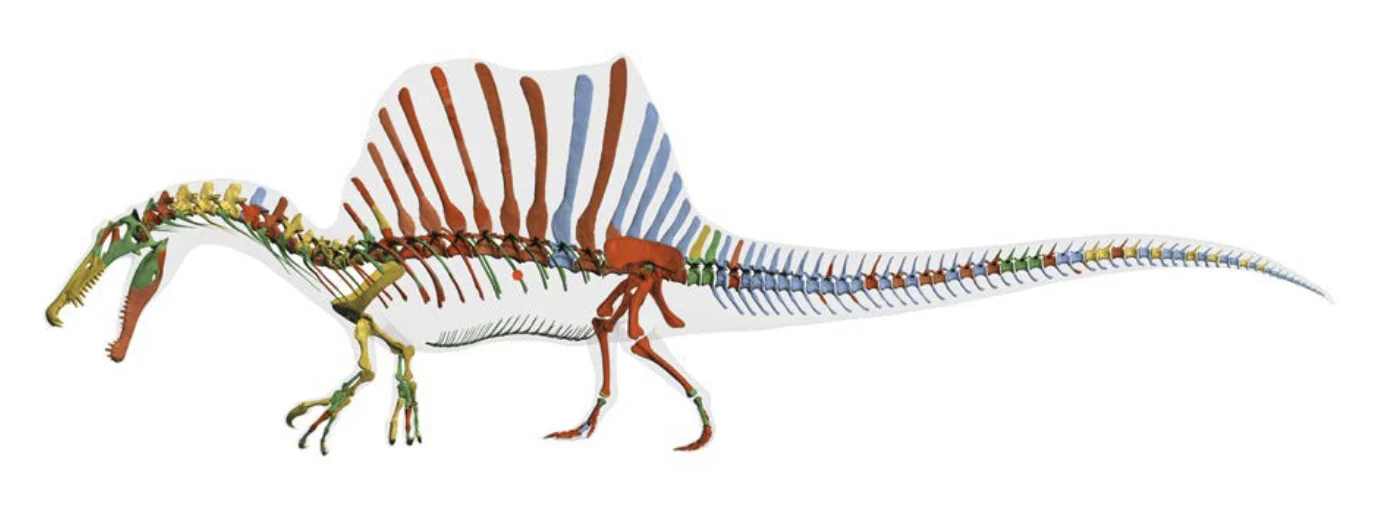
First off, note that when looking at Figure 2 from the paper (shown at top) they color in a lot of “Spinosaurus” material, which might give you confidence in the proportions they use to reconstruct the skeleton. However, if you read the supplemental data (and as with any paper I highly recommend you do) you will find the Supplemental Figure S3, which has a whole lot of additional colors. In order to interpret this you need to know that the red and rust-orange represent the newly designated neotype and the older (now destroyed) Stromer specimens, but about all of those other bones? Yellow is referred isolated remains (i.e. they aren’t informative in terms of proportional scaling), the green elements are based on other spinosaurids (e.g. they are not from Spinosaurus) and the blue are “inferred” (e.g. restored, not based on actual fossils).
I of all people won’t begrudge the authors’ for inferring missing bones, and they are to be commended for the supplemental figure, which so clearly labels which bones are based on which specimens in a visual and easy to understand diagram. But when boiled down to the bones that impact the scaling of the specimen there is a lot less data to work with than a reader might infer from Figure 2 up at the top of this post. In terms of proportions, most of the newly available data only pertains to the pelvis and the hindlimbs. I created a (rough) schematic diagram to illustrate what we knew prior to this publication from Stromer’s material (smaller skeletal) and what we have to base the proportions on with Stromer’s material plus this new specimen (NOTE: I haven’t changed the proportions or shape of the new pelvic and hindlimb elements, this is a schematic diagram).
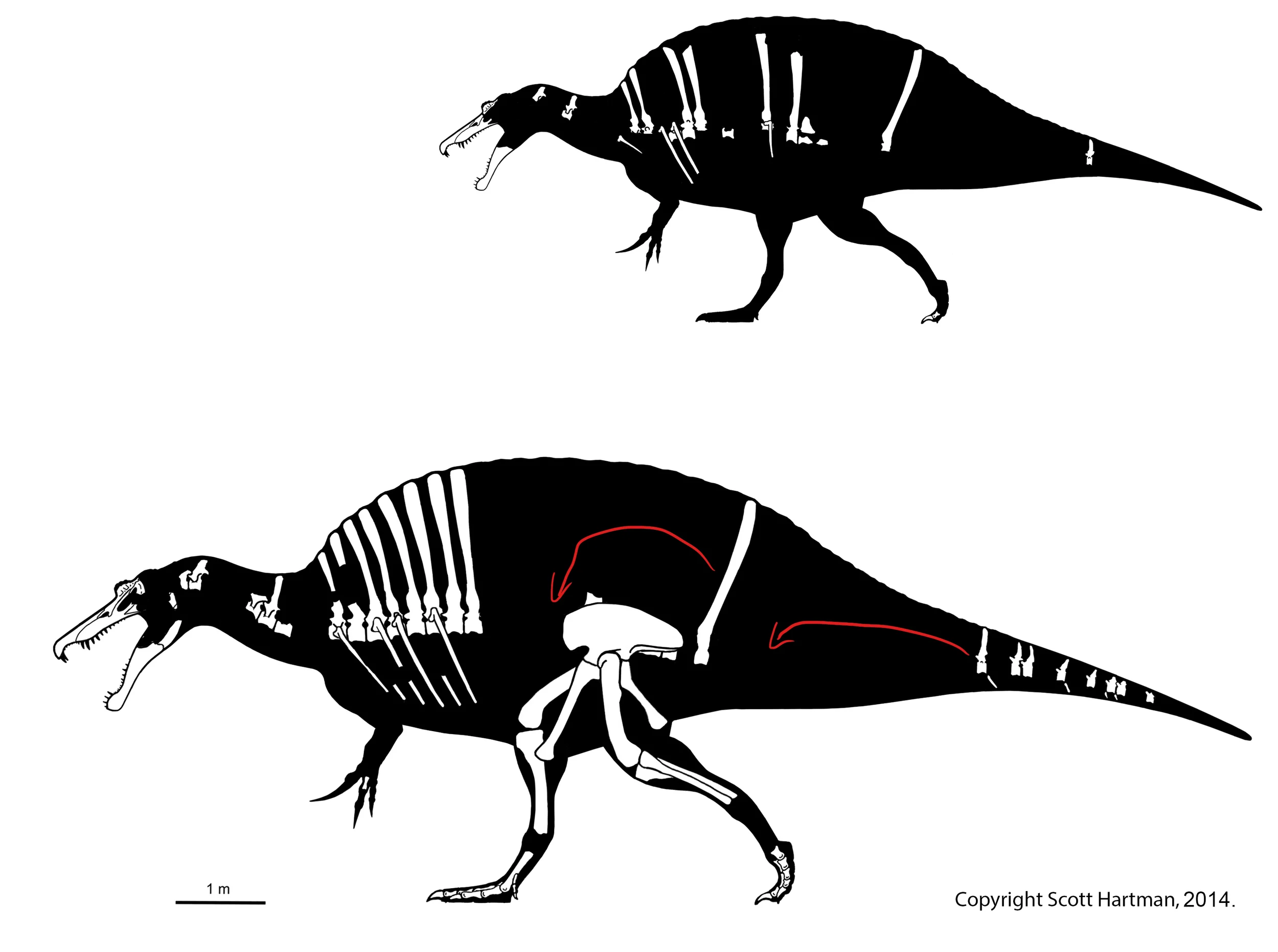
Ibrahim et al. (2014) shift the tall-spined “caudal” vertebrae back to being a posterior dorsal, and they move the next tallest caudal almost all the way to the anterior part of the tail, in contrast to the positions that have been recently suggested. This results in a much shorter “retro-look” sail and a rather skinny but flexible tail. That may well be correct, but what I want to focus on is the pelvis and hindlimb proportions. The authors’ provide a wonderful table (S2) with measurements of individual elements of the neotype specimen, which is naturally the first thing I went to check when I saw how radical the new interpretation was. And that’s where we run into trouble.
How can we know how large the pelvis and the hind limbs are relative to the rest of the animal in a composite skeleton? The best way to tell is to scale them against the dorsal column, and luckily the neotype specimen (FSAC-KK 11888) has several vertebrae. Table S2 in the supplemental data section reports that D8 is 18 cm long. It also reports that the length of the ilium is ~71 cm in length, or nearly 4 times the length of D8 (3.94 to be precise).
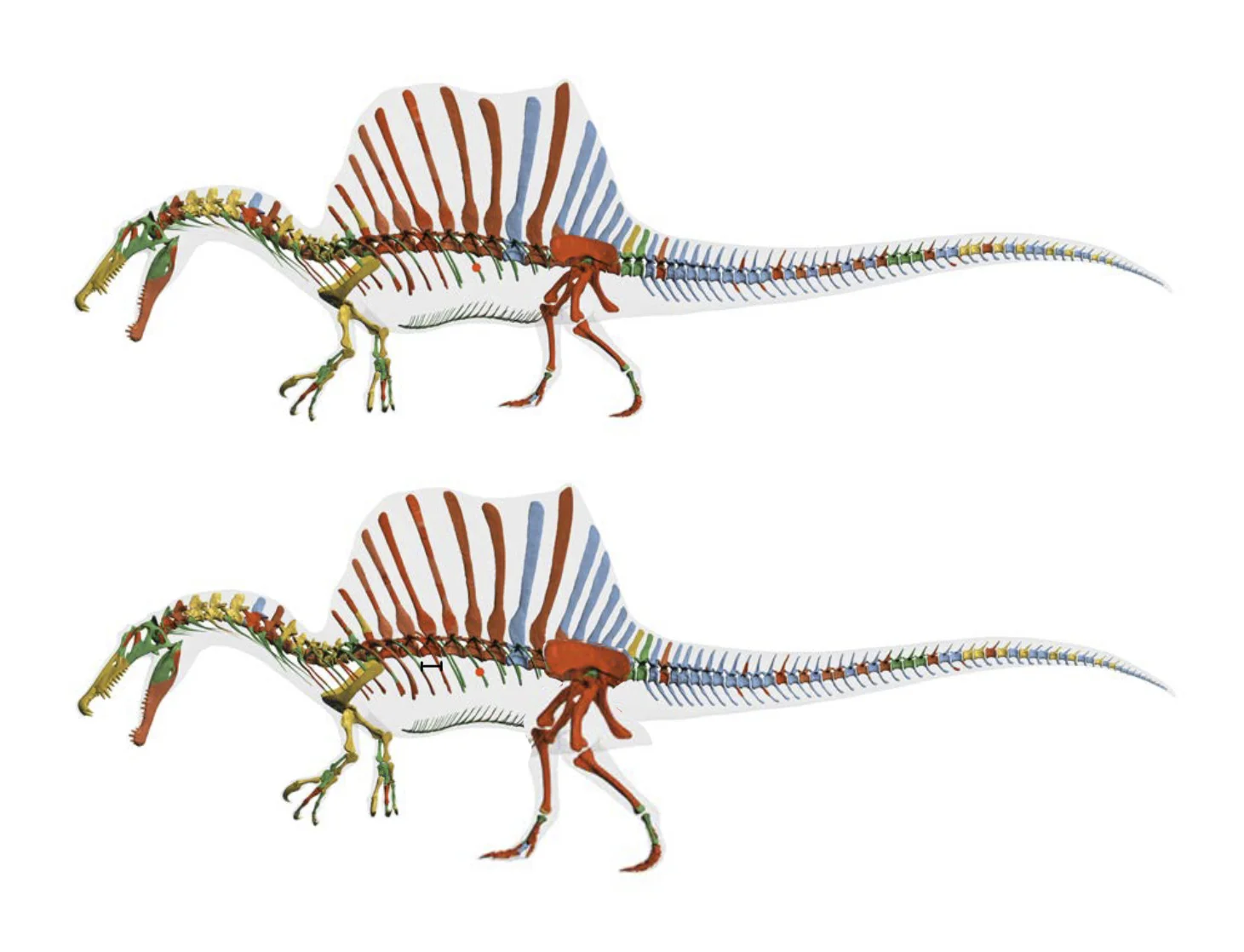
As it happens you can use ImageJ or Photoshop to check the linear proportions of those elements with their respective measurement tools, and here is where something fishy happens, as the ilium in the reconstruction from the paper is much too small relative to the vertebrae from the same specimen. In fact it needs to be increased about 27% (e.g. x 1.27) to match the published length. And it’s not just the ilium that is wrong; the rest of the pelvis and the entire hindlimb is off, and they are off by about the same amount, suggesting it’s the reconstruction and not the measurements that are in error.
I’ve “corrected” the size of the pelvis and hind limb so that they match their published size relative to the dorsal vertebrae, and it makes a pretty big difference. Not only do the hindlimbs look more in line with other theropods, but the deeper pelvis would also impact the center of gravity calculations (by shifting them back). I haven’t had a chance to look at the scaling of the cervical or caudal series in depth, but assuming that Table S2 is correct then the appendicular skeletal proportions published in the paper cannot be right. At the very least it calls into question the idea that Spinosaurus was an obligate quadruped on land.
Now I want to say a few words of caution. Given the heightened popularity of Spinosaurus (especially on the interwebz) I fear this will lead to exuberant and irrational skepticism of the Ibrahim et al., paper. I am not advocating the wholesale rejection of their data - the new specimen certainly helps fill in some osteological gaps, and the taxonomic revision they undertook was desperately needed. Likewise, the bone density data (and previously published isotope work) make a strong case for Spinosaurus eating fish and spending most of its time in and around the water. In other words, it’s an important contribution to science. And I am certainly not trying to impugn the integrity of anyone - I am only saying that there appears to be a significant error in the scaling, something I’ve certainly done myself. But given the facts available it appears that the proportions of the skeletal in the paper cannot be correct, and so the locomotive and ecological interpretations that depended on the proportions must be questioned.
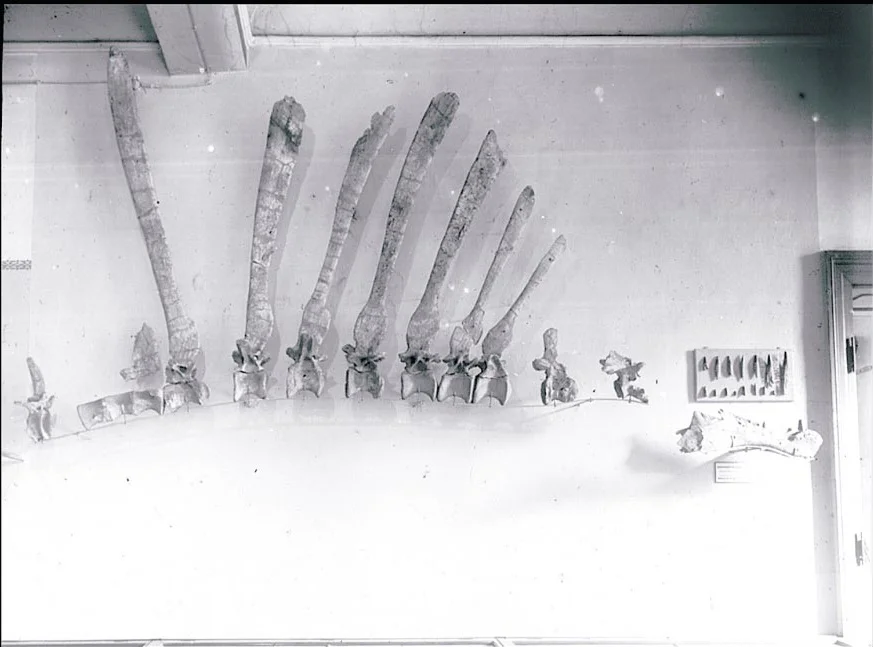
Also, note that I will definitely have to revise my own skeletal reconstruction. There are other issues that need to be resolved - for example, the skeletal reconstruction in Ibrahim et al. reconstructs all of the dorsal centra as far longer than tall, which is in contrast to my reconstruction. It’s also in contrast to the surviving photographs of Stromer’s original material, but at least some of the centra in that photo have been restored. It may be that there is a transition in the dorsal series, but without more work that’s pretty ambiguous. In short, there is quite a bit of work to be done.
Hopefully I’ll be able to revisit the skeletal with this new data in hand sometime soon. In the mean time, remember that we are always taking a chance when we illustrate poorly documented fossil taxa. And that’s ok, because revision is part of the secret sauce that makes science work.
153 comments
Interesting post. Given that the reconstructed spinosaur is based on different specimens, and that the new specimen is not fully mature, it is also plausible that the femur/tibia and limb/pelvic ratios are biased by the immaturity, as in other large-bodied theropods the distal limb elements usually are allometrically shorter in bigger/older specimens than smaller/immature. This is why I remain "agnostic" on the detail of the published reconstruction.
Being agnostic is a perfectly reasonable stance, but let me say that while decreasing fermur/tib ratios are normal ontogenetic predictions, shrinking pelvic elements relative to the dorsal column is not known at all. That, along with the fact that all limb and pelvic elements are off by the same amount are why I doubt that there are other explanations than a scaling error at play here. But time (and more data) will tell!
My agnosticism means that I think it's not necessary to explain the current data of Spinosaurus with the Ibrahim et al.'s reconstruction (and posture): all details of my criticism will be explained in a future Theropoda.blogpost post. At the same time, as I've discussed in my last post, there are good reasons to consider Spinosaurus as really unusual among theropods in the long vertebrae and the short legs.
There is a paper that comes to mind about a juvenile megalosaur skeleton found in a lagerstaten. It has a large head relative to the body, stubby legs, doesnt look disproportionate though. This situation with Spinosaurus brings to mind Majungasaurus and the difficulty artists experienced when scaling the hind legs to the body. The result was again Coelophysis-like proportions with a long thorax, neck, and tail but having stubby legs for its body.
I support this Scott. You are correct that the leg proportions are not quite right and that this would make it completely useless in land... on top of that, the hands don't seem adapted for quadrupedal locomotion either!
Not even as a knuckle-walker?
It's unlikely that Spinosaurus, or any theropod, could knuckle walk very well (or at all); there'd not only be far too much weight on the hands, but theropod knuckles can't even be pronated, meaning any quadrapedal movement on theropods would amount to awkwardly lumbering about on their wrists like a really dopey ground sloth.
So, as far as I can tell, knuckle-walking theropods is pretty much impossible, or if they would do it, it'd be extremely awkward to do, and thus useless for much of anything. It'd also hamper the animal's field of vision, which is important for predators, especially those with other predators in their habitat.
As well, Spinosaurus was already using it's arms for fishing and attacking, and being quadrapedal with theropod anatomy would render the arms useless, either through lack of motion range or the knuckles and wrists getting crushed from the weight on them.
Hmmm...I see your point. Ah, well, it was just a thought!
The wrist joints of great apes are also pretty stiff. Indeed, knuckle-walking tends to evolve as an alternative to other methods of locomotion when there are constraints on the lack of shock-absorbing adaptations on other joints (e.g., short olecranon process, fixed scapular region
Thanks Luis. To be clear, sometimes science is counter-intuitive and the idea of a quadrupedal Spinosaurus is pretty intriguing, it just doesn't appear that the corrected proportions support that view.
As Thom Holtz stated in the Dinosaur List... the forelimb proportions seem to be the ones that are "out"(!??!!) as they are a composite... the only idea that comes to mind regarding this being quadrupedal on land is a kind of gigantic walrus...the hands found bend and spread >outward< instead of inward as Alan Gishlick demonstrated the hands of theropods could do! Then it would be using them as "wings" to propel it in the mud and then the water... food for thought?
I can see how that would work, except that walruses depend depend on quite a lot of dorsoflexion as they inch along, and I'm not sure I would expect that much movement in the spine of a theropod - or at the least I'd expect to see synapomorphies to allow it.
Honestly, being interested in dinosaurs at the age of 17, and since second grade presents me as a loner in the world of sports loving American guys...however, I never thought that I would ever see another spinosaurus aegypticus skeleton discovered... it's like having an early birthday present. Anyways, not to detract from the discovery, but when I was looking online, I found Spinosaurus body fossils for sale... hand and toe claws, partial vertebrate pieces, a full finger... don't you think that's a sin?
Don't trust anything you see online.
well for that it needs some atlethic hands
they didn't find a whole skeleton you know that right
Scott, I also have to add to the factor of the hand construction not fitting with quadruped walking. I think specifically of the larger claw on the third finger. A group of dinosaurs featuring a similar feature are the raptors, and their toe design is built so it can retract the claw to keep it from digging in the ground while walking, hereby preventing extended wear. The Spinosaurus doesn't seem to incorporate that retraction feature on its hands, which would mean the larger claws for grabbing would quickly wear down and become much less effective. This seems to be a factor that isn't really considered, but I think it's one of the most relevant ones out there really. Until something is proven for fact, then I am with you on the skepticism of the quadruped Spinosaurus. Looking forward to seeing your future work on the subject!
Unless, if it was to be a quadruped, Spino would curl its fingers. Pretty much walking on its knuckles like gorillas and the Prehistoric Sloths.
YES now spino don't suck no more :D plus now spino won die right after trex in my coming animations :)
I support. this as. well. I do believe that new spinos legs are short. I think that it. would be perfect if he was a little taller and also spino is my favorite dinosaur
Yes, you are right Sott, although the skull (and probably the forelimbs) then should be make a bit longer. Even with this longer hindlimbs, don't seem to be long and strong enough for an efficient bipedal locomotion. Probably the animal spent most of its time in the water.
I don't think anyone is disagreeing that it spent a lot of time in and around the water. The question whether it was closer to the usual theropod "stork" wading style or the new aquatic "croc" or "early cetacean: ecomorph.
The arms not known from a specimen with associated material that can be scaled, so on what possible basis could you be suggesting they be larger? They could just as easily be smaller from the data at hand.
But if the dentary is in the same scale as the centrum (they're both part of the Romer specimen, aren't they?), the skull shouldn't be any larger than this...
Sorry if the dentary is a new material; I haven't got access to the full text yet (Science Xpress???)
Yes, they based the arms and shoulder girdle of Suchomimus, which does not have the "short leg" morphology they are suggesting here. Thus I suspect they have exaggerated the forelimb size and if we find an articulated specimen with fore and hindlimb it will show that they are not quadrupeds.
Ok for some reason signing in with facebook did not include my name. So people don't think I am hiding it, its T. Alex Dececchi
Go check out the supplementary data, its free! (link is in the article)
Stromer, not Romer.
I was saying "probably", if Ibrahim et al. (2014) humerus length estimation was right.
Thanks for your response
Here is a photo of the neotype, with the hindlimb and verts in the same picture. Not ideal in terms of perspective, but a possible independent check: http://www.repubblica.it/sc...
Thanks Tom, I checked out your photo too, and I get roughly the same results, that the ilial length is close to four times the length of any of the dorsal centra. Taken literally that photo suggests the ilium length is 3.5 times the length of the centra as they are lined up in the photo (which is still larger than the Science skeletal), but the photos also shows a variety of gap lengths between the vertebrae and of course the oblique angle means that the centra are twisted and we are visually seeing "more" centra due to their thickness. I'll add the photo to the article later today.
Another Great and tempestive post Mr Scott!
To join the limbs discussion The Andrea statement it' s absoluty true but in big full grown theropods the hindlimbs are Also massive and a lot stockier than in juvanile specimens and probably a 15(?) meters Spinosaurus would have bigger (but no longer) limbs.
Sigh...I was really trying NOT to be tempestive.
Very nice and thorough post, Scott. I have my doubts about the obligate quadrupedality, especially since nothing about the theropod forelimb would have been very effective at that kind of movement. Keep up the excellent work.
Funny Scott , I first saw this current proposed reconstruction of Spinosaurus and thought that the ilium, pubis, ischium and femur all looked too small in relation to the rest of the skeletal recon. personally I felt the femur should be the same length as the forelimbs ( wrist to humerus head) and that the tibia and fibula should be about 10% longer than the Femur. all this would have made the whole dinosaur stand taller and therefore raise the hands off the floor. the construction of Spinosaur hands ,to me , didn't favor being able to support a Quad form of locomotion . the Claws especially were too large and sharp to be making contact with the ground, if so they would have been blunter as opposed to the nasty sharp recurved meat hooks shown in the fossil evidence of Spinosaurs. anyway it was fun to then see your opinions above , to be very close to my ( unprofessional ) observations . thanks for presenting more thought provoking research for us to play with. lol.
I HIGHLY doubt those larger legs would've made much of a difference with what you're suggesting Scott. Spinosaurus, according to the papers, weighs 20 tons, as in not Theropod heavy, but Small Sauropod heavy in terms of weight. The larger legs WOULD work, but overall I can't see this thing being bipedal regardless. Imagine the restoration of the creature as a knuckle walker; take the posture and tilt it slightly so the front end is more pointed downward, and that's how I'd imagine the restoration would work provided the legs you've suggested are the actual size of the legs for Spinosaurus.
Even then, this thing was more than likely living in water constantly and rarely ever on land. The body it has is more suited to water locomotion than it is land locomotion, especially when you consider the 20 ton weight. I mean, even if it had legs more built like those of Tyrannosaurus, the 20 ton weight would still be impossible for a Biped of this particular size and body type. The signature sail Spino has is certainly not helping the bipedal idea.
20 tonnes? By that do you mean the estimate from Therrein and Henderson (2007)? I doubt the accuracy of estimates derived from this method.
Even aside from the usual problems with estimates derived from such equations, there is a multitude of miss-cited and erroneous data in that paper, much of which is used to form the equation. And for all intents and purposes, given the small number of taxa used to create the equation, the equation would pretty much treat Spinosaurus as a gigantic Tyrannosaurus simply because of its long skull.
Large carcharodontosaurids have skulls lengths that approached that which is estimate for Spinosaurus, and thus would be estimated to be almost as heavy by Therrien and Henderson's equation, but there is no doubt that they were bipedal.
The sub-adult that the legs are from was almost certainly smaller than big Tyrannosaurus specimens. The type specimen probably was too, albeit longer. The big Milan rostrum, MSNM V4047, could well be larger than big Tyrannosaurus and Giganotosaurus specimens, but if it is then it probably wasn't by much.
The 20 tons is recent; the findings that caused this debate showed the Spino's bones are SOLID, meaning the entire thing was much heavier by default.
I don't think the morphology of a theropod front limb would work for quad motion anyway. It couldn't reach its arms far enough forward for a decent stride, and the fixed scapulas/coracoids wouldn't help much. Retracting its arms would be no problem. I'm not even going to get into the knuckle walking. The animation I've seen of the Spino quad walking cheats the arm forward in the stride. Some side to side undulation would help, but its still front heavy. 30% larger hind limbs and pelvis would help move the COG back. It would create deeper ( and heavier ) guts as would a deeper tail. Also, if I'm reading it correctly, the hind limbs were of denser bone than the forelimbs.
But what is the source of the 20 tonne estimate if it isn't the one I mentioned? It would imply that Spinosaurus would be around a third more voluminous at roughly equal lengths than the hugely robust Tyrannosaurus.
I don't want to sound like this is an argument from incredulity, but the scenario above just isn't feasible in my opinion.
There are no reliable estimates of 20 tonnes - just because something gets into print doesn't mean it holds up to scrutiny.
If Sue the TRex was indeed 6-7 tons, I would venture that this Spinosaurus would be 8-10 tons max.
While the increased bone density would certainly make the animal heavier, I do remain sceptical about the high estimate, in part because of recent work suggesting we tend to over estimate dinosaur weight...granted said study led to some revisions of the weight of Tyrannosaurus...up a tonne or two but howsever. Given its proportions, bone density and the kind of fat you get in semi-aquatic/aquatic tetrapods, I think the 20 tonnes estimate is an extreme possibility and while a quadrupedal spinosaur could afford to heavier, it seems unlikely that even the pachyostosis would double the weight of the animal compared to others in its general size range. But I've always thought that with super heavy estimates so hey ho, personal biases.
Hmmm Tyrannosaurus had hollow bones. Spinosaurus had not, and was bigger.
Honestly, while the solid bones impact density (and hence buoyancy) in practice they don't add THAT much mass. 8-10 tonnes (as suggested by Simmons) strikes me as reasonable.
Cool Scott; I had real problems with those hands being used to walk quadrupedally. Additionally, I have a real problem with the sail being adaptive to swimming. But maybe a strong pull of sexy ridged backs drove evolution in somewhat contrary directions. Orrr..... Passive drifting assisted by sail permitted covering larger area without disturbing bait fish (lures) attracted to the large shadow of the drifting beast. Or..... Hauling up on the beach, the sail speeds recovering from swimming in the cold water (nutrient-rich) upwelling water along coast... But.... shallow coastal estuaries and rivers would not be cold, so what are the environments represented by the Kem Kem redbeds? Finally their tail recon certainly does not look very well adapted to swimming... Questions...questions....
Are we sure the head and arms are scaled properly as well? The head and neck look quite proportionally bigger than the torso, and if the arms are based on the (smaller) Suchomimus, then wouldn't scaling kick in with the arms?
The head should be close, but much of the neck is based on isolated elements, and one could question the lack of change in the length of the anterior cervical centra.
There seems to be composite error throughout the figure. Notice the size of the anterior cervicals compared with the posterior ones. However, Ibrahim et al. (2014) was worth the wait. According to their supplemental material, the humerus is the partial one that Dale Russell (1996) described in his paper on isolated dinosaur bones found in Morocco. It has features that distinguish it as probably a spinosaurid humerus. Russell described it as being about the size of a Deinonychus humerus. An isolated ulna similar to that of Suchiomimus was also found. These are isolated finds though, and no other bones were found that would help in scaling them. Also, I noticed that Ibrahim et al.s (2014) description of the neotype femur matches that of Stromers (1934) Bajariasaurus? referred femur from plate III, fig. 14. The diagnostic character is that the fourth trochanter scar takes up nearly 25 percent of the length of the bone, and the femur has a pronounced curvature in lateral view.
I think that it is because the same vertebra was dittoed over and over in the reconstruction of Ibrahim et al. (2014). Dale Russell (1996) provides a lot of good data on the Spinosaurus neck. Of particular use are his illustrations of articulated neck vertebrae. His Spinosaurus morrocainus cervicals (3) can be sorted into position based on the development of their epipophyses. The cervical with the greatest development of the epipophyses is vert.3 in the series. The vertebra missing much of the anterior ball of the centrum is vert.4 and has intermediate epipophyses. Vert.5 is the other elongate cervical vertebra which has reduced epipophyses. Vert.5 and vert.3 are shown in Russells (1996) figure that is a string of four vertebrae that includes both of Stromers original cervicals from the destroyed type specimen. Stromers cervicals represent a partial axis and either vert.6 or vert.7. It should be noted that all of Russells (1996) Morroccan finds are isolated bones from individuals of differing sizes.
Russell (1996) also describes a string of 8 cervicals of Sigilmassasaurus in his paper. Only half of these represent the true Spinosaurus column. The first two in the series are duplicates of vert. 9 but of different size and ontogenetic age (according to the table measurements given for the specimens), the second one being the smaller individual. Likewise, the second two vertebrae are duplicates of vert.10. The third in the sequence is the younger and smaller, and the fourth much larger with all of the characters of the third but more pronounced and better developed. The 5th in the series is interpolated, pure speculation. The sixth in the series is vert. 11 (presumably the first dorsal). Russells articulated series is more schematic than the larger scale drawings of the individual vertebrae. The larger drawing suggests that this vertebra is not well preserved with some parts reconstructed. Vert.11 may be a cervical, but I think it is a dorsal because of the positions of the parapophyses and diapophyses. The seventh in the series is interpolated, speculative. If enlarged, the eighth in the series articulates well with thesixth in the series and becomes vert.12 or the presumed second dorsal.
In my preliminary tracings so far, I have come up with a reasonable neck that resembles the necks of more complete large basal tetanurans like Allosaurus, Piatnitzkysaurus, and other genera of Spinosaurids. I do not think it will come out to be as long proportionately as in Ibrahim et al.s (2014) reconstruction.
Well, this needs to be investigated even further so we can see if Spino wasn't completely quadrupedal as the exhibiton and Nat Geo are showing for now. Still, somebody must looks at the leg bones of Baryonyx and Suchomimus and see if their leg bones did have bone marrow or not. Probably did. As I said in a facebook comment, we need more specimens of this unmaginable genus. Especially the females and babies. And of course, if lucky enough, the Sue or Wankel Spino by any chance in North Africa. Or maybe in other countries that may show a quadruped spinosaurid, possibly the Irritator, Oxalaia and Ichthyovenator.
Ibrahim et al did look at the bone density in a Suchomimus femur (in the supplemental material) it's 0.67, slightly higher than in Allosaurus and Tyrannosaurus but less than in Troodon and of course much less than in Spinosaurus (0.97).
Wow! Thanks for this info, blaze_0! I was hoping that someone would answer me that question I made. So it shown that Suchomimus had lighter legs than Spinosaurus's indeed.
I agree with Cau and others that ontogeny likely changed the hind limb ratio quite a bit during the growth phase of this species which parallels what we see in many other theropods. The reconstruction is a composite of several specimens and perhaps this fact should have been more concisely stated by the authors. That being said I can well imagine that less mature spinosaurs may have more resembled other species (Suchomimus, Baronyx) in stance/movement but became more closer to the skeletal approximation the authors made with advancing age and size. As for the bipedal/quadrupedal debate I think we need to break that impasse by observing that the vast majority of large/amphibious tetrapods will adopt a belly slide locomotion on muddy/unstable surfaces (crocs, seals, penguins, otters, loons). As noted by several people there are no obvious weight bearing adaptations in the manus of these creatures for knuckle walking. Likewise there are some obvious problems with navigating muddy tidal flats (check out the stratigraphy section in additional material among other lines of evidence) as a multi-ton obligate biped. That is why a belly sliding/combat crawl type of locomotion is a fair compromise between the known anatomical constraints and habitat of these animals. Additionally the ulna (colored yellow from isolated specimens) appears rather robust and flattened at either end for possible weight bearing load - although the ventral surface of the animal would have taken most of the weight. Simply fold the forelimbs in, lower the belly down, and push off with the hind limbs. This scenario takes care of all the problems people have noted with regards to habitat, center of gravity, and anatomy. I am not suggesting bipedal locomotion could not have been used as well, perhaps a bit like a pangolin as Darren Naish suggested, but again there are some obvious problems with falling face down especially for large multi-ton animals. When bipedally walking they perhaps touched down occasionally with the forearms for stability. By getting down on its belly Spinosaurus would avoid the potential problems of falling face forward preemptively. More at my blog antediluvian salad: Did Bakker Get Spinosaurus Right After All
Working slowly on a re-postured version of the Spinosaurus to fit Scott's rescale. Also toying with flattening the tail a bit to make it a bit more rudder like, similar to a crocodile monitor.
A very nice and a crucial study of a new reconstruction of Spinosaurus possible posture. Still, I wonder if those hind legs could make it walk bipedal for long, or walked on all fours yet but with a humpback position. This is getting debatable and even more curious.
Agreed, although the the scaling of the legs has caused a bit of a row across the dinosaur fan base; one thing we should not forget is the new known structure of spinosaurs' feet which are in my opinion the most interesting of the contents of this bone haul.
George - the stomach cavity had to be larger - see my comment above to Scott about repositioning the gastralia by tilting it downward towards the rear and correcting the animal's silhouette front and aft of the hips ...
What like this or at a greater angle with a more pronounced jut at the hip.
Yes, that is looking much more natural. I think that if should probably bulge down a little more at the hips, but I'm interested in what Scott would have to say ...
I won't say much until I finish the skeletal reconstruction based on the new material...
Here is the final version, Thank you for the input.
For the quadrupedal version, you should replace the human silhouette with a picture of Raquel Welch wearing a leopard-skin bikini.
Hmmmm as much as you would like me to no.
The restoration on the bottom even with it's clearly different look appears most consistant with even the JP3 version of spinosaurus. Even though that movie wasn't good and the spino was inaccurate in a lot of ways, it's posture appeared most like what is seen in the bottom illustration here. I suppose Jack Horner was thinking along the same lines as you when he helped Stan Winston's cre for the film.
This makes me wonder what Horner thinks of the "crocoduck" version of the spinosaurus now that I mention it.
I had no intention of basing the spinosaurs' posture off of Jurassic Park. I was looking at other previous constructions namely planet dinosaurs with a bit more articulation in the tail and neck to account for their increased length and flexibility.
Thank you so much, this cleared up my concerns and skepticism about the hind limb proportions which I basically rejected seeing as how disproportionate they were. Even if it was more aquatic than originally thought, it would still make sense for the animal to have large enough legs in proportion to it's body size like other theropods.
It did come onto land at times and it wouldn't make since to think it moved like a Varanid monitor on land or had such puny hind limbs when the animal itself is built the way it is.
But, what about the mass center? I think it was an obligated quadruped because of the mass center.
The enlarged pelvic region and hindlimbs should move the center of mass closer to (or at) where it should be for a biped.
Nope, the mass center is still wrong after the "correction". It only makes it taller.
No, Blaze is correct. The pelvis becomes much deeper, as does the posterior part of the trunk and the base of the tail. It would have a dramatic impact on the CoG, plus the longer femur means that the CoG doesn't have to move back as far to be a plausible bipedal animal. There are other issues with the paper's CoG calculation, but I'll leave that for another day.
Thanks for the reply ;)
But I think it does not necessarily debunk the quadruped idea, and at least it was most of the time quadruped.
Um, if the hind legs are now much longer than the forelimbs and the center of gravity shifts back and there is absolutely no visible adaptations for locomotion in the hands...how is it not debunked/likely to be used most of the time???
I can see your point. Thanks again.
I don`t understand. I mean, I am a bit confused here.
So there are two sets of remains, and in one of them there are remains of the legs, hips and vertebrae. You measured them relative to each other and used the scales to predict the proportions of the missing "bones" in the other set of remains. In this second set there`s only legs and hips, is that right?
There are no hip or leg bones in one specimen (Stromer's). The new specimen lets us restore the pelvis and legs, but to since the two specimens are different sizes you have to cross-scale using the vertebrae to do so. It appears that the new paper made an error in that scaling process, so I've presented a corrected version above based on their own measurements.
The new neotype has skull pieces, a finger piece, vertebrae, ribs a pelvis and hindlimbs. The real answer concerns the synonomy of Spinosaurus aegyptiacus, Spinosaurus B, as well as Spinosaurus C (what Andrea Cau calls the neotype on her site). The neotype allows some of the fossils in Stromers (1934) paper (published years after his original description) to be referred positively to Spinosaurus aegyptiacus. These apparently include a tibia and a mid dorsal that are figured for Spinosaurus B. The ratio of mid dorsal (centrum?) length to tibia length in Spinosaurus B is 23% and is 25% for the Neotype. So there was a second set of vertebra and leg remains but it was considered a chimera because a ratio of 25 percent was previously unheard of in theropods, and because all but the base of the neural spine was broken off of the Spinosaurus B vertebra, hiding its true affinity to Spinosaurus aegyptiacus. Detailed comparison of the new specimens with Stromers paper should yeild up new previously unrecognized Spinosaurus bones that were referred to something else entirely. In fact, Ibrahim et al. (2014) have probably already done this in a synonymy or a referral of specimens section in their paper. You may find Stromers monograph far more useful than you imagined!
This also appears to be the train of thought that Ibrahim et al. (2014) have taken in their reconstruction. Even with Scott Hartmans correction, much of their work appears sound. I am only troubled by the proportions of the tail, and the position and relative size of the pectoral girdle and forelimbs. If dorsals have become cervicalized in a dinosaur, the pectoral girdle usually moves backwards with the new transition point. Just look at birds! This will shorten the trunk and lengthen the neck, further reducing the center of gravity problems. The greatly upturned neck would help keep the head above water and like on a bird would keep the head closer to the center of gravity. If the back of the dorsal column was directed upwards at the sacrum and arched like a therizinosaurs, it may have also lessened center of gravity problems that Spinosaurus might have had.
Jeez, I hope I'm not let down when I read the paper. What a case of paleontological sleuthing! Ive heard so much about whats in this paper I cant wait to get it, and of course the all important supplement.
A figure in the supplemental material by Ibrahim et al. (2014) shows the parts of the neotype and the corresponding parts of Stromers (1934) Spinosaurus B
His site. Andrea is the italian cognate of Andrew.
Hah! I remember when Spinosaurus was given a generic carnosaur head. XD
Same here, though that certainly changed when Baryonyx was found.
Not at first it didn't. Jurassic Park 3 was the first I heard of Spinosaurus having a crocodilian head or being related to Baryonyx.
Scott - on your reconstruction - shouldn't the gastralia be tilted down toward the pubic bone and the silhouette adjusted accordingly (both in front of and just to the rear of the hips? The stomach cavity had to be larger than that...)
All I did was correct the size of the pelvis and hind legs to match the measurements provided in the supplementary data of the paper. I will have a proper skeletal drawing out...sometime.
Remember guys, it's Spinosaurus, not Stegosaurus :P
On a more serious note, I agree with this "correction". The front limbs are, in no way, supposed to support much load.
Folks, I'm gonna throw something out here - The Spinosaurus' sail could not only have been added ballast, it may indeed have
served a heat regulatory purpose. I think this is doubly likely since
the new findings establish that it was skin covered rather than a hump -
the easier to warm the blood that courses through the vessels just
under the skin.
Think about this: Crocs need to get out of the
water to sun themselves (yes, I KNOW that Spinosaurus was most likely
NOT (as) cold-blooded as Crocs are), but the Spino could just turn the
sail towards the sun if the water was getting too chilly - and voila -
thermal regulation that does not require it to leave the water.
Makes sense?
http://translate.googleuser...
http://translate.googleuser...
I FOUND THIS LINK AND I THINK IT HAS SOME CURIOUS INFO ABOUT THE NEW SPINOSAURUS. CHECK IT OUT IF YOU WISH.
That's Andrea Cau's site - I hope most of the readers of my blog know if it, but if not it's certainly worth a read.
Hello, So Spinosaurus B AKA Sigilmassasaurus is spinosaurus? In Stromers (1934) plates concerning Spinosaurus B, there is a dorsal which looks like the neural spine is broken off at the point before the base would constricts and elongate in a Spinosaurus vertebra. Such a vertebra (just before the ilium) is present in the neotype photograph. In Russells (1996) paper on isolated dinosaur remains from Tafilalt, he considers this a sigilmassasaurus dorsal. However, in Russels paper on the isolated remains of both these taxa the posterior neck of Sigilmassasaurus really climbs up into a vertical position, like a modern bird! Furthermore, Russell reconstructs a sequence of vertebrae based on isolated vertebrae that contains 4 cervicals, 2 pectorals (including 1 interpolated vertebra) and 2 anterior dorsals (including 1 interpolated vertebra). He also identifies 3 post-axial anterior cervicals of Spinosaurus which are obviously from different positions in the column. Because each vertebra is an isolated find, it is possible that at least in Sigilmassasaurus, one or more cervicals may be duplicated in the reconstruction. This is not so in the Spinosaurus cervicals because each has a different development of epipophyses, neural spines, and length to height ratio. Given ten neck vertebra, there is no room for a transition between the two types of cervicals. Unless, as Russel speculates (and Ibrahim et al. 2014 show in their reconstruction) Spinosaurus/Sigilmassasaurus had more numerous neck vertebrae and perhaps fewer dorsals. Could the shorter ilium of the neotype imply that Spinosaurus had fewer sacrals as well? The neotype seems to contain caudals reminiscent of Sigilmassasaurus (second from the ilium).
Thank you Guest!!!!
I have now been able to buy the article itself along with the free supplementary information. The additional figures were helpful. I do appologize for the comments about the Bajariasaurus femur though. Seeing the paper propers actual scale drawing of the actual femur of the neotype ( as oppposed to the verbal description in the supplementary information) shows that it is significantly different from that bone in Stromers (1934, Plate III, fig. 14). It also looks as though predatory dinosaurs are rather uniform in the number of cervicals and dorsals in their presacral vertebral column. Advanced birdlike forms like Avimimus gain one cervical at most. (I consider vertebrae to be dorsals even if they are anterior to those that connect to the sternum as long as they function as part of the trunk and not the neck.
well, I also support this, but, is there any evidence to say that spinosaurus had longer back limbs than spected?
I knew there was something... well, "fishy" (the word just seems so appropriate) about the quadruped Spinosaurus theory. Even by just looking at the animations, my own wrists hurt. However, even in this corrected version, the legs seem to
be somewhat shorter than the average theropod's. As I said, the idea of Spinosaurus requiring its four limbs to walk doesn't convince me at all, but I think that even as a biped, the animal would be a little "clumsy" while moving on land. I mean, I can imagine it walking like a duck or an albatross instead of moving agilely like a roadrunner or a cassowary, for instance. That would be odd, but maybe not as odd as a four legged theropod in my opinion.
By the way, interesting post, Mr. Hartman.
P.S: I'm not an English speaker, so I apologize for any possible mistake.
The photos of the neotype specimen do seem to show a transition in centrum length that increases posteriorly. What is also apparent is the fact that the pelvis is much lighter in photographic tone and seems to have been put together from numerous fragments. A great deal of it appears to have been reconstructed in plaster. I wonder if it is all present and correctly reconstructed?
The Ilium, especially so.
If not for their yellow color (indicating isolated sources) the forelimbs would appear to be pure conjecture, and how were they identified as pertaining to Spinosaurus. Was the identification based on their similarity to those of other spinosaurs? torvosaurs?. Or were they also found with diagnostic Spinosaurus cervical, pectoral, or dorsal vertebrae? If the forelimbs and girdles were indeed smaller, then Spinosaurus may have instead had a more coelophysid like build. The caudals appear to be too far forward in position relative to the pelvis in the photo. Admittedly, it is hard to read the tea leaves, even when you have a good photograph.
Where did the isolated remains that make up the pectoral girdles and arms come from? they really appear out of scale. This is especiallythe case when comparing them to those of other spinosaurids. How ere they even scaled into the reconstruction? I cannot wait till the library opens tomorrow! I want this paper!
If you had a long enough tail, you could counter balance anything. The posterior dorsal centra seem paralellogram shaped in the photo of the neotype. The back seems to have been arched up rather sharply at the hips, rather than merely horizontal.
This has been a vexing theropod to even attempt to draw, dont know how many failed attempts I have made. I have some realy random and obvious observations to make; but have more questions than anything else.
Scott could you please delete this post, for some reason when I deleted this broken post it turned into a guest post.
Sure thing.
I do not want to blast a reputable scientist. This, however is not the first time a dinosaur has been possibly altered for reasons of "becoming a superlative". In 1996, I viewed the reconstruction of Charcharodonotsaurus, as well as the reconstructed skull of Giganotosaurus. The Charcharodontosaurus had an excessive angle to the post orbital, thereby increasing the overall length of the skull.
I cannot see the reasoning behind the hind limbs of a juvenile being paired with an adult skeleton, but it does indeed draw attention and further funding to one's operation.
All other Spinosaurids do not have this shrunken hind limb anatomy. Why would Spinosaurus deviate so much from the rest of its relatives?
Well, evidently, Spinosaurus DID have shrunken limbs relative to other spinosaurids, the point is that it is not to quite the extent that the original skeleton reconstructions suggests.
Mr. Hartman, my name is Nic Sveen, and may I add I am and have been a great admirer of yours and have followed your work since I was very little. Your work has been absolutely invaluable to me in my own work. I'd like to say thank you so very much for all you have and continue to contribute to all of us paleophiles. Hahaha.
I'm with Luis Rey on this, I agree entirely with the theory you have put forward. It is far more logical for multiple reasons. Interesting as it is to imagine a 50' predator that moved like a seal on land, the majority of how the bones and joints in the forearms work simply do not seem to permit such locomotion. Though I do not believe (as some people would be quick to criticize) it takes anything away from the theory that this animal is still fantastic evidence of a species on it's way to becoming completely aquatic, and with the sheer amount of what we have not discovered as opposed to what we have, this new evidence brings us ever closer to the fact that the true reality of prehistoric animals is infinitely more amazing then the myths and media beasts we've turned them into.
Sorry, didn't mean to ramble. Just wanted to show my support! Thank you for your time, Mr. Hartman!
Nic
Hi Nick. Thanks for the kind words - I agree that the bulk of the evidence suggests that Spinosaurus was at least as aquatic, if not more so than other spinosaurids. Whether that would have continued to parallel the early whale line or not is something we can't know for sure, but it's certainly a tantalizing possibility!
Indeed! It's so amazing to think that what we know is only a very, very, very small amount compared to what remains to be discovered or is unfortunately lost forever. What I wouldn't give to obtain the knowledge of all the things that once lived on this planet, every species and every time frame.
None the less, the small amount of discoveries we do have the privilege of making and studying, and that which we will continue to discover, is still plenty amazing.
Thank you for replying, it really is an honor. As I said before, I've been following your work since I was just a small child with an unyielding passion for dinosaurs. Your skeletal works have always been at the very top of my list for reference when doing any paleo-art. I'm looking forward to the day when I can buy some very large resolution skeletal references from you one of these days. So thank you again, sincerely, for all you have contributed to the paleo-community. Invaluable would be an understatement.
Nic
I never would have guessed that the leg/pelvic ligaments were 1.27 out of place much of less the caudal vertebrae that puts on some insight that Spinosaurus couldn't walk to well in Sereno's reconstruction and I support you on that.
There were just some things that didn't hold to much water with Sereno's work and that would be the fact of water pressure…yes of course Spiny had enough oxygen isotopes to live off in the water, but then when you think about it those albeit legs of it's wouldn't be able to hold the extra weight from the water, let alone it's own if it got out of the water. If Spinosaurus had gotten out of the water it probably would've collapsed on itself.
This is the work of Ibrahim et al., not "Paul Sereno". I realize he's the second author and I know Paul can be a polarizing figure to people outside the field (probably for some inside the field as well) but it's not fair to cite the second author and pin the parts you don't like on him - it's a team effort behind the good (and lets not forget there's much good in the paper) as well as the questionable.
Second, the oxygen isotopes have nothing at all to do with "living off of" in the sense of breathing. The isotopes simply show that it was drinking from and eating animals that lived in the watery environments (as opposed to subsisting purely off of iguanodontids eating terrestrial plants).
Finally, there is no questions that Spinosaurus could leave the water at least once in a while. Even 200 tonne whales without proper limbs can survive until they suffocate themselves, and Spinosaurus had proper (if somewhat reduced) theropod limbs and would have simply walked across the landscape when not in the water.
sort of makes sense that's its more like a river otter than a corgi but it could still be quadrupedal as I think only a single finger bone was found and the rest of the hand and wrist is largely inferred from baryonyx and other spinosaurids is it not?
Yes, but with the corrected hind limb there's simply no reason to expect it to be quadrupedal. That would be a massive change, and pinning your hopes on missing bones is special pleading, something we are taught never to do as scientists.
I can't seem to agree with how big the new Spino's head and neck are in comparison to it's body. When you look at the head to body ratio of different dino species within the same family or sub group - there's little change if any at all. Shouldn't this apply to the Spinosaurids too? I took this new version and redid it's design based on the head/neck to body ratio of close cousins like Baryonyx and Suchomimus. I tried to scale the size based on skull length but I could be wrong on the animal's height. I'm not saying that my version of Spinosaurus is correct or anything but this look does seem likely possible. Semi-aquatic yet has a similar build to it's relatives. Is it possible that you could draw a skeleton of my version, Scott? Just to see how the reconstruction would look.
I can't get myself to agree that it's head and neck are that big in proportion to the body. It looks ridiculous! I did a reconstruction based on head to body ratios of it's cousins Suchomimus and Baryonyx. This look - while probably not correct - does seem more believable. I hope I scaled the size of the animal correctly based on the proportions. That is if the image will show, it wouldn't show the last time I posted it so I had to delete the comment. Is it possible to draw a skeletal reconstruction of this Spino, Scott?(that is if the image was posted with my post) It would be interesting to see what the reconstruction of my hypothesized version of Spino would look like.
I can't get myself to agree that it's head and neck are that big in proportion to the body. It looks ridiculous! I did a reconstruction based on head to body ratios of it's cousins Suchomimus and Baryonyx. This look - while probably not correct - does seem more believable. I hope I scaled the size of the animal correctly based on the proportions though I feel as if the animal should stand taller. Is it possible to draw a skeletal reconstruction of this Spino, Scott?(that is if the image was posted with my post) It would be interesting to see what the reconstruction of my hypothesized version of Spino would look like. Here is my hypothesized reconstruction: http://logannoll.deviantart...
its not semiaquatic its a different kind of crocodile, the hind legs are just says it lived under water, there's no reason to give it lizard like skin and call it semiaquatic
What is Spinosaurus' height?
if you look at the legs it looks even to small to take it's body and i don't think spino only lives in water cause it practically can't take the spine with it's body and finding spines isn't always evidence and they said it came from morocco while spino lived in egypt so it may could be a another spinosaurid or something and i actually agree and support you scott
Great job, Mr. Hartman, although I do believe that Spinosaurus aegypticus and/or S. morracanus, as well as Xuanhanosaurus qilixaensis could have moved around on all fours if individuals of those species ever needed to. This can be seen in our own species, such as having to crawl on our hands and knees to look for something or if we are playing with our children. Paleoecology and Paleobiology are the worst but coolest branches of science due t the speculation but also the possibilities, which are technically endless. For all we know, some ankylosaurids could have been asexual due to the struggle with figuring how they would have reproduced. This is cool, man.
We can pronate our hands. Spinosaurids could not. Try scrambling around on all fours using your wrists instead of your hands for balance.
you got a point but don't forget it was some places where even warm in that age and that's another place where they found it also as you see at most creatures wich live like spino for example crocs aren't only eating fish they also eat meat because even if you have plenty of fish they also eat a bit of meat because they also need that they also have a huge threat in the water for example sarcoshuchus so spino would be a to easy target and spino looks just to small and it's claws where not really able to walk on so it would be useless to walk on it.
I'm glad I'm not the only one who thought there was something fishy as you put it, about the 2014 skeletal reconstruction. in fact, the whole idea of spinosaurus being quadrupled, when compared with other spinosaurids, seemed fishy to me. Thanks for posting this article, I hope it gets noticed by the world of palaeontology.
I was thinking that one other feature of spinosaurus biology and habitat to support the longer legs would that spinosaurus was most likely warm blooded and the areas it lived could have experienced seasonal droughts. This would mean that spinosaurus would be forced on to land at this time for food because it couldn't brumate/wait out the drought without food like a crocodile, and therefore probably would have needed the longer legs to move around during those times.
There is something chimerical about the new reconstruction. It's difficult for me to imagine how the Ibrahim spinosaurus could have possibly survived for 15 million years in a large predator (terrestrial & aquatic) rich environment. The front limbs must have been very, very strong, but they don't pronate, so that makes terrestrial locomotion unfeasible. The shortened hind limbs would have made the animal sluggish, both in land and in water. It just strikes me as unfeasible.
I think that this on the top is right
The sail alone calls the quadruped idea into question IMO.
This supports the reason why the model they constructed for there "River Monster" video was able to stand on its hind legs, and why the "Bigger than T-rex" video's animated spinosaurus actually has its legs longer when it overlays the skeleton model.
spinosaurus didn't look like that because the spine would be to big so it couldn't support itself on land therefore dying really easily and spinosaurus had the strongest arms ever so if it had to walk on them that means it can't use them at all also the legs were really muscular because the spinosaurus did swim in dangerous waters with harsh currents so it needed to stand upright to sneak on prey and to swim the opposite way. The new spinosaurus is messed up is what i am saying, the real spinosaurus from the original specimens had a sail formed like an arch and a shorter neck like the spinosaurus from jurassic park 3
Actually the spinosaurus looked like this a tall streamlined predator with killer arms and deadly jaws.Also on the other spinosaurus the legs are to weak to support it on land and water. Another thing is that one skeleton had carcharodontosaurus bones in it if it was a quadrepedal animal it would back off.
I HIGHLY disagree, how did we confuse the 2 leged spinosaurs with the 4 leged spino. another thing is what about the leg of the 2 leged spino what happened to those bones ?. I also don't think spino was ONLY a fish eater.also I have a theory my own theory . I agree spino hangs out in the water and normally eats fish but I see him eating fish like how a bear would do. the bear would sit by the river.watch to see if any samon passes by and BOOM the bear catches it with its claws and holds it with his teeth.like the spino probably did. BUT when moments like droughts or lack of fish the spino searches for another lake, in the meen time he will have to hunt land prey such as oranosaurus however the spino wasent good at chasing prey so he'll have to use the ferns and bushes and sneak up to the oranosaurus , when successfully get close to its prey it doesn't have a strong bite force so the spino kills the oranosaurus in a way a allosaurus would kill a camptosaurus by using its teeth like an axe and slaming his teeth into its prey,making the camptosaurus die from extreme blood lose.the spino didn't use its teeth like an axe though but like a knife and stabes it while using its POWERFUL claws. however the spino had a rival, carcharodontosaurus ,another theropod spinosaurus was bigger but carcharodontosaurus has a more lethal bite,to counter this the spino uses its powerful claws and swipes at the carcharo in the skull ,breaking bones and possibly if a critical blow in the skull could result in instant death. then the spino returns to a river continuing his fishy diet THATS how I think spino lived. note:there is a bunch of typos sorry XD... and I don't disagree with the "new spino" because it doesn't look cool which why some people hate it but its just something about that doesn't seem true)
PS WHY IS THE SPINO's SPINE CURVED LIKE THAT ?! something IS fishy about this T_T
The argument Ibrahim made regarding the flat feet of spinosaurus rather peeked my interest. Assuming it is accurate to picture spinosaurus with "flamingo"-like feet (flat and possibly web-toed), that would put into question it's effectiveness on land.
Many believe this creature might have indulged in cleptoparasitism, and though there is no doubt that this creature was intimidating enough to scare smaller theropods away from their kills, it's ability to fight off a large theropod, perhaps a carcharodontosaurus, remains questionable. It has big claws and long teeth, but was that enough to make up for its apparent "duck feet" and awkwardly long body build?
My questions to Dr. Hartman are merely: How devout of a fish eater do you think this creature had to be? If it scavenged on land, would it meet any threats/obstacles? I understand that these questions can only be answered through speculation, but I'm curious as to how you imagine spinosauruus to behave.
Even with the corrected proportions, I can't see how this creature's legs would be able to support it's weight on land.
Not sure how people can sell teeth etc online and difinetly say its spinosaurus when we have NO full skeleton to say they are part of one , I mean do you find a tooth and just go oh that's a spinosaurus , I've been interested in dinosaurs all my life and I am blonde so feel free to correct me if I'm wrong ..... Cheers Jude
Scott - THIS is what Spinosaurus MOST LIKELY LOOKED LIKE. Feel free to forward to Mr. Ibrahim, et al. It will help him to clear up his confusion.
I agree with this 100%. Like Luis has stated, the Spinosaurus would have been completely useless on land. The reason I say this is since 1. The Spinosaurus wouldn't be able to run well on land with those small legs. 2. He wouldn't be able to attack with his hands since he couldn't lift himself up with his legs to use his arms so basically his arms are completely useless.
Interesting.
I agree on this statment i would love to team up with you to find out if biped spino could hunt on land and how
I greatly enjoy scott's reconstruction, spinosaurus was a fish eater and I would imagine it hunting similarly to a grizzly bear, also it would need to have its hands free in order to hunt property it's jaw looks like it would clamp down on the fish possibly an onchopristis immobilizing it and the claws would got to work simply tearing it to bits.
How do they know the newly found bones are from an adult, or the same adult and not a juvenile? I like the original construction better.
I was thinking that also it could have been a juvenile.
You are correct because the time it lived had droughts leaving it in danger of extinction plus there is proof of it fighting carcharodontosaurus
It's obvious it's on 2 feet, why would it need such powerful claws if it can't use them.
I need more skeletons before I make a decision.
Sir, you did a good job!! Well done!!
I know some researchers who were also critic about their (Sereno & Ibrahim) research. They also disagree on a lot of things. The hind legs probs they had already from the beginning as a critic point. Even the movement on the knuckles by the Spinosaurus actually would and could never happen. So a biped Spinosaurus it is!!
I want to know something this picture belongs to Spinosaurus, right? Then which bone it is? It seems like femur so it is pretty much bigger compared to new femur.
so i looked it up and i saw that spinno fossils were found at egypt and morros africa so there is a good chance that the new one is in the same genus as spinosaurus can be sure untill we find more fossils tho
So is this dino a four legged or two legged
Scott I do have a curiosity on whether the sail actually looked like that
I think you should tell a paleontologist near you about this error in leg proportions so that he/she can spread the word throughout the paleontological commmunity to help correct ibrahim et al only a little bit. Also I think the pelvis and hind leg bones that Dr. Ibrahim claimed he found were from a juvenile and not an adult which could account for the inaccuracies you spoke of. He should have double-checked using a CT scan or X-ray images with Dr. Sereno to see if those bones were from a juvenile or an adult. I am not saying that it should be public to the world, I am only saying that it should be known to the paleontological community, because there is already a skeletal recontruction of spino at national geographic's musuem in D.C based on ibrahim's findings and I hate it.
nice
There' is no way even if the legs were 50% longer than high estimates, that this animal was a land animal. The physiology makes no sense for a land animal, and its skull is clearly that of a fish eater (which was never in doubt I guess). Why anyone would think that big bulbous back would belong to a land animal I have no idea. Every rendering I have seen of this creature seems contradictory to it being a terrestrial animal. And if it was a land animal, it seems quite intuitive that it would of been a quadruped, though a slow on at that. But how it would walk with wrists like that I can't understand.... t seems far more adapted in every way to being aquatic than terrestrial.
The main point would be that Spinosaurus's closest relatives like Baryonyx and Suchomimus simply do not have that extreme of limb proportions. In other words, the whole "whale-like" evolutionary line, itself, is debatable. We have definitive evidence of modern-day cetaceans being descended from land-based mammals because of both modern whale and dolphin skeletons, plus the fossils of Ambulocetus, Dorudon, the beast I like to call "Basilocetus" because, well, you know, etc.
I'm just saying, in order for the "baby-leg" hypothesis for Spinosaurus to be plausible, we need to find ancestors that have at least some signs of having shrinking legs over time, in other words, the spinosaurid equivalent of Ambulocetus.
This reconstruction doesn't solve the problem as much as raising new ones.
I support your theory! The leg proportions are way too off in the new version. And its based off fossils that might not even belong to spinosuarus. Also there's fossil evidence of spinosarus teeth with large land dinsosuars suggesting it wasn't just aquatic
Interesting Glad to see some people are still as interested in the best dino or dare I say marine reptile
I should show this to my good friend trey the explainer
Hi Scott. After looking at the size of the head, sail, arms, legs, and tail, I've finally come to the conclusion that the center of gravity is in front of the hip, meaning that spinosaurus would be more comfortable walking on four legs. The reason why I think this is because you have the combined weight of the head, neck, arms, and sail on one end of the body, while on the other side you have a skinny tail that isn't much longer then that of body that is also being supported on quite small legs even with the larger legs on. Also not helping is the fact that spinosaurus is 60 ft longe in parts of tunisia and morrocco and weighed 10 tons. I literally got a tape measure out, put against the screen, and measured spinosaurus tail and body size. What I found is that its tail is only .2-.3 inches longer then the body. Then I measured t rex body and tail size and found that the tail is a inch longer then that if the body. Not only that, but t rex also had a much larger, stronger leg to body ratio and a much longer, thicker tail to body ratio meaning that t rex, in proportion to spinosaurus, has longer, thicker, heavier tail. So weighing 10 tons and having quite small legs and tail and having decently sized skull, arms, and sail, I have come to the conclusion that the center of gravity can not be on top of the hips as it needs to be for bipedal walkers. Example, if t rex tail was a lot skinnier, then that would affect his center of gravity and he will have a lot harder of a time staying balance, especially if he was running. And I think we can all agree that spinosaurus front end is heavier then that of t rex. So spinosaurus center of gravity can't be on his hips, and if it's not on his hips, then that means bipedal wasn't his normal every day stance. Btw, his knuckles breaking wouldn't be a valid argument unless you have thoroughly studied spinosaurus knuckles and arm movement which I highly doubt considering how rare spinosaurus bones are. Besides, saying spinosaurus can't walk on his knuckles because other theropod dinosaurs can't is like saying gorillas can't walk on their knuckles because humans can't. Anyway, I think spinosaurus mostly walked on four legs because his center of gravity in-between the middle of his stomach and his hip, though can stand, walk, and even fight on two legs considering the every so often fight with carchadontosaurus. So while I do agree with you on the legs Scott, I don't really agree with him walking completely on two
why is the sail not round? Are we sure that's right? looking at other sail backed animals would suggest that the sail should be rounder.
Do we even know that those leg even belong to Spinosaurus. I think it looked like this. (I created this) https://uploads.disquscdn.c...
Join the discussion
Thanks — your comment is in the queue!
It'll appear here in about 5–10 minutes, once I've approved it — you'll need to refresh the page to see it. (Comments don't post instantly anymore.)