Size estimates
Spinosaurus fishiness part deux
September 14, 2014
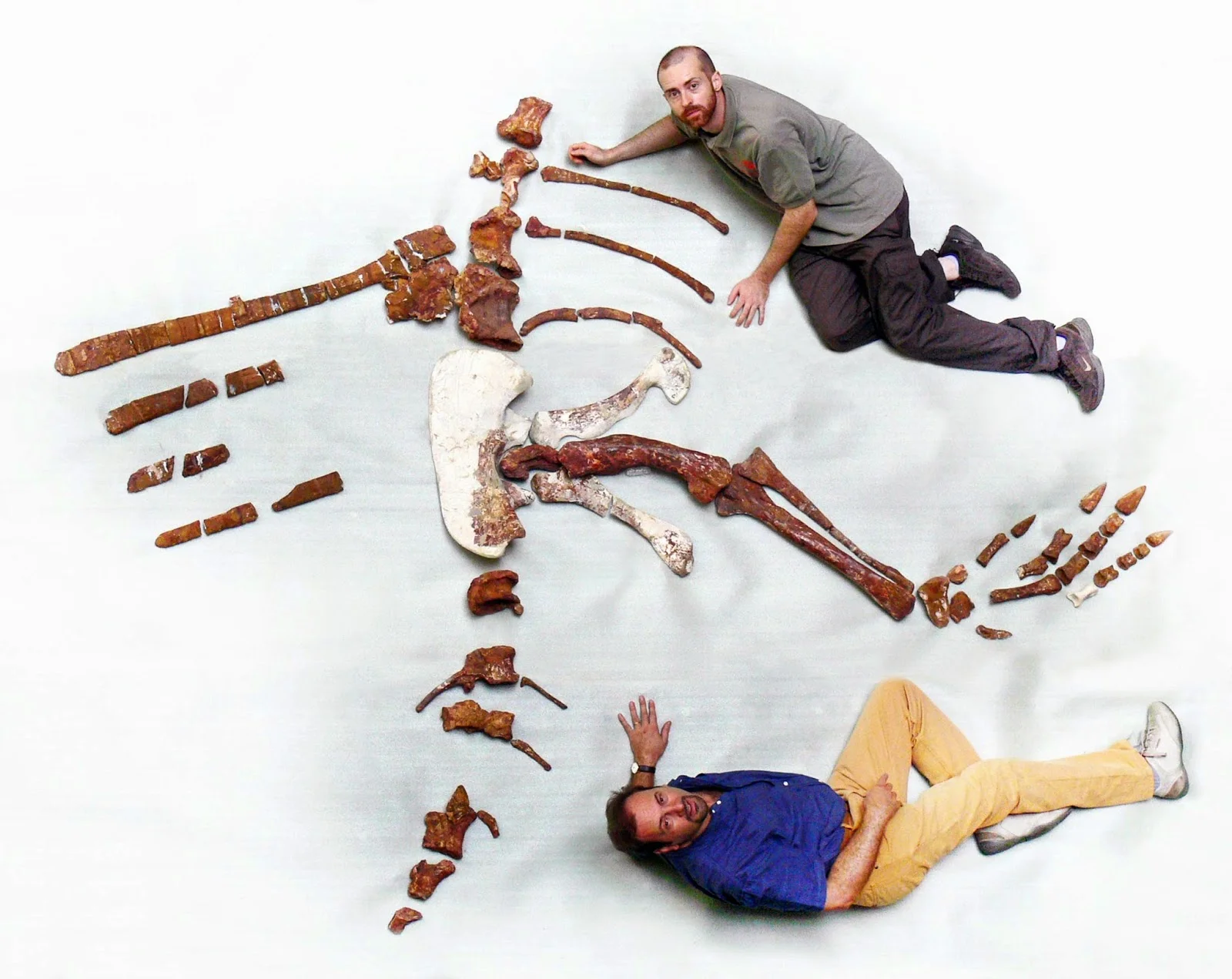
In my previous post on the proportions of the new Spinosaurus material I argued that the pelvis and legs are not reduced in size to the extreme degree portrayed in the composite skeletal in Ibrahim, et al., (2014). In the comments section of that post theropod-worker extraordinaire and all-around swell guy Thomas Holtz mentioned a photo (seen at left) that could serve as a sort of independent visual line of evidence that the pelvis and legs of the new Spinosaurus specimen are shorter than other theropods, and potentially shorter than I calculated from the supplementary data. Checking our assumptions (including mine) is part and parcel of science, so let’s take a look.
Andrea Cau wrote an excellent post on his blog wherein he makes a strong case that the remains of Stromer’s “Spinosaurus B” specimen and the newly described material by Ibrahim et al. are not themselves chimeras, instead accurately recording theropods with smaller-than-usual pelves and hind legs. This is an objection that has been raised before to try and explain away any oddities of the original Stromer material, and has been informally raised regarding the newly described neotype specimen.
I find Cau’s argument, as well as the taphonomic description of Ibrahim et al. persuasive, and I think it’s very likely that the two specimens are not, taken individually, composites of multiple individuals. Jaimie Headden warns that mixing the two specimens together might result in a chimera, especially when you start referring isolated remains, some of which have been referred to other taxa (e.g. Sigilmassassaurus). I think he makes a good case, but that doesn’t impact the scaling of the pelvic girdle and hind legs, which in the new specimen really are reduced compared to other spinosaurids (and other theropods in general).
This should not be contentious - to my knowledge no one is arguing that the legs of Spinosaurus are unreduced. My own “correcting” of the composite skeletal proportions still results in a theropod with a reduced pelvic girdle and hind limbs (certainly reduced compared to my original skeletal reconstruction). Given the other data from isotopes, sensory pits on the schnoz, etc., there is also a case to be made that the limb reduction correlates with increased time spent in or around the water. The question is to what degree, and that’s where the numbers published by Ibrahim et al., don’t seem to add up to their reconstruction of a quadrupedal, Ambulocetus-grade level of aquatic behavior.
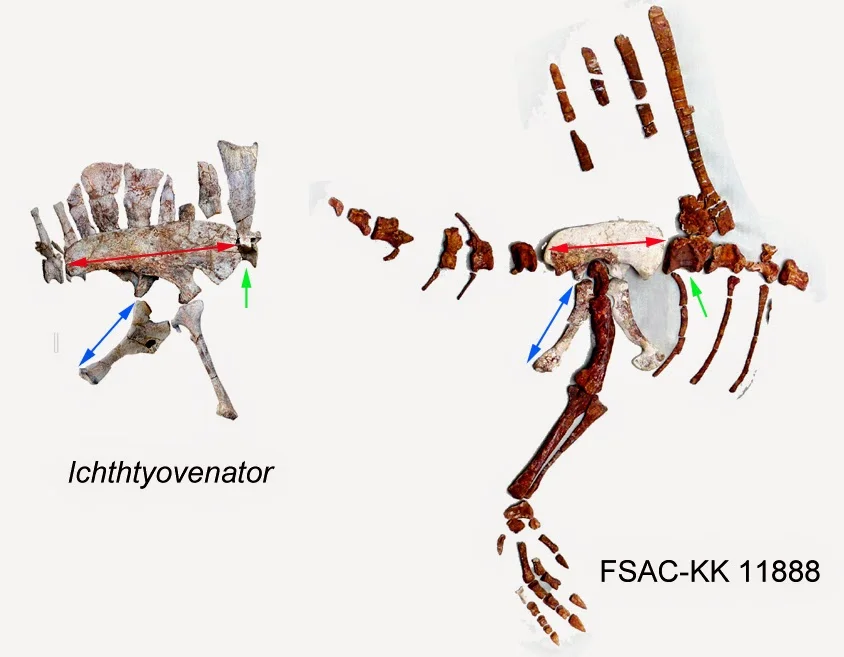
Cau posted another image (seen directly above) which was taken at less of an angle than the one featuring Homo sapiens for scale, so let’s work with that image. On first visual examination there’s no getting around it, that’s a small pelvis and hind limb! But that’s not really in dispute, the key is to what degree is it reduced? In the paper the ilium in the skeletal is portrayed as slightly shorter than 3 dorsal vertebrae. Glancing at the photo it should be obvious that the pelvis is not that short, but what we really want is a more precise estimate. Measuring the length of the individual centra in the photo can actually be pretty tricky; between distortion and the vertebrae sitting at semi-oblique angles it’s hard to ensure you aren’t making them longer than they really are. In measuring the three longest centra relative to the ilium I get a scalar of between 3.6 and 4.0. I would attribute that variation to the inherent imprecision of the technique, but notably it’s in the same range as I previously calculated from the authors’ measurements in the supplementary table S2 (which is 3.9).
But wait, there’s more! Stare hard at the limb proportions for a bit. Notice anything strange?
If you said “neither the femur nor the tibia appear shorter than the ilium” then you get a gold star. Why does that matter? Because in the official composite skeletal both limb elements are portrayed as shorter than the ilium; in the case of the femur it’s portrayed as dramatically (~17%!) shorter than the ilium.
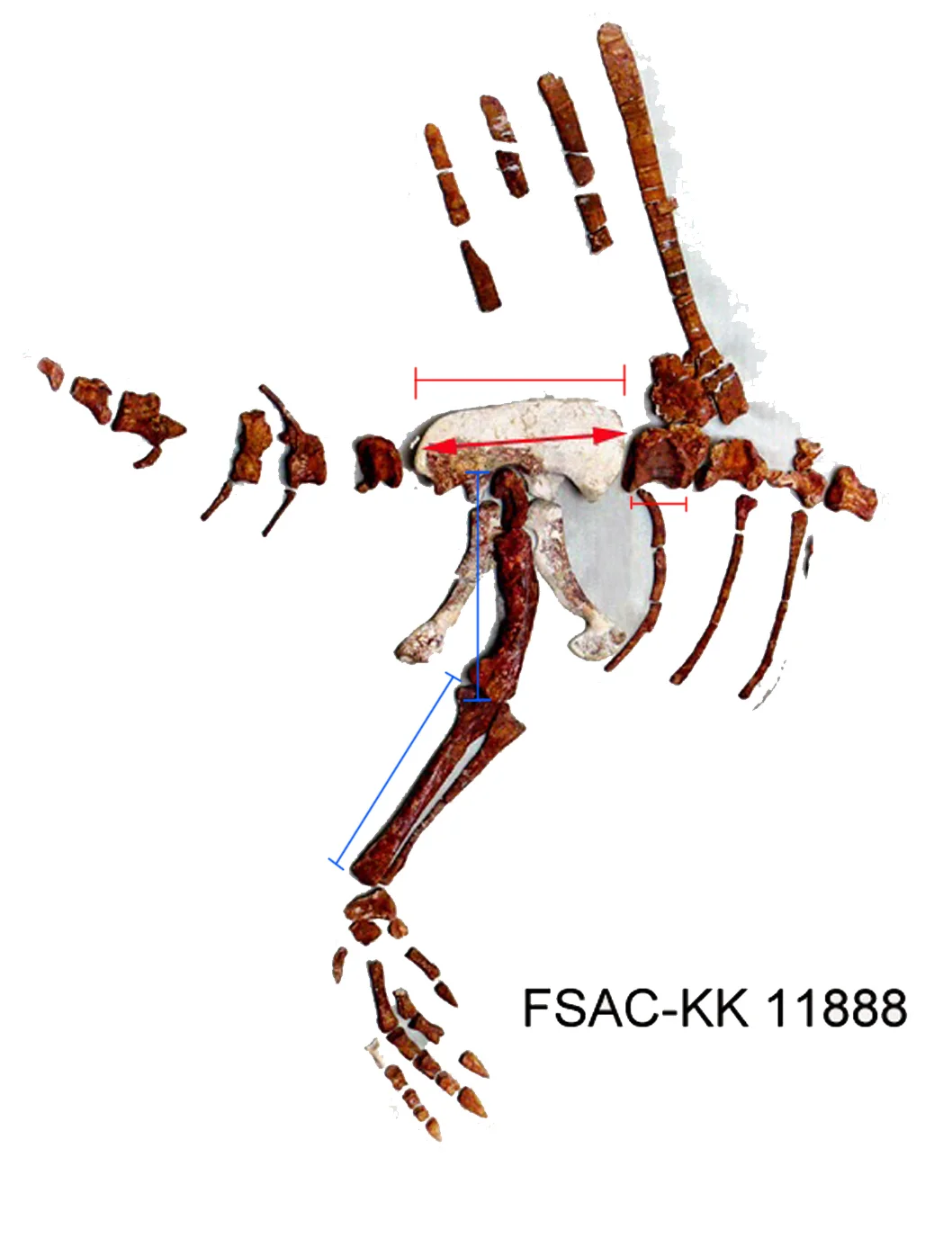
Don’t take my word for it, pop the file into ImageJ or Photoshop and try it yourself. At right is the same image with my own measuring points added for reference.Given that the ilium is restored as 71 cm in length the femur certainly appears substantially longer than the published length of 61 cm.
Of course now we are in the realm of questioning whether the measured and published lengths are correct. It may seem like this is a case of who are we going to believe, the paper or our lying eyes, but it’s really not that simple. Measuring photographs is not reliable - foreshortening and parallax can bedevil well-meaning folks who take measurements from photos. Another possibility is that the femoral head could be broken in these photos and turned upright, leading to the appearance of extra length. I’m not convinced of that, but there does appear to be a break in the upper 1/4 of the femur that might shrink the femur by ~5-10% when fully seated (though it would still be noticeably longer than portrayed in the official composite skeletal).
The simple fact of the matter is that measuring photographs that other people have taken is just not sufficiently precise to establish the exact proportions of a specimen. So have I accomplished something aside from increasing our uncertainty? That would actually be an OK goal, as I want people to understand that this isn’t easily resolved. One thing these photos are not evidence of is the neotype possessing legs and a pelvis as small as shown in the Ibrahim et al., composite skeletal - taken at face value these photos seem to show legs that are even longer than I originally suggested.
But really it’s the ambiguity that is important. Most of the data in the Ibrahim et al. paper are solid and probably won’t prove to be controversial. But the interpretation of a quadrupedal, semi-aquatic theropod that parallels early whales is a major claim, and it (mostly) rests with the accuracy of the skeletal reconstruction (both the proportions of the limbs and the estimated center of gravity stem directly from it). And that is where I feel the paper falls short; an Ambulocetus-grade spinosaur is an extraordinary claim, but it fails to provide extraordinary evidence for the proportions and center of gravity that make or break this claim.
The authors, their preparators and scientific illustrator(s) went to great lengths to scan in existing bones, model the lost bones from Stromer’s specimen, etc., but when it comes to documenting how these disparate specimens were scaled together into a composite skeleton the paper simply says they were “size adjusted”. The supplement provides an “order” that was followed in scaling (neotype specimen>models of Stromer’s specimen>isolated bones>bones from other spinosaurids). But that’s not very informative. I and several others have noted, for example, that the centra on the neotype presacrals appear more elongate than in photographs of Stromer’s Spinosaurus B. How is this reconciled in the composite? The composite skeletal shows the pelvic girdle improbably high on the mostly incomplete sacral vertebrae (which makes the legs functionally shorter) - how was that deduced? These are the sorts of things we need to know if we are to favor the early-cetacean model over a “giant-stork” model, but at best we are left with too little information to test the idea, and at worse measurements that suggest the skeleton isn’t modified to the extreme levels implied in the paper.
Important Note:
I find it sad that I need to write this, but I fear parts of the internet have run amuck. I’ve seen people attack the credibility of either the journal Science or the authors of the paper. DO NOT DO THIS! There is nothing at all to suggest malfeasance, and knowing most of the people involved either from personal experience or by word of mouth I will happily vouch for them as good, honorable individuals. I realize that some people on the internet feel very strongly about how Spinosaurus “should look”, but don’t make the mistake making the issue personal. The fact of the matter is our wishes won’t affect the proportions of Spinosaurus one iota - all we can do is try our best to uncover them and then let the chips (data, not cow) fall where they may.
29 comments
An interesting feature of the article that intrigued me was that they stated that the tail had increased flexibility to aid with swimming. How was this determined?
Lots of smaller (front to back) tail vertebrae. Everything else being equal more chances to bend in a given amount of tail length means more flexibility.
I can't replicate your estimates of proportions.
I assume that the long, continuous neural spine in the photo is equivalent to the red portion of the fifth long neural spine in Ibrahim et al.'s reconstruction, and find that the ilium (but not tibia) seems to be proportionally accurate in their reconstruction. I get a similar result for the dorsals, in as much as I feel confident in my measurement thereof. I wonder if this is partly because of the excessive similarity between the red and orange obscuring what material corresponds to what.
The legs still seem too short in their reconstruction, but not by much.
I still can't shake the feeling that Spinosaurus might have "looked wrong" to the same degree as an azhdarchid in some respects.
Yes, one thing that is problematic is that the red and orange are really hard to tell apart in the composite skeletal in the supplement; this is especially vexing in the dorsal series as it looks like there has been work done to "match" the vertebrae as the centra in the official composite skeletal are significantly more elongate than Stromer's material. The lack of vertebral ID and the fact that several of them are at oblique angles in the photo (making them look longer) makes it almost impossible to accurately measure them from these photos.
As for whether or not Spinosaurus will ever "look right" - it honestly doesn't matter. Sure, people are more comfortable when things look familiar, but sometimes nature is just strange. It doesn't bother me at all that the composite looks unintuitive, just that the numbers don't seem to match (to be honest, an ambulocetus-grade spinosaurid would be pretty awesome).
Yeah. As I said, even if Spinosaurus "looks wrong", so do azhdarchids with their comically-oversized heads and necks.
So given the margin of error present in comparing the photos to the skeleton, does it seem plausible that their reconstruction is correctly scaled?
Sadly, the National Geographic article has a much better figure of the composite model than the paper itself. There's a four page fold out where the neotype is red, but the holotype* is yellow. The first three dorsal centra shown in the photo are placed in order as six, seven and eight in the composite. There no other dorsal centra shown as preserved in the composite, so the big one by the pelvis may be a sacral. The most complete spine is shown on dorsal eight, and only seven, eight and nine are shown as having overlap between the neotype and holotype.
An odd thing about the photo is that it shows more material than the composite or description imply exists. The supp info states "no part of the ankle is preserved", but what are those distal to the tibia and fibula? I'm assuming what's placed as metatarsal V in the photo turned out to be metatarsal I, as no mtV is shown as preserved or said to exist. The composite only shows the one complete caudal, plus a proximal centrum and a neural spine, so what are those other four bones in the photo? You know what would have helped, authors? Giving a better axial material list than "partial cervical, dorsal, sacral, and caudal vertebrae, partial cervical and dorsal ribs, and partial chevrons."
*Labeled "Stromer's bones" in the supp info, and obviously includes Spinosaurus B, contrary to the National Geographic label "Stromer's 1912 Egypt find", as Spinosaurus B was found in 1914.
Agreed, whether or not it looks silly is irrelevant. But this photo actually leans the other way, with their reconstruction looking even more wrong than I initially thought. Given the uncertainty I'm not willing to embrace this as definitive, but at this point I would need to see much better new data to accept the extremely-reduced quadrupedality model.
Questioning the data is important but I think when the dust settles the adaptations of the foot, reduced hind limbs, generally elongated morphology, sensory pits, isotopic data, dense bones, dietary inferences, and geologic setting of a fluvial/tidal/deltaic environment will all speak overwhelmingly in favor of an increasingly aquatic adaptation for Spinosaurus. Of the two prevalent forms of locomotion cited - obligate biped or obligate quadruped in a knuckle walking stance - I, and many others, have noted numerous problems with BOTH forms of locomotion. The relatively slender hand and wrist bones do not suggest knuckle walking. As for bipedal walking there is the issue of COG and even if possible through changes of proportion to bring the COG back under the hips there is the real and common sense problem of being a multi-ton obligate biped moving around on tidal mud flats. During bipedal locomotion all the weight will be concentrated on one foot - which poses serious problems of getting mired - something any one of us can go experience first hand if you go out and try to cross a tidal mud flat.
Breaking the obligate biped or quadruped dichotomy and invoking belly sliding as a predominant form of locomotion solves all of the above problems. This is the method of locomotion that pinnipeds, otters, penguins, loons, special forces operatives, and probably Ambulocetus use to move over slick/muddy/difficult terrain.
Did Bakker Get Spinosaurus Right After All
Might I ask how the sensory pits on the head are different from those on other Therapods.
Functionally? Not that much different. There is no way to determine the type of nerve ending or sensory organ at the end of the nerve fiber from the fossils. The number of openings and their concentration in an area of the snout may be more useful, as it allows us to speculate that more narves are running to certain regions of the snout than others, and this has some import.
Thank you for replying, it always bothered me when news articles wrongly stated that spinosaurids evolved sensory pits as a speciallization for swimming. I just needed confirmation that there wasn't a noticable difference between those of other therapods structure wise.
The problem with common sense is it can also be misleading. The issue of miring is real for quadrupeds as well as bipeds (and the skinny clawed hands of Spinosaurus would be of little help), but the idea that a large animal is somehow at a bigger risk of slipping is one of those misnomers with no actual evidence to support it. Certainly neither issue is based on the kind of evidence that would outweigh the anatomical data.
"the problem with common sense is it can be misleading" yes sometimes, but how have you shown I am misled? I still am not convinced it could walk bipedally (very well) and there are really problems with knuckle walking. By folding the front arms in, lowering the torso and pushing off with the back legs all these problems are solved. This is merely a co-option of known resting theropod anatomy: Milner ARC, Harris JD, Lockley MG, Kirkland JI, Matthews NA (2009) Bird-Like Anatomy, Posture, and Behavior Revealed by an Early Jurassic Theropod Dinosaur Resting Trace. PLoS ONE 4(3): e4591. doi:10.1371/journal.pone.0004591
Several extant theropods - loons, penguins - use this very method of locomotion. And they happen to be primarily aquatic as well. Simple? Yes. Common sense? Yes. Wrong, not necessarily. You or no one else I have contacted (and if you read my comments there are several) has shown me why it is wrong.
The bipedal/quadrupedal dichotomy is dominating the conversation. Belly sliding is a third option.
Tidal mud is a very different beast than the type of mud you might encounter in a lake or high gradient stream/river. Large crocs can use a variety of walking techniques but I am yet to see an instance of a large crocodile moving across tidal mud in a high walk or any stance but a belly slide
For me the fact that a crocodile can utilize a variety of stances but always seems to go to belly sliding speaks to the benefits of spreading your weight out on a difficult substrate to gain traction.
Belly sliding used by both the croc and bird archosaur line archosaurs - phylogenetic bracketing. Solves problem of COG and knuckle walking. Simple co-option of known theropod resting anatomy - no drastic anatomical makeovers needed (ventral surface absorbs most of the weight arms are minimally involved). Provides solution to dealing with difficult/muddy terrains with known analogues in crocodiles/pinnipeds/penguins/loons.
I would say it is simple and parsimonious.
Duane Nash antediluvian salad
Belly sliding requires you to be able to propel yourself on the substrate. Crocodilians are already built for this with their sprawling limbs. Loons and (especially) penguins have shifted their legs posteriorly and rotated the acetabulum laterally so their limbs push out to the side more (loons of course depend on that as a propulsive stroke). So short legs aren't enough, Spinosaurus would need to be shown to have a radically modified pelvis, which the neotype simply doesn't have. Also note that plenty of living theropods simply walk along tidal flats - loons belly slide not because walking can't be done, but because their aquatic adaptations make locomotion on land difficult.
Now, if those pelvic and femoral adaptations were there in Spinosaurus I would say it deserves more exploration, but without them its hard to see how belly-sliding could have been more than a very occasional mode of locomotion. Second, there seems to be no reason to invoke it - matching the skeleton to the published element lengths makes normal theropod bipedality easy to accomplish, and it also moves the center of mass back. With those two problems solved belly sliding as a regular form of locomotion becomes a solution in search of a non-existent question.
I understand the appeal of breaking false dichotomies, but sometimes dichotomies aren't false, and sometime the data simply doesn't demand it.
Good points about the acetabulum - thank you for the very valid criticisms. I would offer that the reason rotation of the acetabulum hasn't occurred is that bipedal underwater locomotion was their predominant form of locomotion (as the authors contend and the strong femoral attachment for caudemofemoralis muscles suggests) - so all the nuts and bolts of typical theropod running would still align. Additionally the power stroke of the back leg during belly sliding can be extended down into the substrate thus negating any issues of hind limb length. But then again we may just differ here on leg length as I believe the authors pretty much got the proportions right and you have your reasons for believing otherwise. Not a graceful animal out of the water in my opinion but if all you have to do is amble out to rest and lay eggs that might be good enough. Of course at this point we may very well diverge as I am convinced of an overwhelming aquatic adaptation and you are not - and that is ok. We still await the defense from the authors.
Duane Nash antediluvian salad
You're welcome. I doubt truly "underwater" bipedal locomotion occurred (even with solid bones bipedal locomotion would be much slower than swimming) but I would agree that walking through waist high waters may have been the norm. And note that I'm not ruling out belly-sliding ever, I just don't see evidence that they were specialized for that type of locomotion on a habitual basis.
If it wasn't extinct, getting the details of how it moves would be MUCH more important
But also much easier.
1. It is clear there is a discrepancy in the length of the hindlimb of the neotype relative to the non-hindlimb elements. The photo above from Cau's blog shows the right femur is a little over half the length of the tall complete thoracic neural spine (~55-60%). In the reconstruction of Ibrahim et al. supp info, the left femur is only about 30% that spine length.
Is this an issue of there being differently sized left and right appendicular elements? The table of measurements from Ibrahim et al. do not state which side the bone comes from (i.e., left/right), making this difficult to check upon.
2. A question about the right ilium, and other pelvic elements shown in the photo on Cau's blog: these seem to be paler fragments (relative to the hindlimb bones) that appear to be mounted on even whiter material (?plaster). So, how complete are these elements? I notice the diagnosis of Ibrahim et al. (Supp Info) mentions the ilium is longer than the femur, which I must now assume is based on left, rather than right elements.
Jay
That is an important observation about the femur, That is about where the above photo departs in shape from the paper propers figure 2 (above the prominent anterior trochanter). In figure 2 the tibia is longer than the femur. Do you have E. Stromers 1915 paper?, I have seen your photograph and the centra do look taller in it and not as long. However all of the centra in the destroyed type specimen were illustrated separate by a small space from their neural arches. It is clear that Stromers type specimen was itself a subadult! The centra do not look that much different than those of Spinosaurus B, or the dorsal centra of Sigilmassasaurus. In the photo the vertebrae are cleaned up and the centra are mated to their neural arches along rather strait seams, I wonder if this is an artifact of the cleanup process they went through before display.
Hi Scott,
We are writing to clarify some aspects of the new skeletal reconstruction of Spinosaurus.
It is with a certain sense of surprise that we found out that, a few hours after publication some people thought they had
solved all the mysteries of Spinosaurus (without examining the original material that is).
It has been brought to our attention that your “corrected” skeleton, assembled within a day or so of our publication, has suggested to some that the actual reconstruction, based on the fossil material, was “fishy”. That is not the case.
All the bones used in the digital model were CT scanned using the same parameters. The proportions of the digital skeleton are correct, according to our identifications. The new remains come from a site with just one individual (also remember that there are only 2 other associated dinosaur skeletons from the Kem Kem assemblage mentioned in the literature, it’s definitely not the kind of place where lots of associated skeletons are found) and additional remains of the same animal were found at the site on return expeditions, including partial spines, teeth and other elements. Note also that the thin sections we made represent the same ontogenetic stage (that includes the first remains collected and those collected on later expeditions).
In summary we have evidence for one skeleton, one individual, and one ontogenetic stage. One other thing that many people seem to have missed is that Stromer's "Spinosaurus B", almost certainly associated material (see Stromer's account), shows the same axial/appendicular proportions. Several elements of Spinosaurus B overlap with our material – which in turn overlaps with the holotype.
Let’s look at the methods you used in your reconstruction. Measurements are subjective: if you want to compare the anteroposterior length of D8 to that of the ilium you have to take into account the landmarks we used to measure the vertebrae. This detail was omitted from the table legend - we are measuring from rim to rim, not including the anterior condyle. You suggested that the measurements of the hind limb and the pelvic girdle do not match those of the vertebrae: can this be a consequence of the fact that you used different landmarks? This could significantly affect the proportions. Also, keep in mind that the neotype bones have crushing and distortions, asymmetry, etc that were not removed (we wanted to include these imperfections in the finished model). Some of these distortions, for example the medial/lateral crushing/compression of the distal femur, make it look different (narrower) from the less crushed Spinosaurus B distal femur in posterior view (while by contrast the lateral views are very close) – this is relevant to some other posts online that pointed to the more “slender” profile of our femur compared to "Spinosaurus B". Also, in the 3D model, the femur is not hanging straight down - it is angled outward/laterally slightly and so foreshortened slightly in lateral view, making it look shorter.
One other word of caution: too much is being made of photographs of the specimen in Italy, which were taken before the specimens were fully prepared in Chicago (preparation made them smaller by removing matrix at the articular ends), and also before identifications were made to place the bones on the skeleton in different locations than the Italian photo
depicts. Also, some camera angles create distortions. It was a rough draft, but people now seem to be attempting to get data from it...
For an independent reconstruction effort, also see the skeletal reconstruction by Marco Auditore (on the Theropoda blog);
Marco is part of our team and, using the same data set, independently obtained a reconstruction that matches the proportions of the digital skeleton.
We will detail our methods in upcoming papers. Let me just say that we went to great lengths to ensure that the different
specimens were sized correctly - we examined the material many times, from the tiniest zygapophyses to the most fragmentary rib pieces. We examined hundreds of bones referred to Spinosaurus, and gathered a surprising amount of
information from isolated elements, some of which overlap with our remains. The “core” reconstruction rests on the neotype and holotype (which are very close in size).
We have also gathered information from numerous specimens of other spinosaurids from Europe and Asia, including unpublished material currently under study; this includes an articulated c2-d4 series of Suchomimus that matches the cervical proportions in Spinosaurus rather well (the neck/skull proportions in our model also take into account Stromer’s material), as well as additional juvenile, sub-adult and adult material of spinosaurids. We also know from several lines of evidence that the vertebrae of "Sigilmassasaurus" belong to Spinosaurus – much of this will be published soon.
We are not saying that our reconstruction is 100% perfect – of course it isn’t, and I don't think this claim has been made by one of the authors - but paleontologists and paleoartists in particular should finally accept that there is no such thing as a "final word" in dinosaur reconstructions, weight estimates and behavioral interpretations. Look at Tyrannosaurus, Quetzalcoatlus or Diplodocus reconstructions and count the number of changes in posture and proportions and
interpretations (scavenger, not scavenger, necks held low, necks held up, terrestrial stalkers, fish eaters etc etc). All we can do as paleontologists is present a reconstruction that best fits the available data. And then it is refined as more material comes to light. If we find a long legged Spinosaurus in Morocco, we will tell you, rest assured. But right now we have two associated skeletons with the same proportions. And if we find more forelimb material, we will refine our model if necessary.
We have been very transparent about our approach and have presented strong evidence in favor of our interpretations. The skull of Spinosaurus has "fish eating" written all over it, one of the best matches for the bone compactness profile is a penguin, and we have paddle like feet and a "river of giants" full of car sized coelacanths, giant lungfish, sawfish and many other aquatic forms. Suggesting that Spinosaurus took full advantage of this, and reduced its hind limbs in the way other lineages have done as they spent more and more time in the water is the best hypothesis we have – taken together, all of the evidence suggests that Spinosaurus spent a substantial amount of time in the water. We are working on a monograph that
will include detailed descriptions and more measurements, as well as large amounts of unpublished data. So you will soon have access to more data to inform your beautiful skeletal drawings.
Nizar Ibrahim, Simone Maganuco, Tyler Keillor, Matteo Fabbri.
My thanks to Nizar and collaborators. With permission this has now been elevated to its own blog post: http://www.skeletaldrawing....
Now, I preface this by saying that I am not well-versed in the
heavy-lifting aspects of paleontology as I just like drawing the damn
things, so I do feel quite out of my depth (to use a vaguely aquatic
pun, get it because spinosaurus, har har har), but I how dumb or
pointless of a suggest would I be making to ask if the pelvis and legs
in question might actually come from a juvenile specimen? I know there's
a way to determine a fossil's age, something to do with bone density,
but that's about it. Apologies if I'm just bumbling in without adding
anything to the discussion.
I for one am open to the possibility of reduced hind limbs, but I'm extremely skeptical of the idea of a quadrapedal Spinosaurus. There has never been a confirmed case of a theropod species which was primarily quadrapedal. Furthermore, to my knowledge, al known spinosaurid remains which included limb bones were bipedal. Although the discovery of limb bones from members of this fascinating family are rare, all of the evidence seems to point to these animals being bipeds. Until further evidence is found, I find it safer to assume that Spinosaurus was a biped with shorter hind limbs than most therapods. Neverthless, I'm looking forward to the aforementioned papers. I want to here more about these new remains he mentioned.
Are there any dorsal views of the digital model out there? Specifically, I was interested in the size of the rib cage, both as a indicator of mass, as well as the possibility that - going along with the progressive adaptation for semi-aquatic lifestyles -Spinosaurus might have had a duck-like body-shape that would allow it to float comfortably on the surface - which would seem to fit right in with the idea that the rear legs would act as paddles.
At a glance, I tend to think that this restoration probably undersizes the hind legs, and I'm skeptical of the forelimbs - at least as I have seen them extrapolated from related species - being utilized for quadruple locomotion on land. Of course, the fragmentary remains means anything is possible, but the 'front heavy' reconstruction seems awkward - something that you rarely see in living animals. I suspect that this was a strictly bipedal animal , with the counter-balancing tail allowing for the forelimbs to function as fish-catching tools.
Scott - THIS is what Spinosaurus in all likelihood looked like. Feel free to
forward to Mr. Ibrahim, et al.
Please hopefully Spino is big again and not this quad walking version.
Scott, did you ever publish your findings?
Actually, the hindlimbs probably didn't belong to Spinosaurus
Join the discussion
Thanks — your comment is in the queue!
It'll appear here in about 5–10 minutes, once I've approved it — you'll need to refresh the page to see it. (Comments don't post instantly anymore.)