The road to Spinosaurus I: Megalosaur skulls
November 24, 2020
A few years back I wrote a couple of essays about Spinosaurus, looking at the most recent specimen (FSAC-KK 11888) and what could be said about the proportions and habitat of Spinosaurus. Ultimately I wasn’t able to come to a firm conclusion, and decided I would work from the ground up to create a new skeletal.
It has been slow going since then, as I was preoccupied with finishing my PhD, publishing papers on other topics, and teaching courses at the University of Wisconsin-Madison. But I’ve kept whittling away at it, and today I want to start laying out my thoughts on this challenging topic. Starting phylogenetically broadly and working towards El Spino, here is a quick look at the proportions of megalosaur skulls.
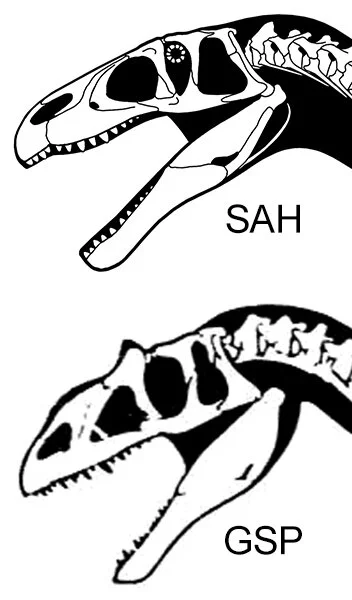
Historically megalosaurs have been known from less than ideal remains, including a lack of articulated skulls. With fairly scrappy remains to rely on, they have traditionally been restored with tall, blocky, vaguely allosaurish skulls. Greg Paul’s take back in his venerable 1988 Predatory Dinosaurs of the World (first figure) was not nearly as short or blocky snouted as most contemporary examples - it was common to restore Eustreptospondylus with an almost ridiculously short (front to back) and tall skull, an interpretation no doubt inspired by the original attempt at a physical reconstruction (a photo of which can be seen on David Hone’s blog here). The influence was pervasive for decades, and similar variants can still be seen in a Google Image Search today. Somewhat more recently megalosaur skulls have been restored with longer snouts, but ones that are tall and blocky (and sometimes quite wide), including the Eustreptospondylus model used in the Walking With Dinosaurs BBC special. I have been guilty of this myself, restoring the skulls in my Megalosaurus and Marshosaurus skeletals in the tall and blocky tradition.
This view of megalosaur skulls made nesting spinosaurs (and their long, narrow skulls) within megalosaurs seem strange*. Of course there’s nothing wrong with groupings that feel superficially counter-intuitive - sometimes subgroups are quite different in proportions from their relatives. Giraffes and whales, for example, are just as much artiodactyls as deer are despite having very different proportions.
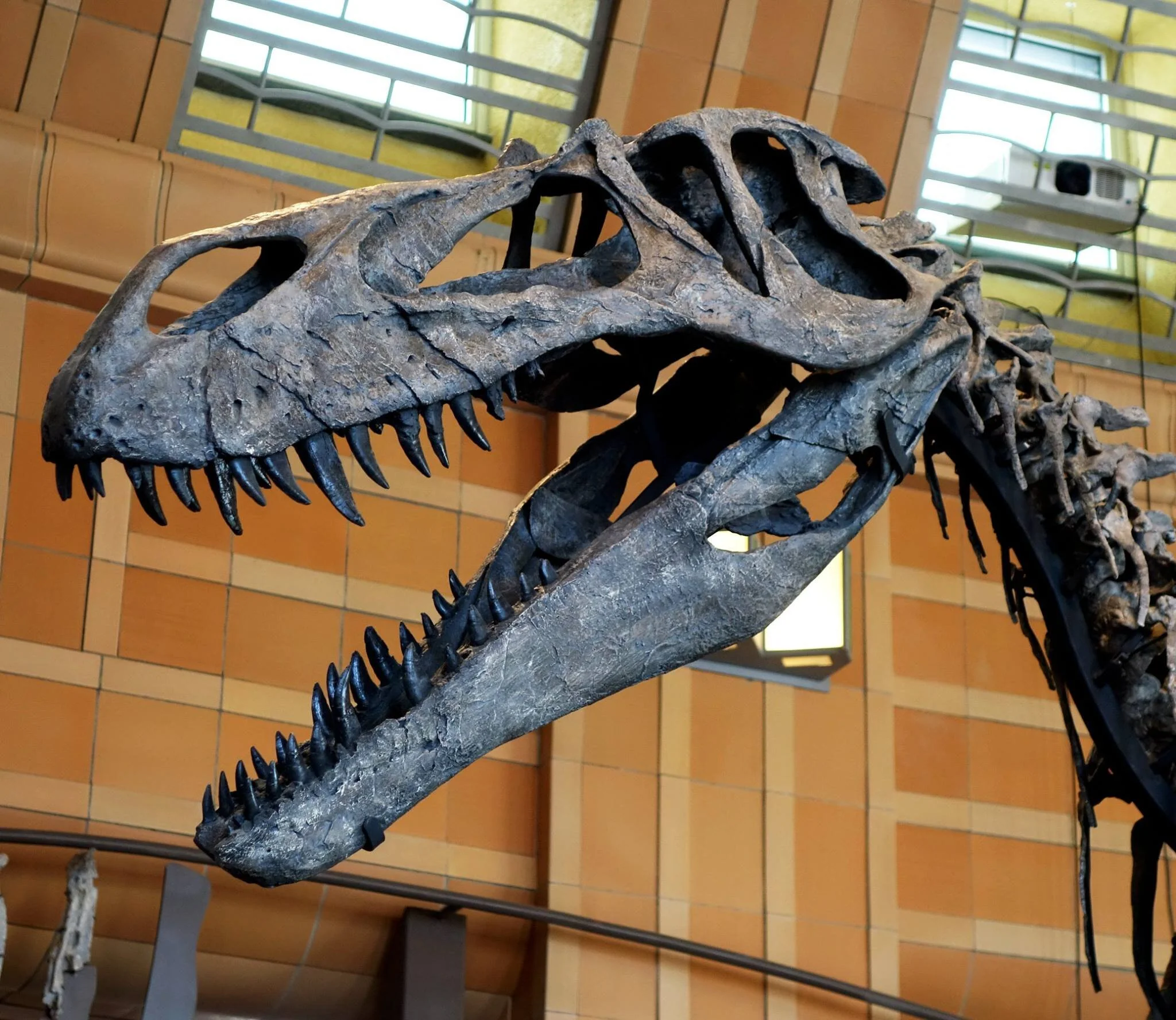
But about two years ago as I worked up my Eustreptospondylus skeletal (based on the excellent redescription by Sadlier, et al., 2008), I was struck by how long and slender the skull was. Shortly after that I also got to see the newly reconstructed Torvosaurus skull that has gone on display in the Museum of Natural History & Science in Cincinnati, which also features a longer and (mostly) lower snout than past reconstructions. Having seen the material the remains are based on, I went back and checked the assumptions in my original skeletal and realized they would absolutely fit together this way - I had been working from the tall & blocky historical impression previously.
The more complete skull of Dubreuillosaurus definitely has a long and low skull; and it’s possible the skull was even longer than most current reconstructions, as the maxilla contacts with the lacrimal and jugal are not preserved, and the broken lower portion of the maxilla is shoved rather far back into the incomplete jugal region. Comparing Dubreuillosaurus to Eustreptospondylus, and their broad similarities with the less generously preserved megalosaur skulls and it looks like having long and low snouts was a common feature in the group. To that end I have reworked my skeletals of Torvosaurus, Marshosaurus, and Megalosaurus to better match their relatives, and added Eustreptospondylus to the Theropod skeletal gallery.
Of course none of these skulls is as specialized as what we see in spinosaurs, but with stout thumb claws and long, low snouts megalosaurs no longer seem such a weirdo home* for spinosaurs. So that’s the broad context, but what about non-Spinosaurus spinosaurs? More soon!
This post was brought to you by Permia
With their attention to detail, good eye for color design, and high quality materials the good folks at Permia produce some of the best paleo-themed merchandise out there. Go check them out!
* A 2019 paper by Rahut & Pol has created some disagreement about whether traditional megalosaurs form a single monophyletic group, or are actually a paraphyletic grade theropods below allosaurs. This is the sort of thing that takes lots of new studies (and therefore time) to resolve, but if spinosaurs and other “megalosaurs” are a grade much of the above discussion still holds.
14 comments
Interesting post and the updated skeletals are great. As you say, a shallower skull for megalosaurs makes the megalosaur-spinosaur connection feel a bit more intuitive (not that that necessarily means much). I look forward to part 2!
Excellent post. For an early example of the long Eustreptospondylus snout, check out figure 3A in Bakker et al.'s (1992) Edmarka description.
Thanks Mickey, and I can't believe I forgot that figure! You are 100% correct that Bakker got that skull very close, long before it was officially revised.
Sorry for being annoying, but I keep being disappointed by the persistent "uncrested megalosauroid meme" which almost everyone follows with no actual evidence... Phylogenetic bracketing supports nasal ornamentation in megalosaurids.
My 12 years old post about this:
http://theropoda.blogspot.c...
Thanks for the comment Andrea, I don't think it's annoying. I have no problem with the idea of a midline crest in megalosaurs, but I'm not convinced "nasal crests bracket megalosaurs" is the slam dunk you imply, as some taxa (e.g. allosaurs) lack midline nasal crests, and the distribution of and developmental relationship between midline and paired crests are not clear at this point. The developmental assumptions one makes about whether paired crests evolve into midlines crests (or vis versa) or evolve from crestless ancestors strongly influences what you think about the phylogenetic constraints on megalosaurs, since basal ceratosaurs and allosaurs have quite different nasal crests. Also, we do have plenty of megalosaur lacrimals and their ornamentation is strongly reduced compared to Ceratosaurus and basal allosaurs. There's also a taphonomic argument to consider - midline nasal crests are often among the more robust parts of a skull, which would make it all the more strange that we have no nasals from non-spinosaur megalosaurs to date.
I would hardly be surprised if we find megalosaur skulls with midline crests. But given the evidence of reduced ornamentation in other facial bones and the lack of what ought to be fairly robust nasals if they form a midline crest I don't feel the evidence is overwhelmingly in favor of it either. Hopefully more complete skulls are forthcoming!
Ironically, the only known nasals for megalosauroid (or megalosauroid-grade) taxa are in spinosaurids and Monolophosaurus, and both show an elongate midline nasal crest. So, the actual evidence is for that condition and not the crestless one.
Pending a megalosaurid nasal, of course.
My comment on the meme stems from the stereotype surrounding megalosauroids as "primitive carnosaurs" thus "unspecialized carnosaurus" thus "unornamented carnosaurs" then "crestless Megalosauroids.
Yeah, I completely agree with your concern about megalosaurs getting memed with "primitive carnosaur" features by default in paleoart. But I also think that if megalosaurs had a Monolophosaurus-style nasal crest we'd have seen it (and of course they can't literally have the same crest, since Monolophosaurus incorporates its lacrimals into the crest, including an antorbital foss that extends up above the frontals onto the crest). But hopefully we will find out, I'm always happy to update them.
Unfortunately, no nasal is known in "true" megalosaurids, so we have to wait for actual specimens.
I do not see nasal and lacrimal ornamentations as strictly co-variant. For example, Guanlong nasal crest is way more elaborated than Allosaurus nasal ornamentation, even if its lacrimal is way less ornamented than in the latter.
I really like the new Megalosaurus and Torvosaurus skulls! Is there any reason the two genera are not lumped together into one genus?
Honestly, since genera aren't real natural groupings it probably doesn't matter much. I've changed a lot on this subject, and now prefer monospecific genera for at least Mesozoic and earlier vertebrates, in part to make sure we don't accidentally hide diversity by adding one specimen in a multi-species genus to a phylogenetic analysis.
I see where your coming from. Great point!
Excellent!! My actual doubt is if, inside Megalosauria, did Afrovenatorines probably had more prominent lacrimal crests? My basis is the Afrovenator holotype, trougth the lack of a redescription and new proper measurements of it made me doubt (Specially on how prominent are really). Eustrestospondylus and Dubreillosaurus can suggest that no, only Afrovenator, but i´m not sure if the las ones where proven to be juveniles.
Is it just me or do these newly projected skull shapes make Megalosaurs look more like Coelophysis?
The new Torvosaurus mount and your new skeletal represent T. tanneri, right?
Is your T. gurneyi skeletal from Hendrickx & Mateus (2014) still accurate?
Join the discussion
Thanks — your comment is in the queue!
It'll appear here in about 5–10 minutes, once I've approved it — you'll need to refresh the page to see it. (Comments don't post instantly anymore.)