The lip post
April 2, 2019
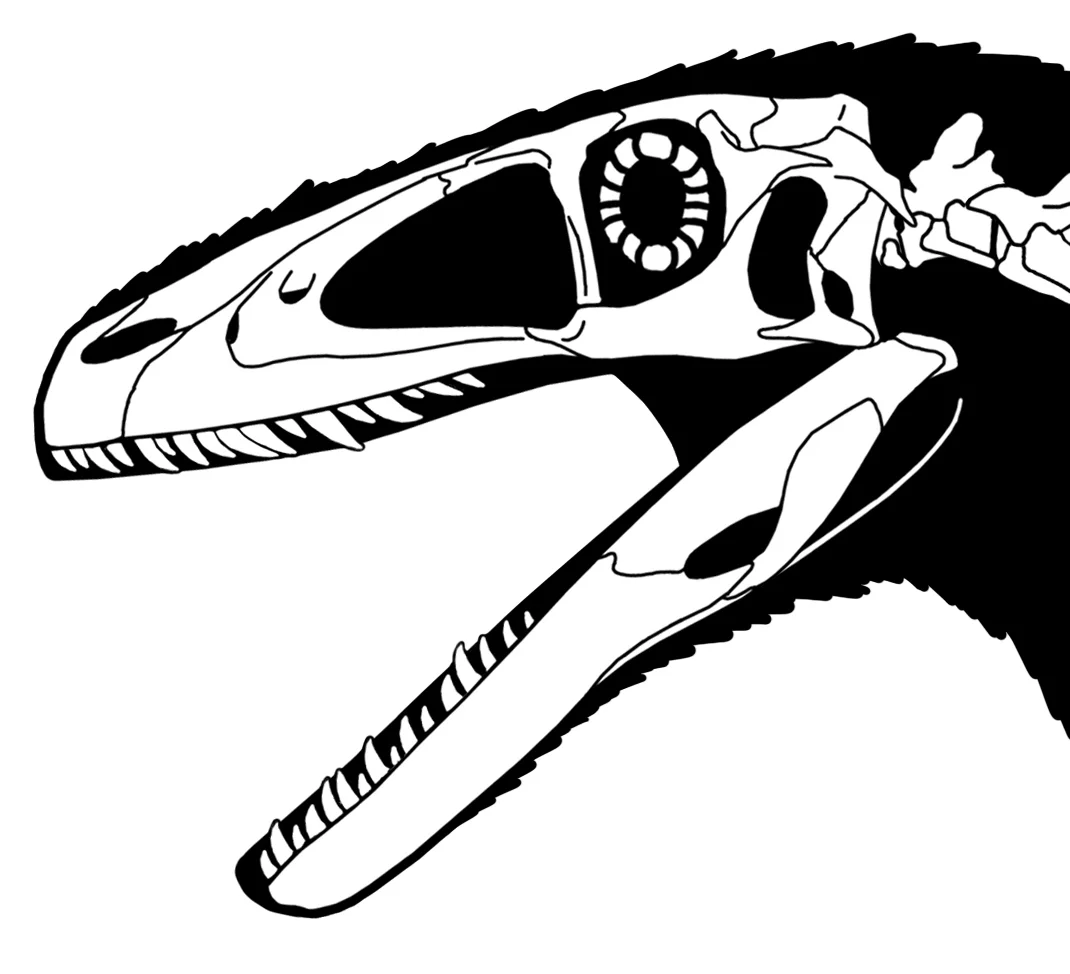
Well here we go. If you follow me on social media you’ve seen this teased, but I’m putting lips on all my non-beaked non-avian theropod skeletal reconstructions. So much for burying the lede, eh?
Ah, but some of you may be wondering why I think they had lips? And what anatomical features I’m using for adding lips and other extra-oral tissues to my skeletal reconstructions? And why I’m doing it now?
All excellent questions. Unfortunately my first draft reached word counts that really ought to be illegal on a blog, so I’ve settled for breaking this up into two separate posts. The first will cover the basics of the theropod lips controversy, the evidence that has me convinced that lips are the way to go (and so convinced I’m doing it now). Part 2 will follow in a few days and will be on the specific osteological correlates and comparative anatomy I’m using to restore them. So with that, let’s dive in:
Lips on theropods are controversial
As with any topic that is subject to debate, how controversial you find this post will in large part depend on how much you already agree with it. But beyond that I want to acknowledge that this subject lacks a scientific consensus - and not in a “we weren’t there so we can’t know for sure!” sort of way (which is often the last refuge for individuals who don’t want to acknowledge contradictory evidence), nor a “some scientists think birds aren’t dinosaurs” sort of way (that is, a debate that has a settled consensus even if you can find an outlier or two who are willing to provide quotes to the media in opposition of a widespread consensus).
No, the debate over non-avian dinosaur extraoral tissues (lips, beaks, cheeks, or the lack thereof) is one that truly doesn’t have anything approaching a scientific consensus. You may be thinking “But Scott, you said you were convinced!”, and truly dear reader, I am. But as a stem educator I think it’s important to acknowledge when a topic lacks legitimate consensus, especially when you are trying to make a case for one side or the other.
Moreover, because this debate has a big impact on how paleoartists restore the most popular, awesomesaucy of all extinct beasts (not to mention scientific interpretations of them) it has naturally proliferated across not just scientific papers, but paleoart blogs, popular articles, and gray literature. Bob Bakker was arguing for lizard-like lips on theropods in the pages of The Dinosaur Heresies back in the mid-1980s, an interpretation also championed by Greg Paul. Tracy Ford has spent a lot of time arguing the opposite in the pages of Prehistoric Times, and perhaps most recently a paper describing Daspletosaurus horneri (and coverage of the story) has went beyond the description of a new species to make peer-reviewed arguments claiming that at least tyrannosaurs were lipless like alligators.
So how is a person to decide? Let’s try to break this down.
The case against theropod lips
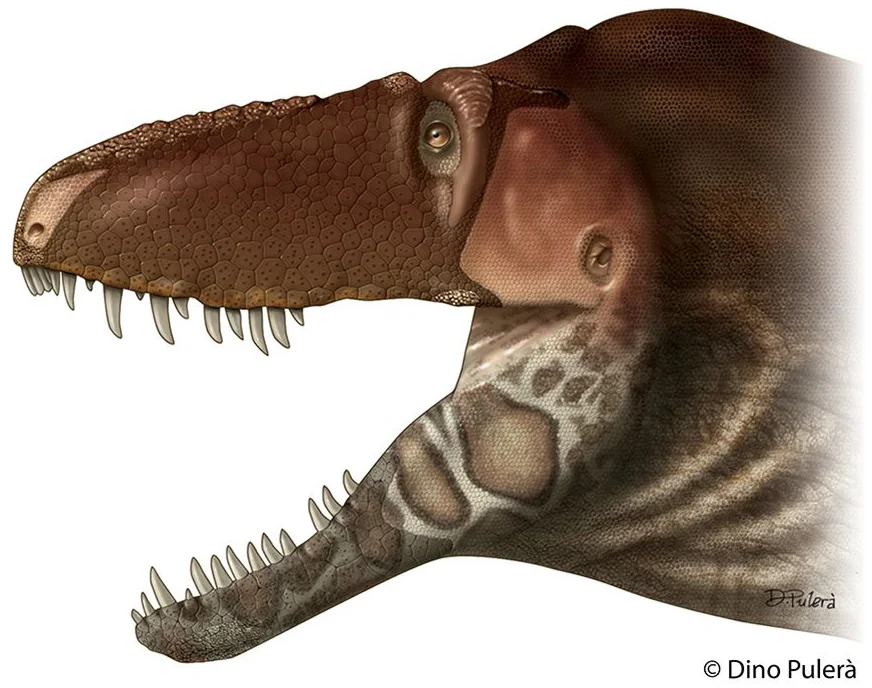
Two main arguments have been advanced to support the idea of a more alligator-like lack of lips in theropods - one based on extant phylogenetic bracketing, and one based on nerve openings and bone texture on the bones around the mouth (the dentary, maxilla, and premaxilla). The extant phylogenetic bracket argument is easy to understand - living theropods (birds) lack lips, as do their closest living relatives (crocodilians), so the default interpretation is that non-avian dinosaurs also lacked them.
The anatomy argument is based on nerve openings and bone texture in the face, (so far mostly in tyrannosaurs). The authors of the D. horneri paper (Carr, et al.) looked closely at the texture of the bones of the skull and attributed a wide range of skin types to them, including keratinous horn-like material, and large and small scale patterns. Specifically relevant for us they interpreted the rugose patterns on the maxilla as being similar to the textured snouts of crocodilians. They, as well as Tracy Ford argue that the foramina (small holes for nerves and/or blood vessels) on the snout and jaws of tyrannosaurs may have made them with highly touch-sensitive, meaning that the nerve openings were to support tactile perception, not lips.
There are also occasional arguments about particularly large-toothed theropods (like Ceratosaurus or Tyrannosaurus) that implies their teeth are simply too large to be enclosed in lips…but that will have to wait until the next blog post. Even with just these main arguments, if the default assumption is lipless theropods and the texture/nerve openings on the snout and jaw support some other use than lips…why would anyone believe otherwise?
The case for theropod lips
First, while the following are my own views on the subject I would be remiss not to acknowledge the many others who have tackled the pro-lips argument before, and anything I’ve read undoubtedly has played a role in my thoughts on the subject. As I mentioned above Bob Bakker and Greg Paul have long argued for immobile, lizard-like lips on theropods, and Greg recently updated his case in the Fall edition of the paleoart/collectibles magazine Prehistoric Times. On the interwebs Mark Witton and Jaime Headden have also made extensive blog posts on the subject. I apologize to others I’ve missed or simply didn’t read. Now then, I want to make clear that in my estimation there are serious problems with the current case against lips.
First off, we need to discuss extant phylogenetic bracketing. The important thing to keep in mind about phylogenetic bracketing is the process is not evidence in and of itself - it’s instead a way of establishing how high the burden of evidence should be when inferring soft-tissue anatomy in extinct organisms. For example, if all of your living relatives have some soft-tissue feature you are investigating, and a fossil species has the same underlying bony anatomy it’s what is called a Type I inference. A Type I inference is the safest form of inference, and requires the lowest burden of evidence (e.g. the fact that everyone has a similar-looking structure) to make your case. Alas, birds and crocodiles don’t between them have remotely the same type of mouth anatomy (with birds having toothless beaks, and crocs having no beaks but teeth set in lipless jaws), nor do they have the same underlying mouth anatomy, bone texture or nerve/blood supply openings on their faces. So neither side of the theropod lips debate gets to claim a Type I inference.
A Type II inference is where only one set of living relatives shares similar anatomy with the fossil species you are looking at. Since your fossil species doesn’t have the luxury of having the same anatomy as both of it’s closest bracketed living relatives it naturally requires a higher burden of evidence to establish that the fossil species in question closely matches one or the other condition. We can safely rule out avian toothless beaks for most non-avian theropods, but we need to at least consider whether toothed theropods share enough anatomical similarity with alligators and crocodiles that is associated with liplessness to justify a Type II inference. If not (e.g. if most theropods had lips) unlike either birds or crocodiles it’s a Type III inference, and therefore requires the highest burden of anatomical evidence. In other words, the anatomical evidence has to be pretty strong to justify shifting the interpretation from a Type II to a Type III inference.
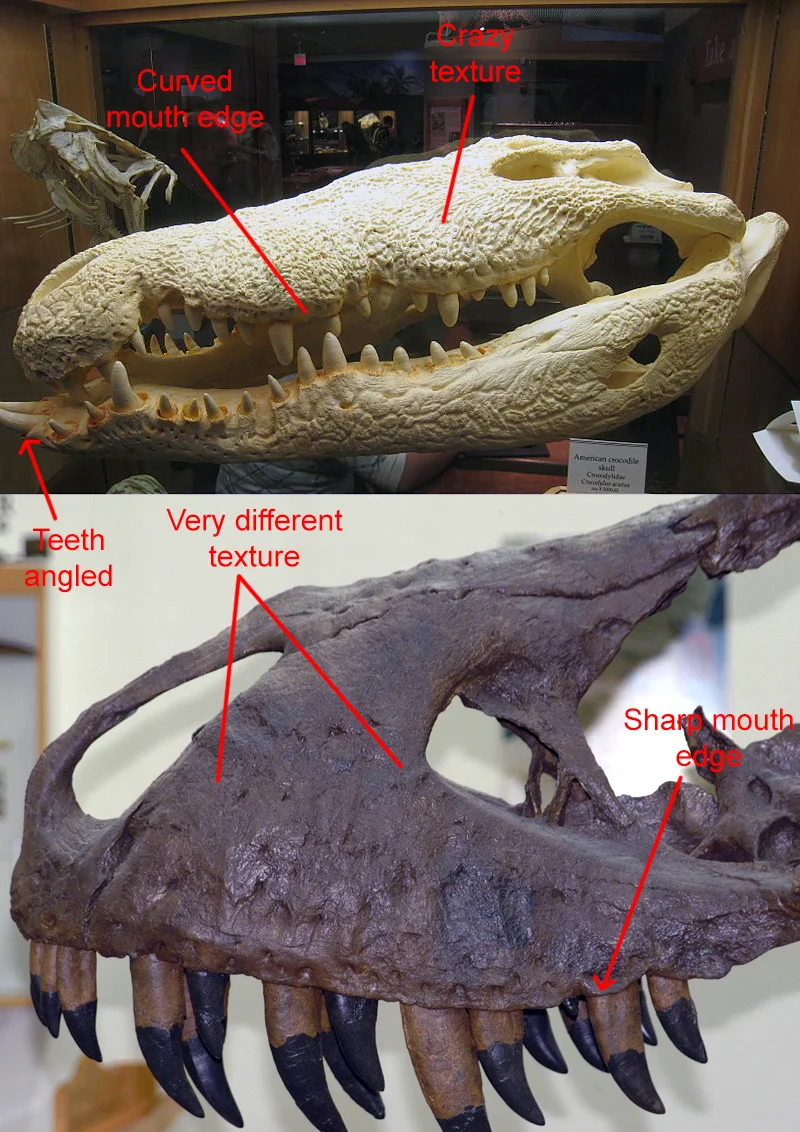
But non-bird theropods clearly have very different anatomy from living crocodiles and alligators, in almost every way you can examine their oral and facial anatomy. If you look at how the edge of the mouth is formed, crocs have upper tooth rows that are set in from a gently curving mouth edge (because that edge doesn’t support lips) and their lower teeth often interdigitate between or even protrude to the outside of their upper teeth (their lower teeth also frequently point laterally or anteriorly…because there are no lips to get in the way). That doesn’t look anything like most non-avian theropod tooth rows, which are set close to a sharp-rimmed outer edges of the mouth (the kinds that lips could grow from) and their lower teeth are either inline with or set to the inside of the upper tooth row (and their lower teeth are not oriented sideways or otherwise angled into the area where lips would be). I’ve highlighted some of these differences in the adjacent photos.
Given that basically all of the anatomy associated with liplessness in crocs is absent (and generally in direct opposition) it would seem a Type III inference is easily made from the preponderance of evidence. I would also argue that this shouldn’t be unexpected once you take a broader phylogenetic look at the distribution of lips in tetrapods (land vertebrates). Lips are extremely common in tetrapods. Mammals, living amphibians, tuataras and lizards/snakes all have lips, which suggests having lips is actually the default condition while losing lips is the less-common and more specialized scenario. Note that both amphibians and lizards share with non-avian theropods similar edge-of-the-mouth and tooth orientation anatomy as described above, further strengthening the connection between lips and mouth anatomy.
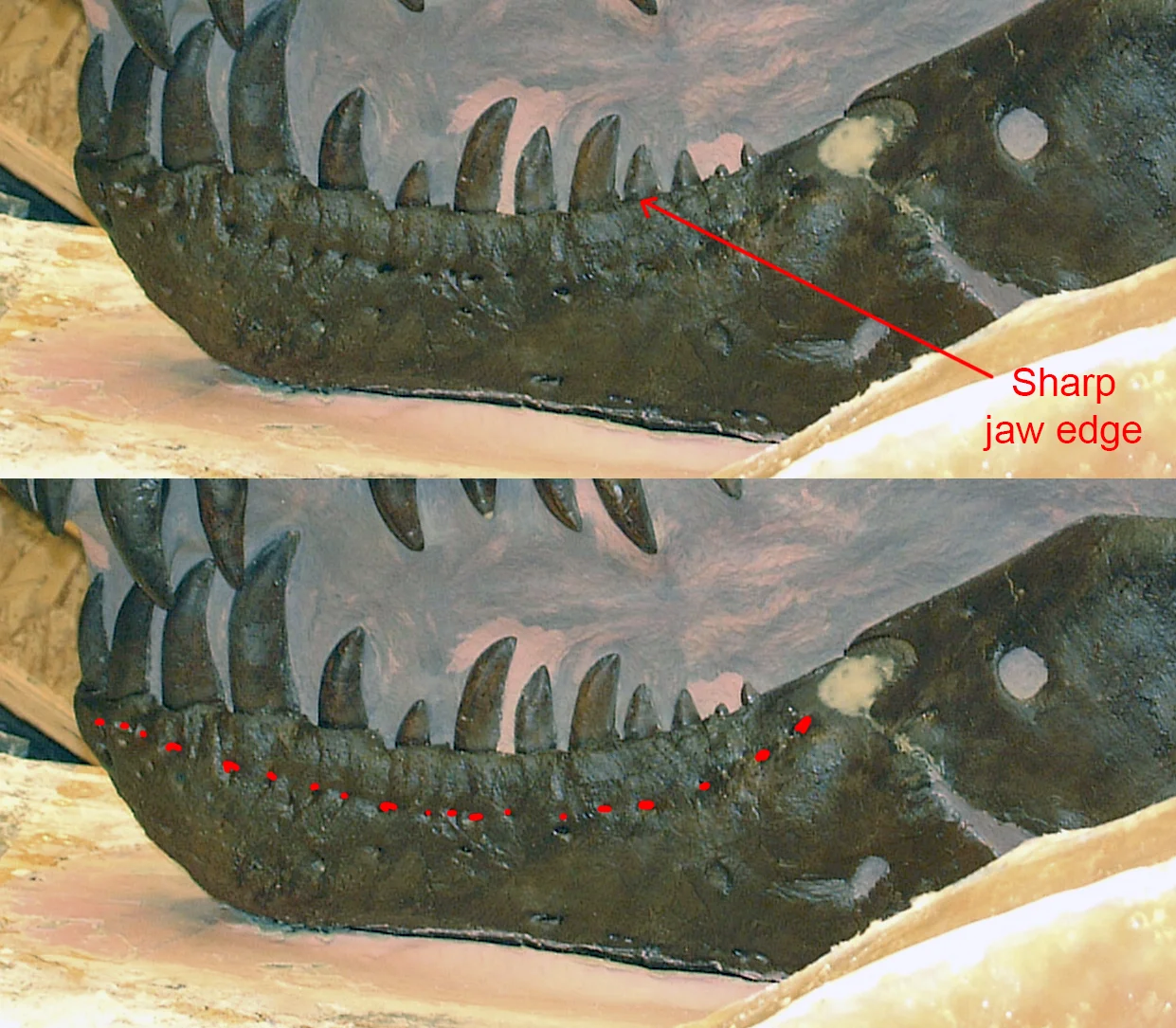
But what of the foramina and textured surface of facial bones in tyrannosaurs? This has been addressed in greater depth by another Mark Witton blog post as well as by Duane Nash, but in short while Carr and coauthors do a lot of good work correlating bony surface textures to different skin types on the face of D. horneri, I don’t believe they make a convincing case that the highly sculpted facial texture of crocodilians (which Duane points out is seen in several other aquatic predators) is similar to the texture seen on theropod facial bones, even in tyrannosaurs (whose facial bones tend to be more textured than most theropods). That crocodile-like texturing also fails to show up on the lower jaw of theropods (unlike crocs), where there is instead a row of foramina (holes) that seem to gently curve down where the largest upper teeth would go when the mouth closes - if this supported the bottom of the lower lips it would form a tooth pocket for the upper teeth. Needless to say this foramina pattern is not seen in crocodilians. In theropods with particularly large differences in upper tooth length (as in tyrannosaurs, which have large maxillary teeth but much smaller premaxillary teeth) the change in the depth of the tooth-pocket on the mandible can be quite striking (see photo below).
I find this comparative anatomy compelling on its own. But in the last decade there was also an excellent quantitative investigation of facial foramina by Ashley Morhardt. For her masters degree Ashley statistically analyzed foramina in living tetrapods, testing for correlations with their extra-oral soft-tissue structures, and then comparing the results to the foramina of dinosaurs.
Unfortunately, as often happens her Master’s work hasn’t been published yet in a peer-reviewed journal (by the way, Ashley’s PhD work researching brain cases and paleoneurology at the Witmer lab has also been top notch, but that’s not today’s topic!). But Ashley’s Master’s thesis is online for anyone who wants to read it, and she presented her results at several scientific conferences. Since it’s unpublished I won’t detail the entire thing here, but it definitely supports fleshy extra-oral soft-tissues in dinosaurs rather than crocodile-like lipless smiles.
In summary: When looking at tetrapods as a whole, having lips is the normal condition while losing lips is a weird/specialized condition. Most non-avian theropods obviously don’t the same oral anatomy as their beaked living avian descendants, but they just as clearly lack the anatomical features we see in lipless living crocodilians - their bottom teeth are not oriented like crocs, the edges of their mouths look very different, the textures on their facial bones are not the same, they appear to have lip-pockets on their lower jaws and when modern quantitative techniques are applied to toothed theropod foramina they match up with animals that also have lips, not with crocodiles or birds. There may not be a scientific consensus yet, but with the currently available evidence I consider lipped theropods to be the overwhelming favorite.
Yeah, but why now?
This is actually a trick question - I started making these changes almost a year ago, and started making them in earnest about six months ago. I’d hoped to write about it over the holiday break, but I ran out of time. What can I say, it takes time to make these updates! Even as this post goes live I’ll only have about ~50% of my skeletals updated in the theropod skeletal gallery. How best to portray the lips on my theropod skeletals is something I’ve been actively wrestling for a while. I had previously convinced myself that while most theropods had lips, maybe I didn’t have to go back and change all of my skeletals if the lips were small enough and/or flexible enough to move out of the way in side view. But getting a close-up look at other lipped reptiles showed this was very unlikely, and moreover many paleoartists (including myself in the past) had followed the insufficient lips on my skeletals in life reconstructions, leaving those theropods in a state of halfsies - not quite a crocodile smile, but not a plausible set of lips either. So it was time to update.
So, white teeth?
As some alert readers guessed, one of the reasons I wrote my post on the problem with outlines in scientific illustrations was because the teeth are going to be impacted. In the past I’ve only drawn theropod teeth in black, to avoid exaggerating their size. Because I’m switching to lipped theropods, most or all of their teeth are going to be behind the lips in side view - so if I left them black they would essentially be invisible. That won’t work, so I’ve had to go back and illustrate them all in white. That works fine for smaller-toothed theropods, but some of the larger-toothed skeletals still have the tips of their teeth poking out past the lips. Which puts me in the very uncomfortable position of having to place an outline around the teeth where they stick out, potentially exaggerating the size of the teeth. To all the paleoartists out there, please resist the urge to make the teeth extend all the way to the outside of that black line - they weren’t that large in life!
OK, so what did theropod lips look like?
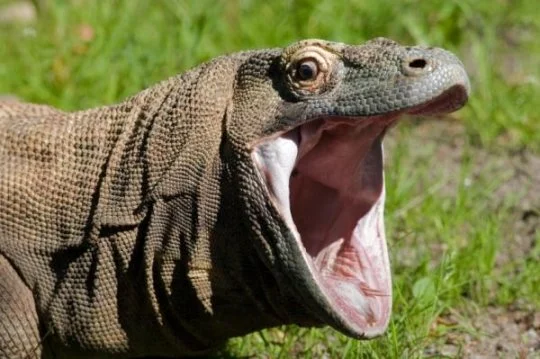
Even if you now agree that lips are by far the most likely condition for theropods there is still the problem of how to go about restoring them. How large were the lips? How visible would the teeth have been in life? Obviously we can rule out muscular, mammal-like lips but after that there’s still a decent range of variation to choose from. This will be the topic of my second lips post, but as food for thought (or something to worry about) check out this image of a Komodo dragon with its mouth wide open in a threat display. See any teeth? Neither do I, but I assure you they’re there, they’re just totally hidden behind lips and gums.
This post was brought to you by Permia
This post is supported by the good folks at Permia. Permia products are the result of self-described paleo super-fans collaborating with paleontologists and artists to create uniquely high-quality clothes and collectibles. I can tell you from personal experience that they never compromise on scientific accuracy, and now they have been so generous as to support posts on general interest paleontology topics. Check them out here: www.permia.com
60 comments
I usually model animals with lips, except for spinosaurids
Yeah, I tossed in "most" a few times because spinosaurs seem to be doing their own thing. I also have thoughts the premaxillary soft-tissues of more basal theropods, but that's all for the next blog post, this is just making the general case.
Then again, on one hand there are some eels with insane fangs and seem to have no trouble with "lips" The pike eel shows remarkable convergence in snout morphology having both the rosettes and the "notch" between the maxilla and premaxilla. It even shares a similar bone texture with the tip of the snout. In some photos of the living animal there is even what appears to be a pocket for the teeth. On the other hand there are eels with bunches of sicko knives for teeth and no lips.
Excellent point. The lips on the anterior end of a pike eel do look a bit reduced in size (that is, they follow the jaw shape more closely, perhaps to expose the teeth in use...though they easily cover them up when the mouth is closed).
yessssss!
Yeah this is pretty epic
But hartsman... Good luck finding neovascular distribution for these witton proposed lips under a ct scan or Saurian for that matter
https://www.livescience.com...
""The issue of dinosaur lips has been confusing for some time," Holtz told Live Science in an email. "[But] in tyrannosaurs, particularly the big specialized ones, the roughened, slightly inflated surface of the bones along the edges of the jaw does not resemble the quality of bone in lipped lizards. It does indeed more closely resemble the condition in lipless crocodilians."
Tyrannosaurine maxillae really do something different from most non-avian theropods with their texture (and with their foramina count). Maybe if the only choices are completely smooth maxillae and croc maxillae I would agree, but when you look at the details they don't look very much like the texture in crocodilians (and several other aquatic predators, as Duane Nash correctly pointed out). And I'm not alone on this. Note that the mandible of tyrannosaurs doesn't have any particular texture (unlike crocs and alligators). I do wonder (and will discuss a bit more in the second post) whether T. rex had a more cornified skin along most of the maxilla, but notably (as also pointed out by Mark Witton) that texture stops before the bottom of the maxilla, which is smooth and sharp-edged, just like other lip-bearing organisms. So while tyrannosaurs are doing something a little different from other toothed theropods, it doesn't look much like what we see in crocs and alligators.
https://www.facebook.com/wi...
Not only Tom well reputed Witmer aswell and Ericson.
And to be honest Wittons whole idea is quite poorly based when we are going into details.
https://www.sciencedaily.co...
Although I agree that Witmer, Ericson, and Holtz are usually people whose side I find myself on, I do not agree with them on this. In particular not enough weight has been given to the actual mouth anatomy and tooth orientation - tyrannosaur mouths in cross-section look nothing like crocs and alligators, and exactly like other lipped tetrapods. I do not agree that Witton's idea is "poorly based" - I'm not saying his correlations between epidermis type and bone surface texture are necessarily 100% correct (whose work is?), but in particular his point that the maxillary texture doesn't extend to the edge of the mouth is spot-on, and once again unlike crocs and alligators.
Also, though I realize Dr. Morhardt's work is currently only available as a Ms thesis and in conference presentations, I've seen both and the results are impressive (and the only quantification attempt so far). Everyone is getting up in arms over surface texture in tyrannosaurs, but A) most toothed theropods don't look like that, B) they are ignoring contradictory anatomy AND contradictory surface texture data, and C) the quantitative data also doesn't support lipless theropods.
We simply dont know what it correlates to since all we basing the correlates of the skin present on the bones Carr and his authors claims for a crocodile "like apperance" and Witton is proposing a different epidermal scales? But as for now we dont have a definit answer.
Literally what Tom said about Lizards with a simple back to back comparsion shows major differences along the edge of the mouth in lizards you have a smooth band wich indiciates something could be anchored.
But what we do know is that a set of lips need to be fed by blood supply If you have acess to any Tyrannosaur material i think you should make a measurement of how much "plausible" extra tissue that would be needed to cover the largest digits in the cranium top and bot, 7-8-9 inches. But back to what the ct scan reveals the neovascular distribution is aligned with the gums and roots no further extension of the branches is there to support any extra additional tissue.
It's nowhere close to 7 inches - like most theropod skulls the teeth of tyrannosaurs frequently slip out (or are prepped out) of their sockets in death, and the over-sized teeth you see in many casts are simply that (some casts seem to have teeth purposely inserted with huge exposed roots back into empty sockets, presumably to make it look toothier). The resulting 4-5 inches of tooth crowns may have been able to slip somewhat into the lower jaw tooth pocket, further reducing the necessary lip size. Also, Morhardt's measurements show that tyrannosaurs actually have more foramina on average than normal theropods, not less.
And finally, there simply IS a smooth, sharp edge on the maxilla of tyrannosaurs below the row of foramina. You can see it in the photos I posted here, or by Googling it. It's admittedly not as extensive as we see in many lizards, but it's also not at all like extant crocodilians.
Its seems to be a misconception about Carr et al or what Tom and Larry. - they never said its like crocs wrapped around the tooths they inferences a model basaed on EPB to the closest living relative as you know. They basically implying that hypsensitivity "as in crocs" with some sort of tissue covering the gums not to the extension of Mark or Saurians. But dont take my word for it you should talk with them.
I believe that a very thin set of lips along the margin top and bot is very resonable.
If you refering to Stan BHI 3033 Stan is not at all reconstructed with the tooths hanging out of the socket due to slippage its new teeths coming confirmed by Peter the other day.
But any kind of tissue needs blood supply for Tyrannosaurs there is none period and ct scan revealed this. The density of foraminas is not the "issue" it all comes back to the amount of extra tissue being proposed and how this would be nourished.
Larrys work some years aback about vascular pattern it is completely different to Tyrannosaurs and other major theropods https://www.ncbi.nlm.nih.go...
Sorry, but I've seen many (and assembled one) Stan skull, and I simply cannot agree that the teeth are in a natural position. They may be in the position they were found in during excavation but the amount of root exposed is simply unreasonable compared to any extant taxa. And again, comparative AND quantitative studies show that animals with lips have less bone-bounded blood flow (foramina) than e.g. beaks. Many lizards (and basically all mammals...despite their muscled cheeks) have if anything less bone-bounded vascularization of the lips than we see in theropods. Also, I don't know what you think I do for a living but I've spoken repeatedly with all of these people for decades - the fact that I don't agree has nothing to do with being unaware of their opinions. I'm not saying you need to agree with me, but continuing to name drop my colleagues like that in and of itself is persuasive is just wrong.
Agree to disagree. Everybody are entitled to their own opinion. And it was no my intention to insult you by writing your collegues names.
As I report in my book, research paper, there are several teeth in Stan that have the replacement teeth pushing the teeth out. You can not push the teeth back lower, it is impossible. I've been studying Stan for a decade. I've talked to Neal and Pete Larson about this. Also, Witmer has x-rayed the type maxilla of Tyrannosaurus and has found the same thing.
Come on Tracy - I've been studying Stan since I mounted a disarticulated skull cast For the Tate Museum from scratch in 1997, and I've also talked to the Larson's about this issue - none of that is evidence, it's just silly arguments from authority. You are correct that some of Stan's teeth have replacement teeth visible, but that's not evidence that they aren't slipped out (and obviously being unable to push the teeth back in when the space would be infilled is also not evidence). The visibility of the replacement tooth crown is potentially good evidence that both have slipped after death; it's awfully rare among extant animals for a replacement crown to be exposed above the alveolar bone to any degree without pushing the tooth above out (let alone several!). We'd need good CT data on the mandible or maxilla of Stan showing that the tooth roots were taking up all the room in their alveoli to accept that extraordinary claim. I've heard that Witmer has X-rayed the CM 9380, which is great and I look forward to hopefully being convinced by it, but note that none of the teeth in the type maxilla are as protruding as the slipped teeth in Stan.
And premaxilla and nasals. The size of those foramina are larger than other theropods and crocodilians. Something is going on..
Yes, Stan is different, and something is going on, something I've been trying to write up for decades. Stan is not the norm...but it does emphases the teeth.
Well we have good working hypotheses for the fused nasals (strength and torsion resistance). The premaxillae of plenty of theropods are actually a bit different than what the maxillary foramina look like IMO. But I do think it's possibly tyrannosaurs were keratinizing/cornifying more of their facial epidermis - they just lack the oral anatomy seen in crocs, so whatever it was it was not that.
It only emphasizes the teeth if the teeth are in a natural position. I know that's what you think, but so far nothing you (or Pete, or anyone else so far) has published has me convinced. To be clear, even IF Stan's teeth are all in their natural position that doesn't impact my view on lips (it would just make tyrannosaurs more like hybrids between big-toothed monitors and non-monitor lizards with overbites in terms of how they closed their mouths) - the reason I doubt the teeth are in their natural place is A) few if any modern analogs exist for such hyper-exposed roots beyond the alveolar range, B) I doubt their gum line was so ridiculously uneven (and/or that the smaller teeth were totally covered in super-thick gingiva), and C) having teeth with their roots so far out of their sockets without half-foot gingiva would have almost certainly resulted in massive injury the first time it bit anything that applied a hint of torque. That said, I would definitely look forward to your take on what is going on pathologically with Stan's mandible, etc.
I have published, illustrated, photographed Stan's teeth in my recent paper. Until you read it...
Glad you are posting this. Can't wait for the second part. Aesthetically speaking, its kind of the same story when T.rexes were being feathered. There was a tremendous backlash, then acceptance. Now it seems to have flipped the other way! I think thats a good thing, as it will make people more critical of popular consensus vs. evidence. We just don't want anyone to mess with our beloved Tryannosaurus rex.
I like that back and forth. As an artist I enjoy getting to try out different interpretations of the evidence. There is definitely a psychological element to the reactions of it all. I think there tends to be a lot of resistance to anything that covers the skeletons to a large degree. All we have are the bones and as enthusiasts we are VERY familiar in an intimate way with the bones and the idea of burying them naturally makes people nervous "myself included". Are we adding too much or too little over the bones, are we interpreting the anatomy "correctly"? Of course, as artists we all pride ourselves on being as "accurate" as possible but staking out a claim and having war over it I have very little taste for. Honestly, I prefer an image that is fairly accurate but also has a beautiful composition and intrigues the viewer.
Only a suggestion, but would it be useful to make the backgrounds of your skeletals grey? That way the teeth could just be white, without a need for potentially confusing black outlines.
That's an interesting idea. It would mean more cost in print (and lower contrast everywhere) but that might not be a huge issue...especially with print becoming ever less common. It's something I'll have to think about.
Once I read somewhere that crocs do have beaks. Their snouts are covered by a keratinous sheath like a beak. Only in the case of crocs that keratin cracks as the croc grows. If crocs have neither lips nor beaks, what do they have then? And what are these crackings due to?
(They wrote my name in wrong order. I am Pedro Salas, not Salas Pedro)
Hi Pedro - it's true that crocs don't really have facial scales, their keratinized skin cracks as they grow. Whether that should be considered a beak, or its own thing is a valid question, but that doesn't change my other interpretations.
I know that doesn't change your point. I just wanted to get things clear about the case of crocs specifically. Now, regarding the main issue, I'd like to know your opinion on a argument I've seen some hold in favor of no lips which is the holes in the palate of certain theropods coinciding with the position of their lower teeth and suggest a very tight closing of jaws.
The degree of overbite is very interesting, and something I'll address in my next post, but I'll note that overbites are found in other taxa that have lips (including you, many non-varanoid lizards, and some fish and amphibians).
Yes, I acknowledge I have an overbite too ;)
I'm looking forward your next post!
I think nearly everyone forgets about one thing when it comes to this issue, which is that the lower jaw of non-avian theropod dinosaurs is considerably thinner than the upper jaw, more so than what we see in animals with lips today.
Which animals? I don't agree, but I'm curious which ones you are talking about.
Every single theropod for one....
Just one example, but most theropods are like this too: https://qilong.wordpress.co...
https://qilong.wordpress.co...
Oh sorry, I meant which lipped taxa do you think uniformly have thick jaws? Because there are lots (lots!) of lipped species with thin jaws.
Well, the example put in the article (Komodo dragon) has a lower jaw that is barely thinner than the upper jaw, for example. I guess it's the same in most, if not all monitor lizards.
It's highly variable among squamates. Some are almost inline, some have mandibles quite a bit narrower than their upper tooth row. Also, note that crocs (which are basically the only tetrapods in existence with teeth and no lips) do not have an overbite - so why anyone would think that having an overbite is a problem with having lips is beyond me.
No lips at all in theropods. You can read my latest research, scientific article, and it is peer reviewed, at http://www.lulu.com/shop/tr... I'm self publishing so I hopefully get some funding for my research.
I included you in the opposition for a reason!
Thanks, but have you read my most recent work?
I've kept up with all of your web/PT/conference work. I haven't read your new $25 publication on the subject because, to be frank, I don't currently have $25 I can throw at it. Perhaps next fall after SVP (or before then if I am unable to go). But I'm not convinced so far.
I totally understand the money problem, which is why I'm trying to sell it so I can have money for research. However, it does address a lot of what you wrote about...and on a side note you might get Greg Paul pissed at you...you need to read Prehistoric Times Magazine...
I read Greg's article - that's why I mentioned it in my post. It'll get mentioned (and not always agreed with) in the next one as well. Also, best of luck with your sales - it's definitely challenging to find alternative funding pathways.
Scott, don't worry about having to draw extensive lips to cover the teeth of the theropods with the longest teeth: as most paleontologists never stop repeating, the skulls of theropods have teeth with all their roots out, while in real life the tooth was way more inside the jaw bones than usually thought. This makes most theropods have much smaller teeth, and most importantly thanks to this discovery, the teeth of the upper jaw never go beyond the set of lower foramina in the lower jaw, just like it should be. Not even Ceratosaurus. So when you watch a theropod's tooth, it's only the very end of it, the curved part, that is the visible part of the tooth in real life, while the upper, straight section is the tooth root, and that was never visible. The roots usually come out of their sockets because during fossilization the skull gets compressed and deformed by sediments, and without muscles and tissues to keep them in place, the teeth come out.
Yes, that's very true. But it still took me a long time to update all my skeletals (regardless of tooth length) and it's still an ongoing process.
Excellent and refreshing read, Scott! It has a quality that I really admire in your work: it is didactic! I looked forward for this post, and now look for the part 2 :)
Thanks Vitor, I try to make these posts both something I'd have wanted to read when I was younger but also something I approve as an instructor. I'm sure I get the mixture wrong sometimes, so I appreciate hearing when it works for someone!
Hi Scott your thoughts on long headline Complex neuroanatomy in the rostrum of the Isle of Wight theropod Neovenator saleriiComplex neuroanatomy in the rostrum of the Isle of Wight theropod Neovenator salerii?
I think the pattern is being recovered not only for Spinosaurids and in this case Neovenator with the presence of the trigeminal nerve Carr et al came to similar result. I observed the rugosity pattern on my maxilla and i came to similar conclusion as the author of Carr et al the overall the shape and form of the maxilla along the edge of the alveloar process is not built similar to crocs but i think there is alot of sidenotes that needs to be touched upon. The shape of the cranium the differences between them and squatmates and croc included i think the monophyletic group is the most parsimonus reconstruction.
We know crocs settles in for winter hibernation without deegrading their teeths and that would be another interesting key for some future studies.
i think it is important to see them as animals, they would need to sustain themself with alot of water to keep proper hydration even if they are terrestrial animals and that could be to moist the teeths i think there is alot of blind spots that needs further investigation
But my research and study would agree upon some sort of covering over gingiva perhaps as in the reconstruction made by Puléra for the Carr et al paper for horneri but definitly not a entirely exposed gum or root.
Thanks for good reading.
Hi Mikael,
First off, the trigeminal is what allows animals with lips to feel - they are not incompatible with lips! Second, in the Neovenator paper in particular it's not just neuroanatomy, it's neurovascular anatomy. In particular Barker et al note that the maxillary branching canals almost certainly include the subnarial artery and maxillary canals. In the discussion the authors express some confusion about the role of vascularization in the maxilla since the foramina are laid out anteroposteriorly along the bottom of the maxilla (thus not taking advantage of the full height of the maxilla for thermal exchange). That is indeed weird if you assume thermal exchange was the main role, but if providing blood flow (not to mention innervation) to maxillary lips was the main purpose then the anatomy they report makes perfect sense.
Anyhow, I'll have more to say soon, but the neurovascular pattern of theropod maxillae look as I'd expect them to if they supported lips.
I am on the edge jumping between a set of osteological correlates scales be it Carr et al "croc apperance hypotethis" or another form av scales along the edge of the alveloar process being nurished by these vessels.
But if lips would be present i think a very thin set would be the most logical hense i feel the variations being proposed is in certain cases pushing the limits.
But i also have to examine further craniums to draw a fair conclusion. I exhanged a few words some months back with Lawrence i think he will have some interesting data to add to the topic.
Looking forward to the second post thanks for the reply.
Theropods are not lizards, they are closer to Crocodilians and Birds. How the jaws close is different from lizards and theropods, the soft tissue is different. All addressed in my research paper.
Of course they aren't lizards - not even all lizards have the same type of lips (or the same degree of overbite, etc.). But not even basal crocodilians look like living crocs, and tyrannosaurs don't look almost anything like them when it comes to oral anatomy.
Hi Scott,
Great post and a lovely read, looking forward to part II! I have a question regarding how you depict teeth however, what about grey? You've stated you dislike the lines around skeletal elements, would a grey not provide a good third option? Your works as of now are limited to a palette consisting of only white and black. A grey would seperate the teeth from both the bones and the soft tissue and remove the need for the black lines you've talked about before. The only place your images contain grey is within the rigorous version, which is usually omitted in your more recent works. Even with a rigorous skeleton however you could use differing shades for teeth and missing elements. As long as they are distinguished enough to not be confused. I've made a quick and rough concept version to illustrate a possible palette. Link: https://sta.sh/0xly891r27b
Keep up the good work!
I was wondering if you could do a Beak post eventually,now that we have beak material from a Hadrosaur?
Why don't you make the black outlines for the larger teeth inset, so the outer edge of the outline is the actual tooth edge? Maybe play with it to see what works best.
Doctor Hartman,I was wondering if the lack of presence of blood vessels might be a bad argument for or against lips.My concern is that the complex nerve anatomy of crocodile skin on their faces might make a complex vascular system nescessary for Crocodiles as well.
I could of course be wrong,what do think?
Great article,as always.Really got a lot of comments.
I went to the Utah Museum of Natural History the other day and I was pleasantly surprised to see your skeletals all over the Past Worlds exhibit. I was even more surprised to see the mount of Anzu straight out of this very website!Awesome! Good job! The baby Allosaurs and Big All were right out of your skeletals too! Great job,keep up the good work!
This is late of me but I do find it surprising that Carr et al 2017 only examined 1 crocodilian species (American alligator) in their study whilst using several birds by comparison. I mean I guess its understandable given their skulls are a bit smoother than many actual crocodiles but I feel that if they used multiple different crocodilians for comparison it'd become quickly clear that the textures present on the maxillary regions are not "identical" to tyrannosaurs and that we're looking at different patterns of ossification here.
Anyway you might find this helpful and cool to read for your next post if you haven't seen it already. In Chapter 7 of the book Tyler Keillor gives an interestingly detailed perspective on the question of theropod lips (more specifically on tyrannosaurs). He also seems to address the "issues" many have brought to the table for the hypothesis and a couple novel arguments not often brought up in such discussions (like jaw closure, palate structure differences between birds, dinosaurs and crocs etc.) https://ia601002.us.archive...
Join the discussion
Thanks — your comment is in the queue!
It'll appear here in about 5–10 minutes, once I've approved it — you'll need to refresh the page to see it. (Comments don't post instantly anymore.)