The hadrosaur repose of 2018
November 30, 2018
Long-time dinosaur skeletal fans may recall that I undertook a long-term project of reposing all of my skeletals back in 2011. That year I managed to update all of my bipedal skeletals (theropods, “prosauropods” and some of the runtier ornithischians). In 2014 I followed that up by reposing and updating all of my sauropod skeletals. My armored dinosaur skeletals have gotten pose updates in a piecemeal fashion, but today I’m unveiling another major overhaul: Hadrosaurs.
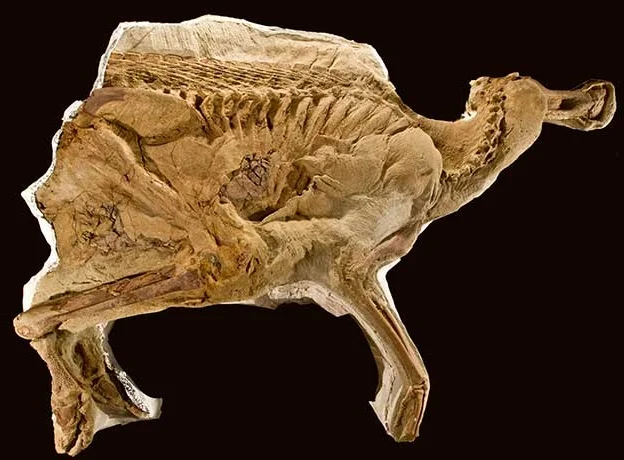
I don’t have as many hadrosaurs skeletals as some other groups of dinosaurs, but there was quite a bit to do for each skeletal. In addition to modifying the gait to more of a sedate walk pose (from the more hustling one I’d adopted from Greg Paul decades ago), there were major anatomical and stance changes that needed to be made. For starters, I’d been illustrating the forelimbs with too much pronation. Both articulated specimens and hadrosaur trackways show that the ‘palms’ faced more inward (somewhere around 45 degrees) rather than facing backwards, as in most quadrupedal mammals. This meant redrawing the hands, wrists, and lower arm bones (ulna and radius) for each specimen.
But the changes didn’t stop there! Many of my older skeletals (prior to 2014) also had the pectoral girdle placement and orientation subtle wrong. Fixing this wasn’t as simple as moving the pectoral girdle, as the change impacts the entire orientation of the body. Because the forelimbs can’t move down any lower (they’re already on the ground!) changing their relative position forces the torso to tilt up, and like a teeter-totter the tail has to tilt down at the same time. That turns out to be a very good thing for functional reasons (I’ll have more to say on that soon), but it also means having to overhaul almost the entire skeletal.
Here’s an example of how that looks with Parasaurolophus cyrtocristatus:
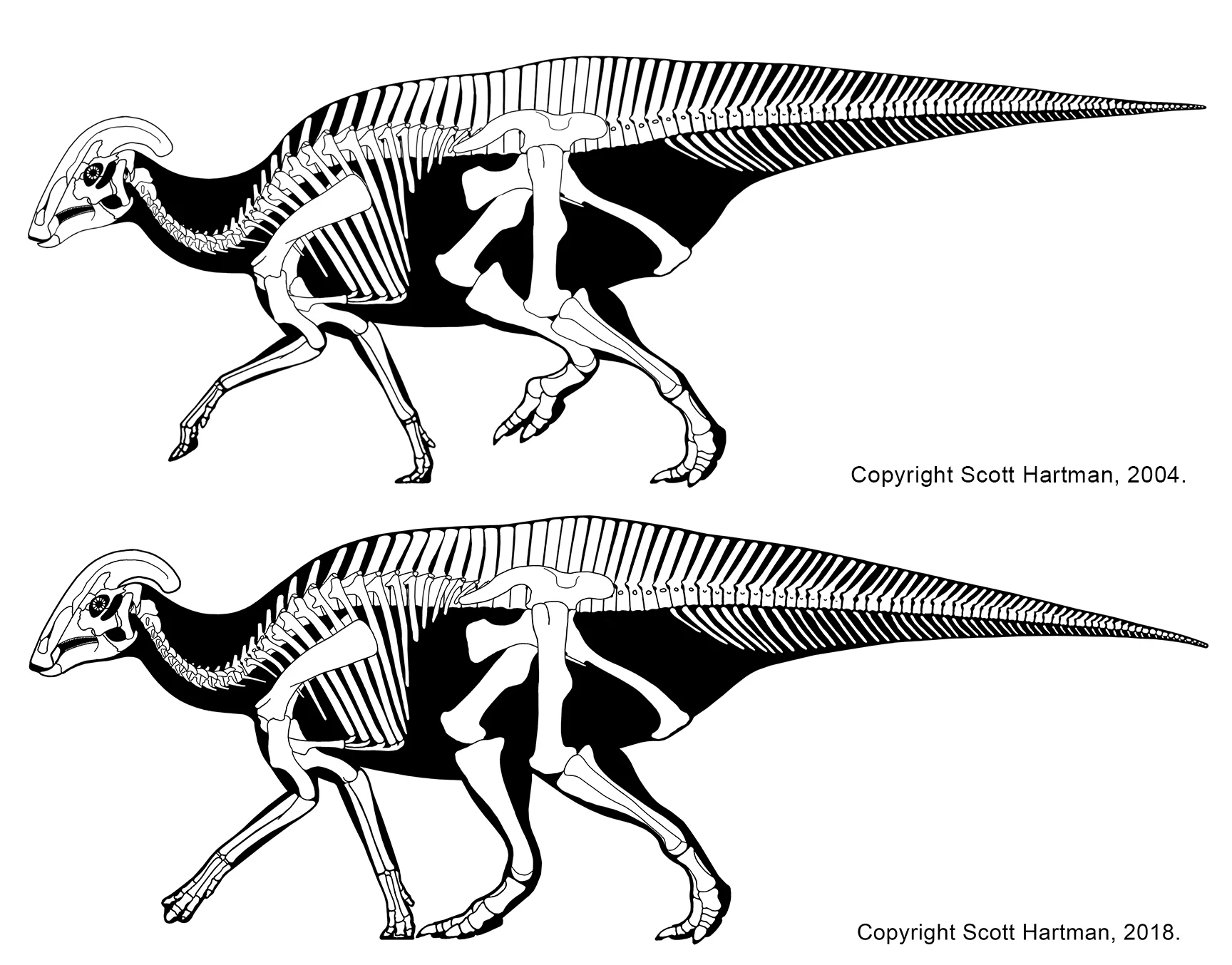
Depending on the age of the skeletal several other smaller updates were also done - keratinous upper beaks have been extended to match recent discoveries, tendon thickness was increased, and tails have become more heavily muscled. The updated hadrosaur skeletals are now live in the Ornithischian Skeletal Gallery, if you want to take a look.
9 comments
The I guess more horizontal pose in these updated skeletals certainly looks a lot less ungainly and more intuitive. The little baby Hypacrosaurus is adorable.
I have a question though; in your Brachylophosaurus skeletal you have restored the soft-tissue spines that ran down the back, but for Edmontosaurus you have not restored the soft-tissue head crest. Is this an oversight or for some other reason?
No good reason - I spent a lot of time with the Brachylophosaurus specimens and got to restore the spines right from them. I haven't drawn it for Edmontosaurus yet, but I also didn't have additional time to devote to this and didn't want to delay posting them. /shrug
What was the source of the no pronation for Dinosaurs paradigm?Does it really apply to Hadrosaurs?
Because the radius emerges from the lateral condyle of the humerus, the only way to pronate your hand around like a mammal is to literally rotate the radius around its long axis so that the distal end flips over the ulna. Animals that can do this have specific adaptations to enable it (it's not the primitive condition for tetrapod ancestors) and dinosaurs lack any adaptation that would enable it fully (though many of the ornithischians quadrupeds plus sauropods seem to get to a 45 degree angle or so - just not a full crawling-human or elephant degree of pronation). It definitely applies to hadrosaurs - not just the articulated skeletons (and "mummies") but the track ways also show it.
So,does this derail the Neornith/Coelurosaur evolutionary sequence?The inability to pronate the arms,I mean.
Criticism aside,I love the new repose,plus,I noticed that a new skeletal of Eoplocephalus was on display in your gallery.
Thanks! There are a few things creeping into the site - not everything gets a blog post ;)
I have a question: Do you think Hadrosaurs are more likely to be fast given what we know about the large Caudioformalis muscles on the Leonardo specimen,or does that make no difference in your estimates?
It looks a lot more natural
Join the discussion
Thanks — your comment is in the queue!
It'll appear here in about 5–10 minutes, once I've approved it — you'll need to refresh the page to see it. (Comments don't post instantly anymore.)