The biggest of the big
June 14, 2013
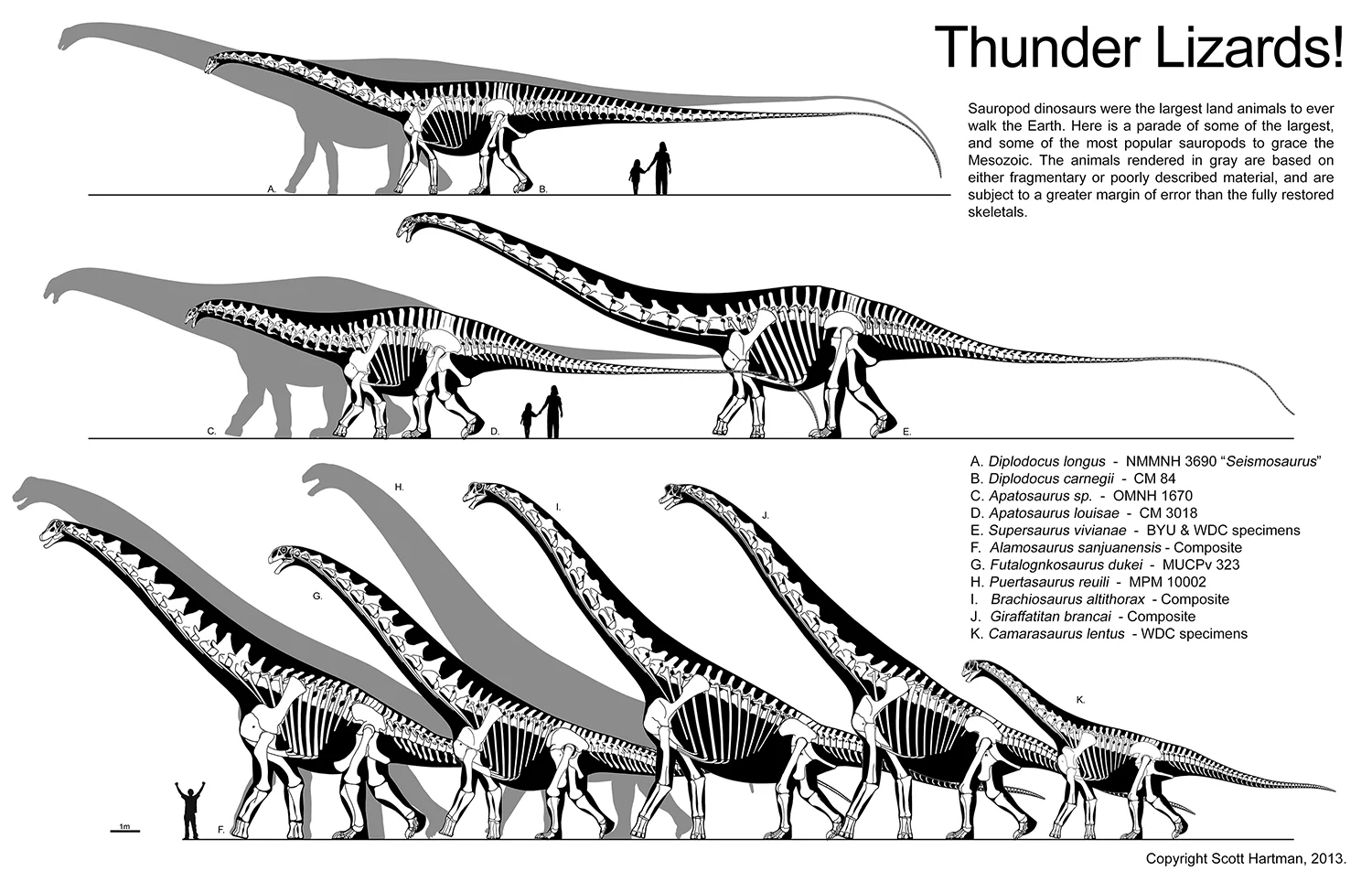
I don’t know if that grabs your attention, but sorting out the size of giant sauropods sure grabs mine. Let’s take a more detailed look at some of the critters in this image:
First off, I need to admit that this is not all inclusive. The legendary Amphicoelias fragillimus will never be included (unless more material is found). I have not sufficiently nailed down the scaling of Argentinosaurus yet to include it, but early scaling makes it look like it’s the same size or slightly smaller than Puertasaurus (which I did include).
Note that most of these animals are only known from a single specimen (and often quite incomplete skeletons at that), which means that we don’t really know what the size range of animals was in a living population. So keep in mind that while we can compare individual specimens, we can’t say with any certainty that the biggest skeleton really came from the biggest sauropod species.
Here are some other quick hits:
-
For personal reasons I love me some Supersaurus. I’ve scaled the reconstruction to the size of the WDC specimen (32m), though the type specimen may have reached 34m in length. Either way it’s the longest sauropod we can reasonably restore, though it certainly was not the heaviest (diplodocids tend to be fairly slab-sided compared to titanosaurs).
-
The large NMMNH Diplodocus specimen (originally named Seismosauru**s) is also very long (~30m) but probably even lighter in mass.
-
Diplodocids may rule the roost in length, but macronarians seems to (mostly) crush them in terms of mass. Puertasaurus is currently my reigning champion; filling in the (extensive) missing elements with other lognkosaur relatives leads to a 27 meter long animal that is clearly the heaviest of the group (I’ll speculate maybe in the 60-70 tonne range, but treat that as arm waving until it’s verified by volumetric or double integration analysis).
-
To elaborate on preliminary Argentinosaurus results (not included above), it’s in the same size range as Puertasaurus, but basal titanosaurs may have had somewhat shorter tails (hence the smaller length) and the vertebrae aren’t quite as wide as Puertasaurus, so my best guesstimate is that it loses on both accounts to it’s lognkosaur relative, if only by a weeeee bit.
-
I didn’t include Paralititan but I did scale it (hey, there’s only so much space). It’s large, but appears to be somewhat smaller than the Dallas specimen of Alamosaurus.
-
Speaking of Alamosaurus, I spent a lot of time trying to sort out who had the biggest fragmentary remains between Fowler & Sullivan (2010) and Guzman-Gutierrez & Palomino-Sanchez (2006). The tibia from Mexico is easily biggest (see gray silhouette behind the main Alamosaurus), but foreground skeletal here is based on Fowler and Sullivan’s largest specimen (an isolated tail vertebrae) which happens to be from animal almost exactly the same size as the specimen on display at the Perot Museum of Nature and Science. Of course at this point we don’t know for sure if the mexican tibia is truly Alamosaurus, or something new.
-
Brachiosaurus has long been abandoned in discussions of who is the largest dinosaur, but I’m not sure that’s a good idea. The skeletal above is restored to the size of the type specimen, but some of the Utah specimens may be larger. The very broad-gutted Puertasaurus ekes out a larger size, but with such small sample sizes I don’t think Brachiosaurus can actually be ruled out at the species level.
-
On the other hand, the significantly less robust Giraffatitan probably can be ruled out despite being quite tall.
-
While titanosaurs are generally heavier than diplodocids, very large Apatosaurus specimensappear to fit comfortably in the same size class. In addition to the Oklahoma specimen I have seen a few other (unpublished) apatosaur specimens that at least rival it in size.

So there you have it. If you have any other questions hit me up in the comments section below.
9 comments
Nice job, Scott! Glad to see some independent confirmation that Futalognkosaurus was smaller than it was initially reported as, as I've suspected for a while.
A couple of nitpicks with #4 though with Argentionsaurus being smaller. The vertebrae of Argentinosaurus (when complete) would have been maybe 25-35 cm taller than in Puertasaurus, and the functional length of the dorsals of Argentinosaurus are all longer by at least 10 cm than the dorsal known from Puertasaurus. As for width, I believe all of the dorsals of Argentinosaurus have had their positions reinterpreted to more posterior positions, so there are no anterior ones known (see Salgado & Powell (2010)). In some titanosaurs, like Alamosaurus and Opisthocoelicaudia, the anterior dorsals can be dramatically wider than the mid- to posterior ones, so interpolating from that, the anterior dorsals of Argentinosaurus could be as wide as Puertasaurus, meaning that (at least in the torso) Argentinosaurus is slightly larger overall.
Also, several phylogenetic analyses have indicated that Argentinosaurus isn't quite as basal as once thought (see, for instance, Curry Rogers 2005 phylogenetic analysis that placed it as a saltasaur closer to Isisaurus and Antarctosaurus). I'm not sure that basal titanosaurs necessarily have a shorter tail, either. For instance, Rapetosaurus has one of the shortest tails I've seen on a titanosaur, and it is fairly derived. Also, Phuwiangosaurus, has a fairly long tail, and yet is placed as a basal titanosaur or somphospondylian (D'Emic has placed it as a euhelopid). Of course, this is all speculation since we don't have neck or tail verts for Argentinosaurus, but I wouldn't discount if from being larger than Puertasaurus.
Regarding #3: I did a multi-view skeletal of Alamosaurus, and although it came out different from yours in some details (like the leg proportions), I did a GDI and got a conservative 18.8 tonnes for a 17 meter individual. So your 23 meter Alamosaurus would be about 47 tonnes by my estimate. I estimated the individual based off of that large incomplete tibia at a shade under 27 meters, which would make it close to 75 tonnes (assuming similar proportions of course). So I think your estimate of 60-70 tonnes for a 27 m Puertasaurus is quite good, although maybe on the low end.
I wish I had some multi-view skeletals of diplodocids, other than Greg Paul's, do do GDI's off. I'd do my own, but I've had a hard time finding quality papers (other than Google book scans which mess up the plates badly) describing diplodocids in detail, with the appropriate figures.
Oops. "do do" in the second to last line should be "to do".
Thanks for the comments Zach. You may end up being correct on Argentinosaurus, that's why I called it preliminary (if I was sure it would have been in the chart!). Either way they are going to be close enough that we really have no idea which species got larger (given the utter lack of knowledge of wear these individual specimens should end up on their respective bell curves).
I don't really believe other people's cross-scaling until I check it, so I'll have to abstain from commenting on the tail of Phuwiangosaurus for the time being. Also I'm pretty skeptical of the more derived position that Currie-Rodgers recovered for Argentinosaurus in the 2005 paper. Mind you I'm not arguing that all derived titanosaurs would have long tails, just that somewhere at the base of the tree those tails should be shorter.
I have a post coming up about the ridiculously large Alamosaurus tibia, and I actually got closer to 30 meters, although you and I restore somewhat different limb proportions. Your mass estimates are about what I've been guestimating, and it looks to me like that 60-to-say-75 ton range may be the top for very large titanosaurs (at least those known).
Thanks again for the thoughtful commentss; there's more to come!
Another giant you may want to consider is Sauroposeidon, which is widely sited as the tallest dinosaur - I personally wonder how heavy they would be, as they may be considered as a intermediate form between the bulky late titanosaurs and the "gracile" branchiosaurs. Another candidate to be included in this club might be the Mamenchisaurus. Similar to the case of Diplodocus, these early sauropods are not particularly heavy due to their weird body proportion. But the length of M. sinocanadorum is the stuff of legend, and I believe their fossils are rather complete.
Scaling for me yields ~67.5 tons for a ~30 meter Alamosaurus. Does that seem about right?
I wonder where BYU 9024 fits on this list.
So how does mamenchisaurus fit into this scale? It obviously isn't competing for the heaviest saurapod but I would think it at least would make the Lindt for length
If we're talking the biggest of the big, why not Camarasaurus supremus instead of C. lentus?
Hi,
Amphicoelias fragillimus has been assigned to Rebbachisauridae based on comparisons with rebbachisaurid taxa and renamed Maraapunisaurus by Carpenter (2018), who revised the size estimate of fragillimus to 99-104 feet (30-32 meters). This new size estimate makes sense because Woodruff and Fowler (2015) consider the idea of a mega-sauropod weighing over 122,400 kg a biological impossibility, and known mega-sauropods are about 110-120 feet long (Diplodocus hallorum [aka Seismosaurus] was long thought to have been 150-170 feet long, but that size estimate was later reduced to 110 feet). Even with these new size estimate, Maraapunisaurus is still a monster sauropod compared to other rebbachisaurids.
As for Diplodocus, Tschopp et al. (2015) restrict Diplodocus longus to the holotype due to limited diagnostic value of the species within Diplodocus, and refer the Dinosaur National Monument specimens of Diplodocus to D. hallorum, in which case the diagram should label NMMNH P-3690 as Diplodocus hallorum.
Carpenter, Kenneth (2018). "Maraapunisaurus fragillimus, N.G. (formerly Amphicoelias fragillimus), a basal Rebbachisaurid from the Morrison Formation (Upper Jurassic) of Colorado". Geology of the Intermountain West. 5: 227–244.
Tschopp, E.; Mateus, O. V.; Benson, R. B. J. (2015). "A specimen-level phylogenetic analysis and taxonomic revision of Diplodocidae (Dinosauria, Sauropoda)". PeerJ. 3: e857. doi:10.7717/peerj.857. PMC 4393826. PMID 25870766.
Woodruff, C; Foster, JR (2015). "The fragile legacy of Amphicoelias fragillimus (Dinosauria: Sauropoda; Morrison Formation - Latest Jurassic)". PeerJ PrePrints. doi:10.7287/peerj.preprints.838v1.
Join the discussion
Thanks — your comment is in the queue!
It'll appear here in about 5–10 minutes, once I've approved it — you'll need to refresh the page to see it. (Comments don't post instantly anymore.)