Theropods
Talos: A troodontid with a leg up on the competition
September 20, 2011
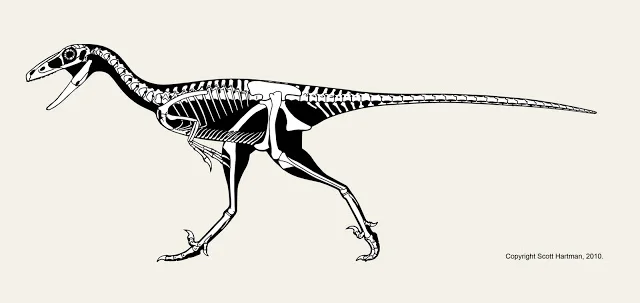
It’s my pleasure to introduce the newest member of the troodontid family:Talos sampsoni. Named for paleontologist Scott Sampson, Talos was described by Lindsay Zanno and others in the wonderful open source journal Plos ONE. Talos is the first troodontid to be named from the Kaiparowits Formation of Utah, making it about 76 million years old. Cross-sections of the long bones suggest that the animal was between four and six years old, and while it hadn’t stopped growing, it appeared to be reaching reproductive age at a smaller size than it’s close relative Troodon.
Of note is that the specimen had a bone in its second toe that was injured and partially healed. Since it appears to have been injured from violent trauma, it’s consistent with the idea that the “switchblade” toe was used in a way that could result in such an injury (presumably either attack or defense). Also, since the rest of the foot shows no indication of the sort of limping or other adjustments you see from a prolonged foot injury, it also reinforces the idea that troodontids walked with the second toe off the ground (as shown above).
I was producing the above skeletal reconstruction for the Utah Museum of Natural History, who has constructed a new building filled with exciting displays that will opened Fall 2012. It should be a state of the art exhibit that everyone should go see if they get the chance. Dr. Zanno was working on describing Talos at the time, so I worked with her to incorporate the data into the skeletal. There is quite a bit of troodontid material from the Kaiparowits, but only a fraction of it can be confidently assigned toTalos at this time. Restricting ourselves to the type specimen looks something like this:
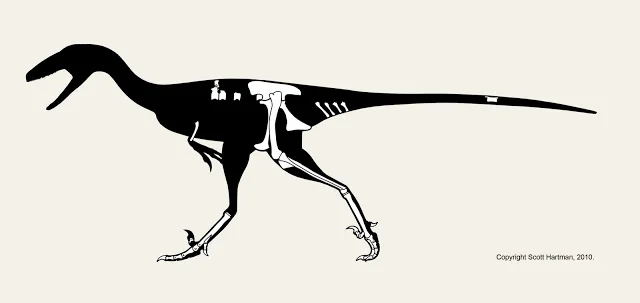
You could be forgiven if your first reaction is “that’s not very complete!”. But I was thrilled. Why? It’s hard to remember sometimes, since Troodon is illustrated frequently, but the published material that Troodon is usually based on is really scrappy. Here is a quick and dirty example of what was published in Dale Russell’s 1969 paper:
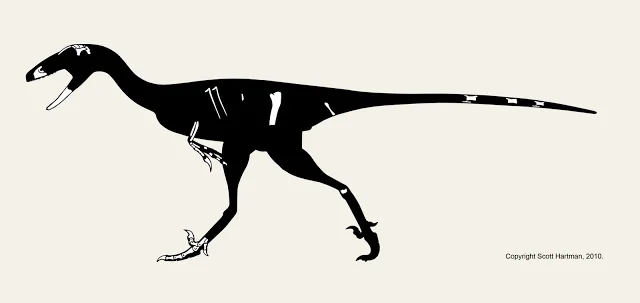
To create the reconstruction (then called Stenonychosaurus) ofTroodon
that inspired him to create his infamous dinosauroid sculpture, Dale Russell had to combine all of the material from the Asian taxa Saurornithoides (as seen below) just to create a usable composite:
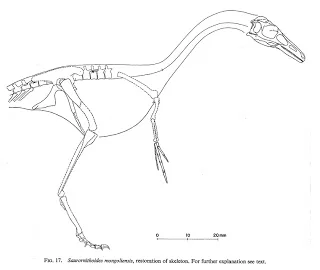
That made the size of the head and pelvis more clear, and provided more back and tail vertebrae to scale from, but look at how “dotted” the outlines of the limbs are - there still wasn’t a good guide for scaling the limbs of any of these advanced troodontids. A few unpublished specimens are out there, but none of those provided definitive limb proportions. Talos finally does that.
So in addition to the interesting conclusions on biogeography, ontogeny, and mode of life, Talos should be exciting to illustrators because it provides the first definitive glimpse of the limb proportions of advanced troodontids. They aren’t radically different from the proportions Dale Russell speculated on in the 1960s (although the forelimbs are shorter than some people have speculated since then), but the good news is that we now know for sure. In fact at this point the only serious unknown is the neck, although there are plenty of more basal troodonts to base that on.
8 comments
Excellent job on the Talos reconstruction. We do have definite limb proportions for Troodon though, if you count the Two Medicine material as that genus (initially I was hoping that's what Talos was, but then I saw it was from Utah...). For instance, the adult MOR 748 has a femur 320 mm, tibia 362 mm and metatarsal IV 227 mm, as mentioned by Varricchio et al. (2002) and photographed in Varricchio et al. (2008).
Hey Mickey - Sort of. Technically only the femur length was published in Varrichio et al 2002 (the tibia and MTIV were given as ratios). I have no reason to doubt the authors' ability to use fractions, but neither paper provided measurements of any other element of MOR 748, so the proportion of the hind limb relative to the rest of the animal was not addressed in either paper.
That's not to say the information isn't in that specimen (or other MOR specimens), just that it hasn't been published yet, which is why I was careful to make a distinction about "publication" rather than "discovery".
But even using your ultra-picky requirements, the photos in figure 2 of Varricchio et al. (2008) are to the same scale, so explicitly show the proportions. Bwa ha ha ha ;)
Actually I rarely trust photographs like that, since the pieces are separate photos that were scaled - errors are pretty rampant in scientific publications when it comes to using scale bars and multiple scaled elements in a figure. But you're missing my point - you still couldn't cross-scale leg against anything else, so it doesn't tell you how big the hind leg is against say the length of the animal, or against the forelimb. With Talos that information is now published.
Very interesting stuff so far, guys!
It'd be very interesting to see what of that North American Campano-Maastrichtian troodontid material stems from where, stratigraphically speaking (I wager a guess that the majority of material recently used skeletal-wise is Two Medicine in provenance). After what Benson and colleagues did with the megalosaur wastebin, I'd be stoked to see some excited researcher do the same to the derived troodontid nexus.
It will be interesting to see which (if any) of the old genus and/or species names (Stenonychosaurus, Paronychodon, Pectinodon, etc.) might be restored. I wouldn't be surprised at all for Stenonychosaurus inequalis returning for a Dinosaur Park Fm. species, as it is based on non-dental material.
Agreed Tom - it seems like there's a lot of species and genus-level taxonomy left to do, and I'd almost expect to see Stenonychosaurus make a comeback. The others may as well. Hopefully more information will become available soon!
Besides the fact that resurrecting Stenonychosaurus would be a pretty smart idea, it would even hold some bonus sentimental feature for all of those who grew up with '80s/early '90s dino textbooks :)
Join the discussion
Thanks — your comment is in the queue!
It'll appear here in about 5–10 minutes, once I've approved it — you'll need to refresh the page to see it. (Comments don't post instantly anymore.)