Size estimates
Smackdown: Supersaurus vs. Giraffatitan and Diplodocus
July 22, 2014
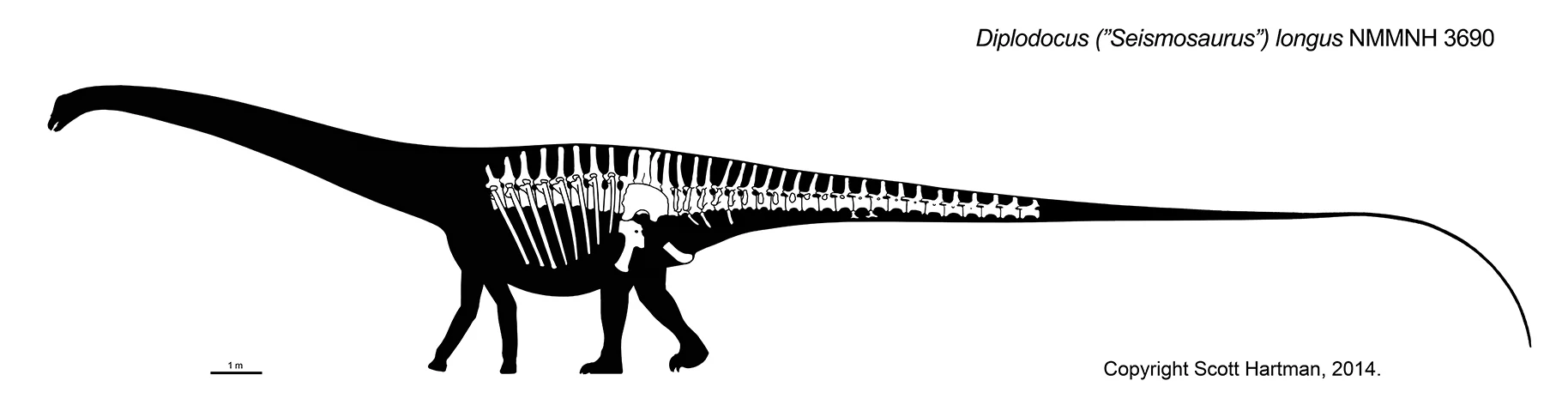
This entry is inspired by a similarly themed post at the always-excellent SV-POW. They compared the size (and neck length) of Supersaurus, Brachiosaurus and Diplodocus. In a stroke of serendipity I read their post as I was reworking my skeletal of the largest specimen of Diplodocus, NMMNH 3690.
NMMNH 3690 is the dinosaur previously known as Seismosaurus hallorum. Most workers have since agreed that it’s just a large specimen of Diplodocus, though many still insist upon giving it a distinct species name, D. hallorum. As my coauthors and I noted in 2007, there aren’t actually any characters that justify that separation. Even the infamous ischial “hook” was shown to be nothing more than incomplete preparation by Lucas and colleagues a year before our paper. While final word will have to wait until someone does a specimen-level phylogenetic analysis of diplodocines, I will continue to refer the specimen to D. longus for the time being.
But enough taxonomy, the point is that there are larger specimens of Diplodocus to use in this comparison! And while the NMMNH specimen tragically lacks any cervicals, if we scale up the neck from other specimens of Diplodocus we can get a good idea of just how long this genus can stretch out to.
Now that I’ve rescaled missing elements, I get a full length of just under 32 meters. Which is a really big animal, but far short of the 38-50 meter lengths that were tossed around in the 1990s. Obviously we can’t know exactly how long the neck was on this specimen, but assuming that it retained similar proportions to other adult Diplodocus specimens we would be looking at an 8 meter long neck.
That is in the same ballpark as Matt’s estimate for Brachiosaurus, but of course the eponymous North American brachiosaurid isn’t known from many more published cervicals than NMMNH 3690 is. So instead of Brachiosaurus I decided to use the better known Giraffatitan. There are some reasonably complete cervical series for Giraffatitan and much better scaling constraints all around. For everyone’s favorite specimen on display in Berlin (HMN SII) I get a neck length of almost 9.5 meters. Another specimen of Giraffatitan (HMN XV2) has a tibia that is reported to be 13% longer, so assuming isometric scaling we would be talking about a neck length of 10.8 meters, which is pretty darn long!
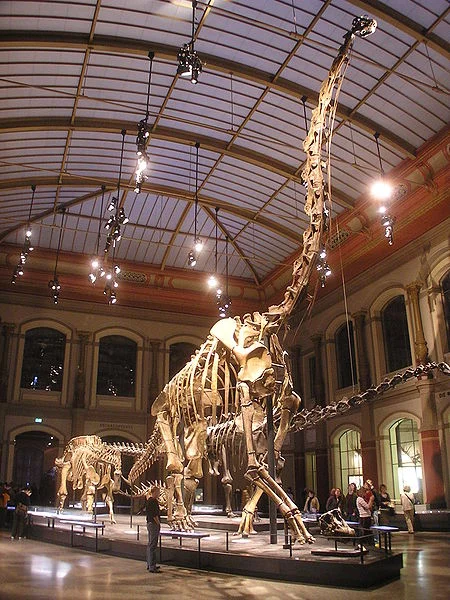
How long you ask? It’s about the same length as you would get scaling up Alamosaurus to the largest tibia that has been referred to it (which puts it up in the range of giants like Puertasaurus and Argentinosaurus), so about as long as the neck of any titanosaur. Up till now it would appear macronarians may lay claim to the longest neck (and potentially total length) of any dinosaur.
Wait, what’s that up in the sky? Well heck, I guess it couldn’t be Supersaurus since getting any adult sauropod off the ground would fraught with…difficulties. But Supersaurus is indeed the taxa we want to examine in this neck-size measuring contest.
At the Wyoming Dinosaur Center I was fortunate enough to work on the most complete specimen of Supersaurus, which had much better representation of the neck. As a result I feel confident in estimating the neck of the WDC specimen as almost 11 and a half meters long. Of course the type specimen from BYU is larger yet. In our 2007 paper we diagnosed “The Spaceship” specimen, BYU 9024 as being either the 10th or 11th vertebrae of the neck, which makes it roughly 6.5% longer than the equivalent vertebrae in the WDC specimen. So to the best of my abilities I would estimate that the neck of the BYU Supersaurus is 12.14 meters in length, a bit smaller than the 13.3 meters Mat come up with in the SV-POW blog.
Why the difference? Since Matt is working from a single neckbone he was understandably looking for an entire sauropod neck series that can be scaled up or down based on the BYU cervical. But the WDC specimen shows that as you get closer to the head the individual neck vertebrae get disproportionately smaller than in other diplodocids.* So while Supersaurus had a heck of a neck, I can’t see it stretching out quite as long as some previous estimates (which put it up in the 15 meter range).
If you made it this far you deserve to see what all this looks like. So here are most of the specimens we’ve been talking about, with my 6 year old daughter and myself for scale:
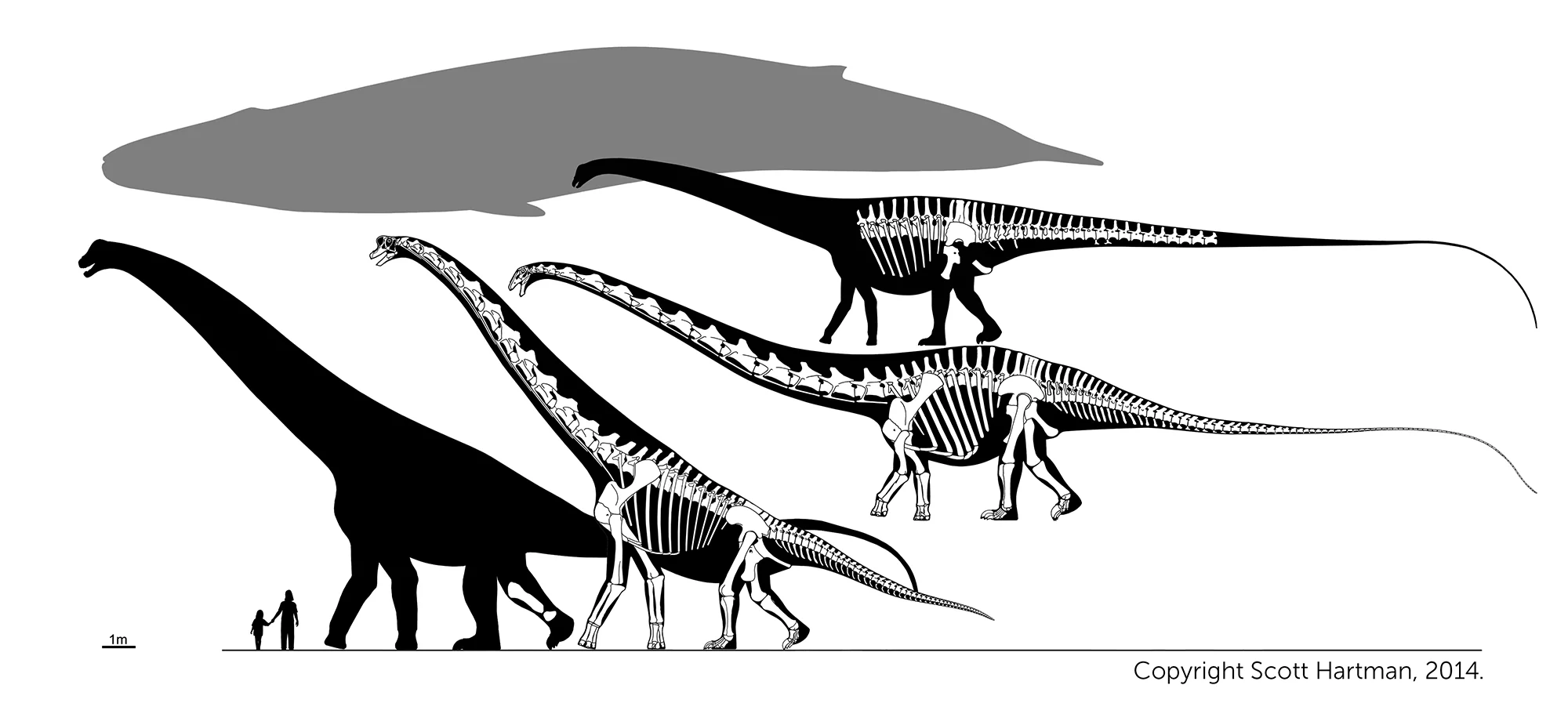
We’ve looked at some pretty large dinosaurs today; some of them are among the biggest creatures to ever walk the Earth. But to keep things in perspective, that’s a blue whale at the top of the image. It’s scaled to be a large well-fed specimen of 30 meters and around ~170 tonnes, far from the largest individual ever reported. And while several of the biggest sauropods may have been a bit longer than the biggest whales, notice that you could fold up all four of these sauropods and shove them inside the same amount of space. That’s HUGE.
* Why should Supersaurus have anterior cervicals that drop off in size so rapidly? One possibility is that the atlas/axis complex may have a maximum functional length to properly support the muscles that turn and position the head. If so that could place a developmental constraint on how rapidly cervical length can increase anteriorly. But this is just spitballing into the evo-devo wind.
Addendum: Based on Mike Taylor’s question below I double checked the scaling on Giraffatitan and it was slightly too large. As a result I’ve updated the image and the text, with the cervical length of HMN SII revised from almost 10m to 9.5, and the neck of the larger HMN VX2 revised down from 11.2 down to 10.8 meters. See discussion in the comments for other details.
29 comments
Excellent as always.
Beware however, a bunch of iscreaming fanboys that sauropods were larger than blue whales are incoming !
Meh - I won't say it's impossible, but people should realize how far away even fragmentary specimens like Puertasaurus or the Alamosaurus tibia are before they indulge in even more radical speculation.
Matt Wedel already did a pretty comprehensive smackdown of the idea that we know of sauropods bigger than the biggest whales. Only Bruhathkayosaurus is a serious candidate, and that is ... problematic. See http://svpow.com/2008/05/20...
If teoretical possibly... but for example Huge Alamosaurus based tibia, Scott estimate- 28-30 m. If Bruhathkayosaurus tibia really have 200 cm , and compare to 170 cm Alamosaurus tibia, then Bruhathkayosaurus was only probably ~34 m. Pictures from Bruhathkayosaurus was terrible but information from paper about shaft wide this tibia is comparable to shaft Alamosaurus tibia... If Bruhathkayosaurus was real could be only slighty larger than biggest Alamosaurus specimen. When we get conservative estimations for example 28 tons for Brachiosaurus etc. and Paul- Argentinosaurus 55 tons- Bruhathkayosaurus could be only slight bigger probably close to 70 tons (of course huge margin mistake). I don't belive over 100 tons sauropods, and all the more 170 tons sauropods!
Sorry for my English :( hope thah we understound me
BEST!
Well, don't forget this guy...
Nice work, Scott -- but where did you get 10 m for Giraffatitan? The widely cited 8.5 m is straight out of Janensch (1950b:102), who measured "Length of the neck along the neural canal" (translated from the German) as 8.78 m. (So, OK, we dropped 28 cm.)
Oh, and the "Brachiosaurus" neck that Matt illustrated is of course a Giraffatitan neck. It's the Chicago mount, which was filled in with sculptures based on Berlin elements.
Hi Mike, I was wondering that myself. I haven't had time to review Janensch's monographs again yet, but in the widely reproduced skeletal reconstructions from it he attributes one additional vertebrae to the dorsal column (and hence once less from the cervical series). If that carries through to his written work and measurements it would almost perfectly account for the discrepancy.
That doesn't sound right. The reconstruction in Janensch 1950c clearly shows 13 cervicals and 11 dorsals, which is what he describes in 1950a.
So I went back and double checked everything, and I did have the Giraffatitan a bit too large in the image (which I foolishly measured rather than using the individual file), but I still end up with a neck length of ~9.5 meters (which I've updated in the post). I double checked it against Janensch's figures of the actual fossil as well as the individual measurements in the tables and I suspect that it's the 8.5 meters that is wrong. Or rather, it may be an accurate measurement of something that itself is incorrect.
According to my translation of the 1950 vertebral monograph (done by Gerhard Maier in 2007) regarding the length of the individual sections of the vertebral column:
"The lengths of the various sections of the vertebral column can be given with the totals produced from the skeletal reconstruction; during the mounting of the presacral and sacral vertebrae, modeled with great accuracy by Senior Preparator E. SIEGERT..."
Of course we have reason to suspect that the casts were NOT done with great accuracy. The dorsals were notorious for being too bulky and anteroposteriorly long, etc. Given the aforementioned double-checking of the skeletal with Janensch's individual measurements and plates of the actual cervical series it's really a question of whether to believe the tables and plates of Janensch, or the measurement taken of the sculpted vertebral column. I'm going to go with the former unless someone has more/better data.
I don't suppose anyone in Berlin would be willing to put up some scaffolding to check?
This has got interesting. Too interesting to perpetuate in a sequence of comments. SV-POW! post coming up. Stay tuned.
Now to get a giant Apatosaurus in there!
I did put one up against Supersaurus here: http://www.skeletaldrawing....
Again superb job ! , I'm only wait for your Argentinosaurus :) New titanosaur from Chubut too should be huge. What we thinks about "Brachiosaurus" nougaredi ? If it from Jurassic (no Albian), mybe close to brachiosaurids. Giraffatitan sacrum was 107 cm long ? (if I not mistake) . That mean if ~22,5 m long Giraffatitan had 107 cm sacrum, mybe "Brachiosaurus" nougaredi measure ~29-31 m (if close proportions). Sorry for my bad English (I from Poland :D).
PS: how italics latin name of dinosaurs here ?
The sacrum of "Brachiosaurus" nougaredi is proportionally very narrow -- one reason to think it's unlikely to actually be Brachiosaurus, and that it may not be as big as we'd all like to think. But, yes, someone should restudy that baby.
P.S. You can get italics by enclosing a word in underscores.
I don't know that is possible, but Nima Sassani wrote that this sacrum in photo (badly quality) looks like hard erosion and when complete will be wider. What do you think about this theory ? Of course restudy this sacrum will be great but I'm afraid that this huge sacrum is lost :(
See previous discussion from here: http://svpow.com/2009/11/24...
Ok thanks !
For me very interested is too Tunesian unnamed sauropod, In 2013 in DML was information about 15 m long sauropod tail found! Really huge to!.
I don't think I know about that -- do you have a link?
http://www.nzweek.com/world...
http://dml.cmnh.org/2013Feb...
If is titanosaur, could be really huge
Interesting, but terribly low on details. Boring old Diplodocus has a tail not too far short of 15 m, so much depends on the affinities (and therefore body proportions) of the animal in question.
Calvo, J.O.; Juárez Valieri, R.D. & Porfiri, J.D. 2008. Re-sizing giants: estimation of body length of Futalognkosaurus dukei and implications for giant titanosaurian sauropods. 3° Congreso Latinoamericano de Paleontología de Vertebrados. Neuquén, Argentina.
In this autors estimates futa tail- 13 m - half length of body- ~26 m. I'm really interest how long could be huge titanosaurs tails- for example Alamosaurus tail is very long, but futa and puerta or Argentinosaurus are mystery.
I too await my Argentinosaurus. Sadly I have to actually do something in order to see it ;)
Will be great :) I'm big fun huge sauropods :)
The whale has them soundly beat. Still, it is amazing that their are Giraffatitans out there at least 40% larger than this one, Supersaurs ~20% heavier, and we can only guess that the Diplodocus and Giant Alamosaurus are fully-grown adults!
Sauropods truly are astonishing animals, but the insane amount of biomass that is B. musculus should not be underestimated!
How about Mamenchisaurus sinocanadorum? I've seen reports that the assembled reconstruction is 115 ft long with a 59 ft neck.
The type specimen is just a skull and a few anterior cervicals that aren't overly large. The material you are referring to is still undescribed, so for now it doesn't exist.
Well once you add Cartilage in between each of the Cervical bones the neck length would be a lot longer in life .
"It's scaled to be a large well-fed specimen of 30 meters and around ~170 tonnes, far from the largest individual ever reported.
Actually, that is very close to the record. The average blue whale weighs between 113-130 tons, and is 79-84 feet long. The 209 ton specimen was not verified. The largest verified was 191 tons. And don't forget to take into account the type of body tissue when talking about weight vs. volume. Blue whales have a very thick layer of blubber around them, whereas a much larger percentage of the sauropods' mass will be lean body mass.
Join the discussion
Thanks — your comment is in the queue!
It'll appear here in about 5–10 minutes, once I've approved it — you'll need to refresh the page to see it. (Comments don't post instantly anymore.)