Skeletal drawing topics
Neutral Poses & Elmerfuddasaurus
July 22, 2011
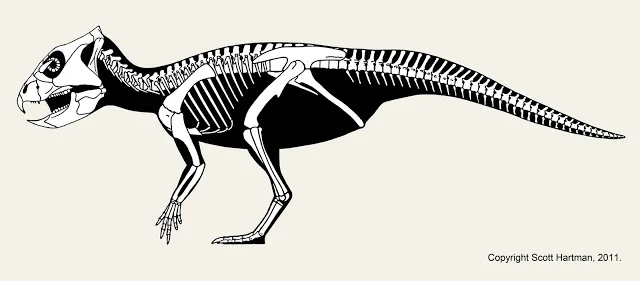
Here’s a quick look at another kind of pose: the neutral pose, which is more or less the equivalent of the standard anatomical poses used for extant animals. I’m actually quite fond of the unassuming aesthetic of this type of pose, but alas I suspect it isn’t a good candidate for a pose to standardize on. To see why let’s take a quick look at the strengths and weaknesses of the approach:
Strengths:
Better shows off the center of gravity (full-tilt running poses always look unstable…because of course they are). A reduced burden for the author/illustrator to get a biomechanically plausible gait (although there would still be the need to get a realistic stance). A pose like this is possibly better for some artists (e.g. 3D artists). Certainly there’s no distraction created by the pose.
Weaknesses:
Some people might find this pose dull, although scientifically speaking that’s not much of a criticism. I suppose when used for education or popular media that could be a drawback, although arguably there’s good reason for people to see dinosaurs portrayed as animals, rather than stylized carnage-machines, so the argument could be made both ways.
The biggest drawback to a pose like this is it shows off less of the anatomy, since the limbs from the far side are obscured. It’s easy-enough to fix that, by arbitrarily moving the limbs like this:
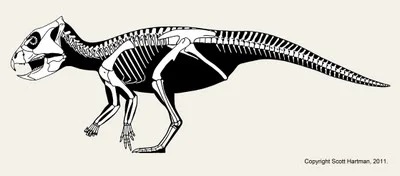
You can even show off some other pose (in this case the fingers are lightly flexed), perhaps the other wrist could also demonstrate the degree of pronation that is possible (in the case of Archaeoceratops it more or less already is), which would then pack in a bit more information. Of course if you move the other hind leg then you are pretty much back to putting the animal in a walk.
Of course you don’t have to put the feet on the ground - if we’re looking for poses that are more neutral about locomotion we could instead illustrate as if the animal were lying on a virtual dissection table:
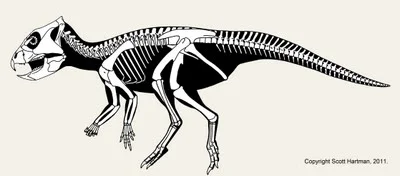
Unfortunately, even if this were explicitly labeled, I suspect someone somewhere would take it as intending to show off biomechanical behavior. Jumping. Or dancing. Or maybe sneaking along, saying “Be vewy vewy quiet, I’m hunting wabbits.”:
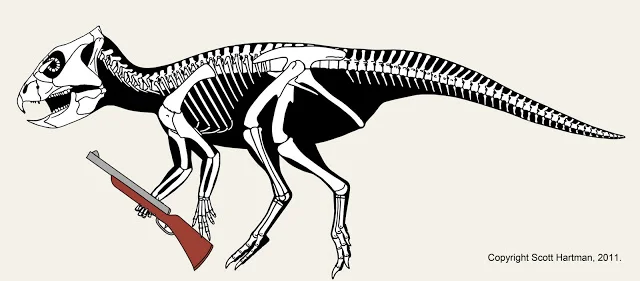
So it seems to me that you probably can’t have it both ways - to get the benefits of the neutral pose we’d have to sacrifice showing off as much morphological data.
Conclusions:
Neutral poses have a couple of advantages - they may benefit some types of artists, they reduce the amount of biomechanical inference that is required, and their lack of “visual excess” means they won’t distract from the anatomy. Unfortunately they also obscure more of the anatomy, and trying to correct this by moving the limbs around quickly sacrifices the very things that were an advantage to the neutral pose.
For this reason I think neutral poses may have limited appeal - and if that’s the case, it probably isn’t an ideal candidate for a new standard.
13 comments
Wow. I didn't know Archaeoceratops hunted rabbits!
...
LoL!
That non-standing neutral pose is nearly a death pose. That would have charm. Otherwise, I'd rather have a bored walk than a perfectly symmetric pose.
If you're going to do a death pose, it could be exaggerated--neck pulled back and all that, so it really would look like it was on a dissecting table. The limbs could be in different positions, too. But it wouldn't have much of a rectangular dimension, and not all the elements would be in the more or less standard "cranial = left, caudal = right" (or vice-versa) orientation, which might screw with some peoples' heads...
@Jerrygami - I thought about that actually, but it really creates more problems than it solves - as you mentioned, it creates issues due to perspective (or lack thereof) in those diagrams.
Another problem is it really reintroduces a higher burden of biomechanical knowledge - a realistic death position generally falls within possible (though not typical) ranges of vertebral motion, so you'd be stuck having to establish maximum ranges of motion, even in taxa where this is controversial (/cough sauropods).
We still haven't gotten to why animals should be running around with their jaws agape and agog.
My life reconstructions are almost always in the neutral standing pose (I go for more the life-study look than a full natural environment look, mainly because I can't be bothered drawing backdrops), so that would benefit me immensely.
Though, I think for the general paleo-art community a simple walking post would be more beneficial as the new standard.
My favourite pose so far is the walk. I don't think many people would have a problem biomechanically with legged animals walking. It's similar to the typical GSP running pose which makes comparison to other skeletals easier.
As for neck and tail posture I personally prefer neutral posture, (or close to it). GSP for example poses sauropods with their neck raised to about the same degree. I think that if you're trying to understand sauropod necks it's useful to see differences in their basic neck posture.
First of all, great to see you crowd-sourcing this stuff, Scott.
As longer as this debate lingers on, I sadly gotta say how awesome the GSP pose is/was, at least with respect to the hind limbs. I always thought that it might be a good idea (or rather, a consequence of its premise) to pose one forelimb in maximum flexion and the other one in maximum extension at each joint even in bipedal animals, to mirror the leg issue. With you willing to change this style, I certainly agree that we need to foster debate. So far, thanks to anyone sharing their thoughts here.
As of now, I'd tend to a walking pose, with both legs on the ground, although a perfectly "neutral" pose with both legs straight under the center of mass is helpful as well. Definitely not my last word here. What I do like to stress is your will to flex your skeletals through all kinds of anatomical ordeals, what with the hand-stand allosaur. The exploded styracosaur was truly impressive food for thought.
Steve O'C wrote:
"As for neck and tail posture I personally prefer neutral posture, (or close to it). GSP for example poses sauropods with their neck raised to about the same degree. I think that if you're trying to understand sauropod necks it's useful to see differences in their basic neck posture."
I hate to be a broken record, but we simply do no know the neutral pose of sauropod necks. We don't know the neutral post of any sauropod neck, let along a whole selection so that we could illustrate the differences. The inevitable crushing and shearing, and the absence of the all-important articular cartilage, mean that any conclusions we draw from the fossil bones are hopelessly misleading.
(The will the the thrust of my SVPCA talk this year, assuming my abstract is accepted.)
I like the neutral pose, but thats because I am a 3D artist and have to model them in a neutral pose to start with for it to be rigged and animated later. So that would be an incredibly helpful pose.
I also really like the walking pose. I think both work well.
:)
A neutral or walking pose is perfectly fine for me. I think pose is not that important on skeletals, as their goal is to show a realistic anatomical depiction of an animal's skeleton. So I don't think they need to be too 'spectacular'. And anyway, your skeletals are ALWAYS spectacular, no matter the pose you use.
"Live" reconstructions are on a completely different league, though...
Hey Scott
I've noticed that you put the COG further forward than I suspect.
I often place the COG further back. If you draw a line from the acetabulum down to the ground it usually intersects near the front of the toes.
Given the new beefier tails ( cfm) on dinos wouldn't the back ends be heavier and thus have the COG further back?
The tail only makes up at most 15-20% of the body mass in the average bipedal dinosaur (less in Archaeoceratops) so increasing the mass of the tail by 10% is only adding like 1.5% of the overall mass onto the tail - so while the COG moves back with the new heavier tails, it's not by much.
I actually think one of the problems of the classic Greg Paul pose is a lot of people assume that the COG is further back than it really is. I did a series of calculations about a decade ago, and for say Velociraptor the COG is almost exactly at the halfway point on the torso (maybe I need to do a post on this at some point).
Honestly, I do like the neutral pose better as a 3D artist.
Join the discussion
Thanks — your comment is in the queue!
It'll appear here in about 5–10 minutes, once I've approved it — you'll need to refresh the page to see it. (Comments don't post instantly anymore.)