Mosasaur Tails - "Teaching the Controversy"
July 1, 2015
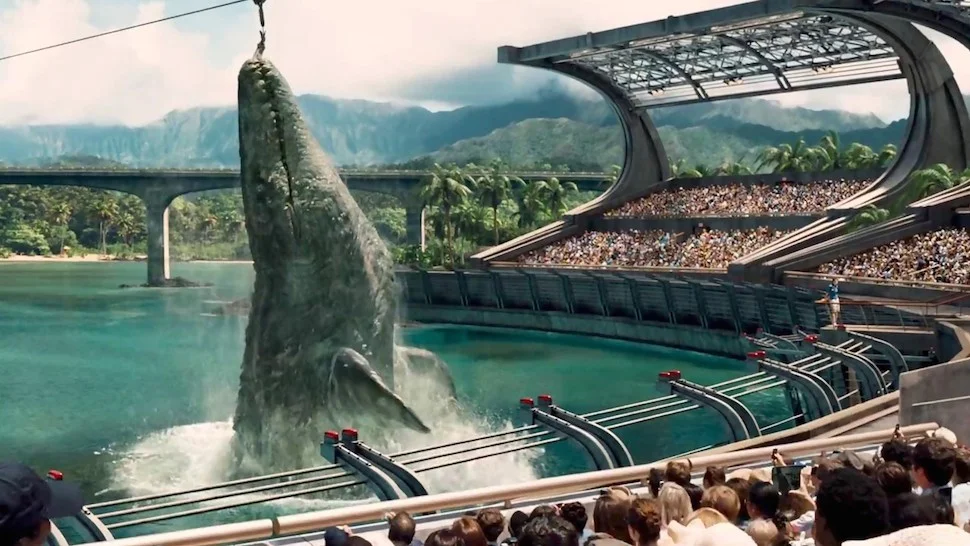
Mosasaurs have become all the rage lately with the release (and immense popularity) of Jurassic World. Purely by coincidence I was commissioned to do a skeletal of a mosasaur, Tylosaurus pembinensis, for a museum display. I hadn’t done a mosasaur before (or any other lizards), but I’m reasonably familiar with squamate osteology so I figured it wouldn’t be nearly as challenging as doing a skeletal of say… an actinopterygian fish.
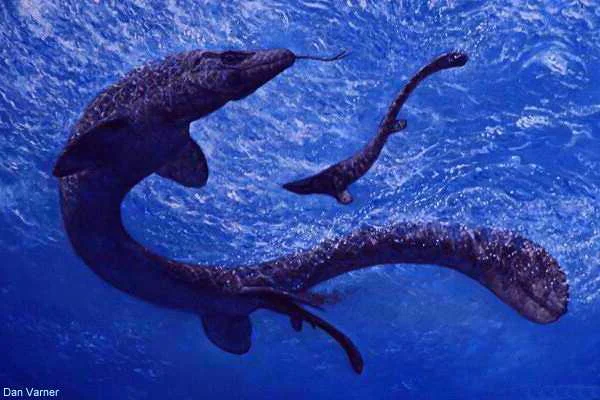
The bones weren’t overly challenging, but the soft tissue proved to be a bit more exciting. Recent workers, especially publications by Lindgren and colleagues, have looked at vertebral mobility and specialization, caudal articulation, and a couple of impressive specimens with skin impressions and have significantly revised the traditional view of mosasaurs as serpentine sea-snake analogs.
It’s clear that at least a couple of mosasaurs had a hypocercal tail fin (a bi-lobed tail where the bottom part is larger), and it’s been hypothesized based on phylogenetic positioning that many more mosasaurs had them to one degree or another as well. If so then many (if not most) taxa adopted a semi-carangiform or full carangiform swimming style, where the body is quite stiff and the tail provides all of the propulsion.
Alas, Tylosaurus is not one of the genera that has skin impressions from the tail fin region, though there are scale impressions known from other parts of the body. So what evidence is there to go on? Tylosaurus does have a downturn in the caudal region, and pretty significant vertebral specialization. For these reasons as well as phylogenetic proximity to other mosasaurs with bilobed tails I tentatively endorse the hypocercal tail interpretation; though Tylosaurus does not appear to have been a true open-sea cruiser, it does appear to have the caudal series to support a hypocercal tail. You can see the resulting skeletal reconstruction in the non-dinosaur skeletal gallery here.
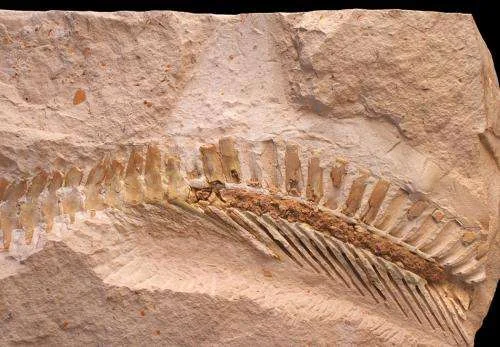
But I want to make clear that this isn’t a universal opinion. After posting an initial version to my Facebook page there was a lot of discussion on it, including useful feedback by Mr. Marine Reptile himself, Mike Everhart (who incidentally runs the very useful Oceans of Kansas website). Mike made some excellent observations on tail anatomy, some of which necessitated changes to the orientation of the chevrons in the skeletal reconstruction. He also is not currently persuaded that Tylosaurus had a bilobed tail. He thinks the tail angle should be more shallow, closer to 30 degrees (I’ve restored it at ~40 degrees), and he thinks that instead of a hypocercal tail that it may have had a continuous “paddle”, not unlike the lovely Dan Varner illustration above.
At this point I am still persuaded by the hypocercal tail model, although there’s definitely a bit of gray here even assuming a bilobed tail. It’s possible that the angle of the tail should be closer to Dan’s preferred 30 degree orientation, though I note that with the updated chevrons there shouldn’t be a problem with a lack of clearance between them when putting the tail into a 40 degree bend (which is already lower than the preserved tail of Platecarpus, which does seem to have a problem with chevron-to-chevron contact). It’s also possible that the top portion of the tail could be a bit smaller, like that seen Prognathodon, though note that Tylosaurus is more closely related to Platecarpus than to Prognathodon.
But I also want to emphasize that science is constantly in a state of revision. We don’t have that many direct skin impressions to work from here, and it’s certainly possible that there could be more than one origin of bilobed tails in Mosasauridae, in which case a wider range of earlier taxa might lack them. And while “certainty” can be nice for feeling good about an illustration, in fact it’s really great that there are different interpretations out there, as these disagreements help drive researchers to find new data, or new ways to analyze existing data to try and resolve them.
So in the interest of “teaching the controversy” on a subject where one actually exists, I decided to make the following image:
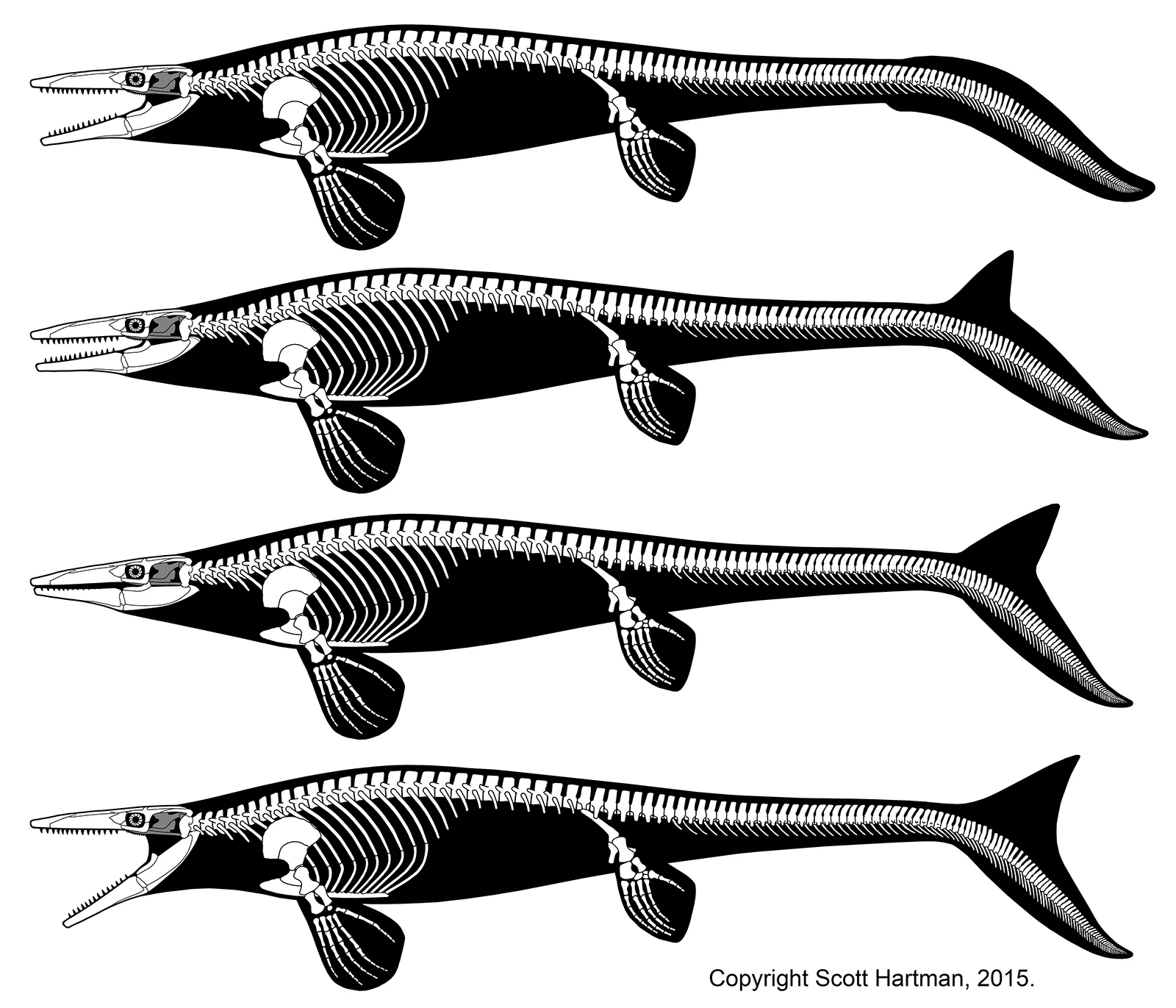
The top image has the tail angle and fin modified to match the more traditional view articulated by Mike Everhart. The bottom version restores Tylosaurus with a fin closer to that interpreted for Platecarpus by Lindgren et al. (2010), though with a less extreme tail flexure. The middle versions are where I bound my own “best-guess” interpretation from the evidence at hand. The second from the bottom is the version you will find in the skeletal gallery, but anything between the middle two would be utterly plausible in my estimation..
So if you are going to illustrate Tylosaurus, feel free to follow my lead. Or that of other workers with differing interpretations - at the least these images more or less establish the range of scientific plausibility for tail flukes. Like any other skeletal my Tylosaurus will be subject to revision if/when more data allows. And always remember, the fact that scientists don’t agree with one another is a feature of the system, not a bug.
Papers of Interest:
Konishi, T., Lindgren, J., Caldwell, M. W., & Chiappe, L. (2012). Platecarpus tympaniticus (Squamata, Mosasauridae): osteology of an exceptionally preserved specimen and its insights into the acquisition of a streamlined body shape in mosasaurs. Journal of Vertebrate Paleontology, 32(6), 1313-1327.
Lindgren, J., Jagt, J. W., & Caldwell, M. W. (2007). A fishy mosasaur: the axial skeleton of Plotosaurus (Reptilia, Squamata) reassessed. Lethaia, 40(2), 153-160.
Lindgren, J., Caldwell, M. W., Konishi, T., & Chiappe, L. M. (2010). Convergent evolution in aquatic tetrapods: insights from an exceptional fossil mosasaur.PLoS One, 5(8), e11998.
Lindgren, J., Polcyn, M. J., & Young, B. A. (2011). Landlubbers to leviathans: evolution of swimming in mosasaurine mosasaurs. Paleobiology, 37(3), 445-469.
Lindgren, J., Kaddumi, H. F., & Polcyn, M. J. (2013). Soft tissue preservation in a fossil marine lizard with a bilobed tail fin. Nature communications, 4.
8 comments
Couldn't a software on hydronynamics help solve the problem by testing how the different silhouettes behave under water? Then the results might be checked out with robotic models in real conditions.
Well, as mosasaurids are presumably surface hunters, then a hypocercal adaptation of the tail would suit them well (assuming ALL of them are surface hunters). The morphology of caudal fins can often speak a bit about an animal's preferred ecological marine niche (Mako Sharks have caudal fins of equal length as an adaptation towards speed, mesopelagic sharks have the dorsal caudal fin much larger than the ventral caudal fin, etc,..), though I'm not sure if this holds true for ALL marine vertebrates.
.......Then again, a mosasaur swimming with gentle lateral undulations of the body like a shark seems more beneficial to such a large animal rather than eel-like methods of swimming (with simple, paddle-shaped tail flukes). But don't modern squamates swim with an eel-like motion when they enter the water yeah? Is semi-carangiform anatomy really more beneficial to mosasaurs than the typical lateral-swishing that modern squamates do?
I also don't think "lateral swishing" is the right word here...
I'm not sure that an asymmetrical hypocercal tail necessarily suggests surface swimming. It would be expected of any positively buoyant swimmer with a relatively low cruising speed (hence why multiple lineages of tail-propelled reptiles ended up with hypocercal tails. Sharks, being negatively buoyant, of course show the mirror tail morphology with heterocercal tails - as you noted). Symmetrical tails are associated with high cruising speeds, in which case it doesn't matter whether they are heterocercal or hypocercal (it just comes down to phylogenetic history at that point).
Semi-carangiform swimming will be more efficient than anguilliform swimming at essentially all body sizes, though at low speeds the efficiency difference is smaller. I suspect that the primary advantage of anguilliform swimming is not so much in the swimming itself, but rather that eel-like (or snake-like) body shapes are really useful for getting into tight spaces, etc.
The one mode where anguilliform swimming is truly mechanically advantageous isn't really a swimming mode, per se: eel-like body plans combined with a laterally flattened body make for some of the best fast-start morphologies, especially if that fast start is used for leaping (this is relatively easy to show mathematically). One would predict, for example, that a specialist aquatic jumper would have a moderately long body, laterally flattened, with a reduced caudal fin. Interestingly, this is exactly the body form of the best vertical jumpers among fish (silver arowana).
Thanks for that insightful input, sir! I'm not really an expert when it comes to hydrodynamics. I guess since mosasaurs don't have laterally flattened bodies, we won't see one making a vertical breach out of the water and gobbling up a dangling shark? ;)
No worries! I work on aero and hydrodynamics so I figured I'd chip in my two cents. Even without laterally flattened bodies, I expect that a mosasaur could pull off a vertical breach - it just wouldn't be as good at it as fish that are specialist jumpers. Arowana can manage more than a body length of vertical height out of the water. By contrast, large whales breach about 1/2-2/3 of their body above the surface. The giant JW mosasaur (if it had been real) could probably manage the same.
There also remains the question of the overall body shape in mosasaurs. While they were probably pretty wide gauge up front, they might have had laterally flattened bodies from the hips back, which would give them quite a bit of fast start surface to work with. Alternatively, they might have been really fusiform most of the way back, with only the tail flattened (that seems to be the preferred reconstruction from mosasaur specialists right now).
Anguilliform swimming seems to occur in small organisms but not in large ones.
I wonder if there is some size related feature in the hydrodynamics and drag that makes an anguilliform shape less efficient above some body length threshold.
Crocodilians use an elongated flattened tail to swim but they can get very close to their prey by approaching underwater; at very close range the sudden acceleration they can achieve is important but it does not occur over any great distance nor reach a very high speed where drag would be important.
However the only truly marine specialists in the crocodilians, the metriorhynchids which fed on aquatic prey developed a reversed heterocercal tail.
Also fish that accelerate towards their prey rapidly like pike or barracuda still have an appreciable tail fin although they do have a long body.
I think you're spot on, actually. Reversed heterocercal tails also occur in the earliest members of Ichthyosauria and Archaeoceti (Lindgren et al 2010). I think a complex, completely laterally compressed body morphology, which is not efficient in very large vertebrates, is where you'd expect to see anguilliform style swimming. Notice how in small fish, they often utilize an anguilliform or semi-carangiform swimming style, but the larger the fish get, the more they use carangiform and thunniform swimming?
-Reference :
Lindgren J, Caldwell MW, Konishi T, Chiappe LM (2010) Convergent
Evolution in Aquatic Tetrapods: Insights from an Exceptional Fossil
Mosasaur. PLoS ONE 5(8): e11998. doi:10.1371/journal.pone.0011998
Join the discussion
Thanks — your comment is in the queue!
It'll appear here in about 5–10 minutes, once I've approved it — you'll need to refresh the page to see it. (Comments don't post instantly anymore.)