Mass estimates: North vs South redux
July 7, 2013
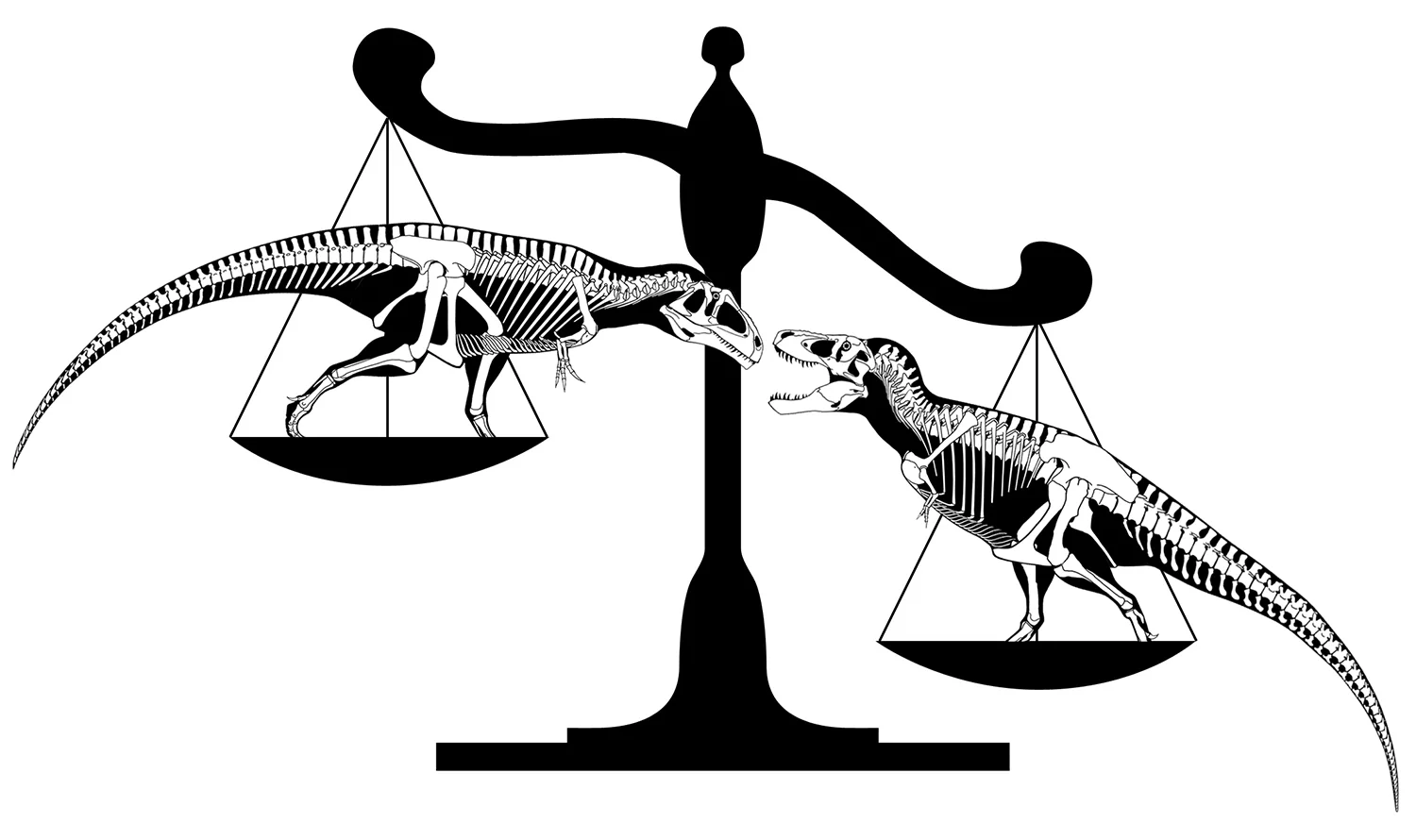
I have good news and bad news today - the bad news is this is not the post where you get an estimate of the mass of Spinosaurus. I know, I know. And I’m sorry. Here’s the good news: in preparation for a deeper look at the challenges of estimating the mass of Spinosaurus, I’ve produced far more rigorous mass estimates of Tyrannosaurus and Giganotosaurus from GDI, and I got some surprising results to share.
First, a word on that Spinosaurus post - I’ve heard from several of you that there is a degree of anticipation for it, and I apologize for the delay. That said, you’re going to get a much better post in exchange for your patience. My original intention had been to do a more generic look at scaling up different types of theropods to the length of Spinsosaurus, which would not have been very precise. Even worse, since it would have relied on other people’s mass estimates it would have been comparing mass estimates derived from different methodologies, which threatened to make the whole process an act of futility.
Instead you will be getting mass estimates I’ve generated directly from my own skeletal reconstructions. The mass estimates I’m sharing today were produced using Graphic Double Integration (GDI), a technique that lets you estimate the volume of complex 3D objects by averaging many cross-sections together. If you are unfamiliar with the process, you can think of it as taking a balloon animal and using math to average it into a more normal oval-shaped balloon of the same volume to make it easier to measure. I won’t go into detail on how to perform a GDI analysis, because the SV-POW team has already written up a really good tutorial here, which you should definitely read if you want to do your own GDI analysis.
First: the reveal:
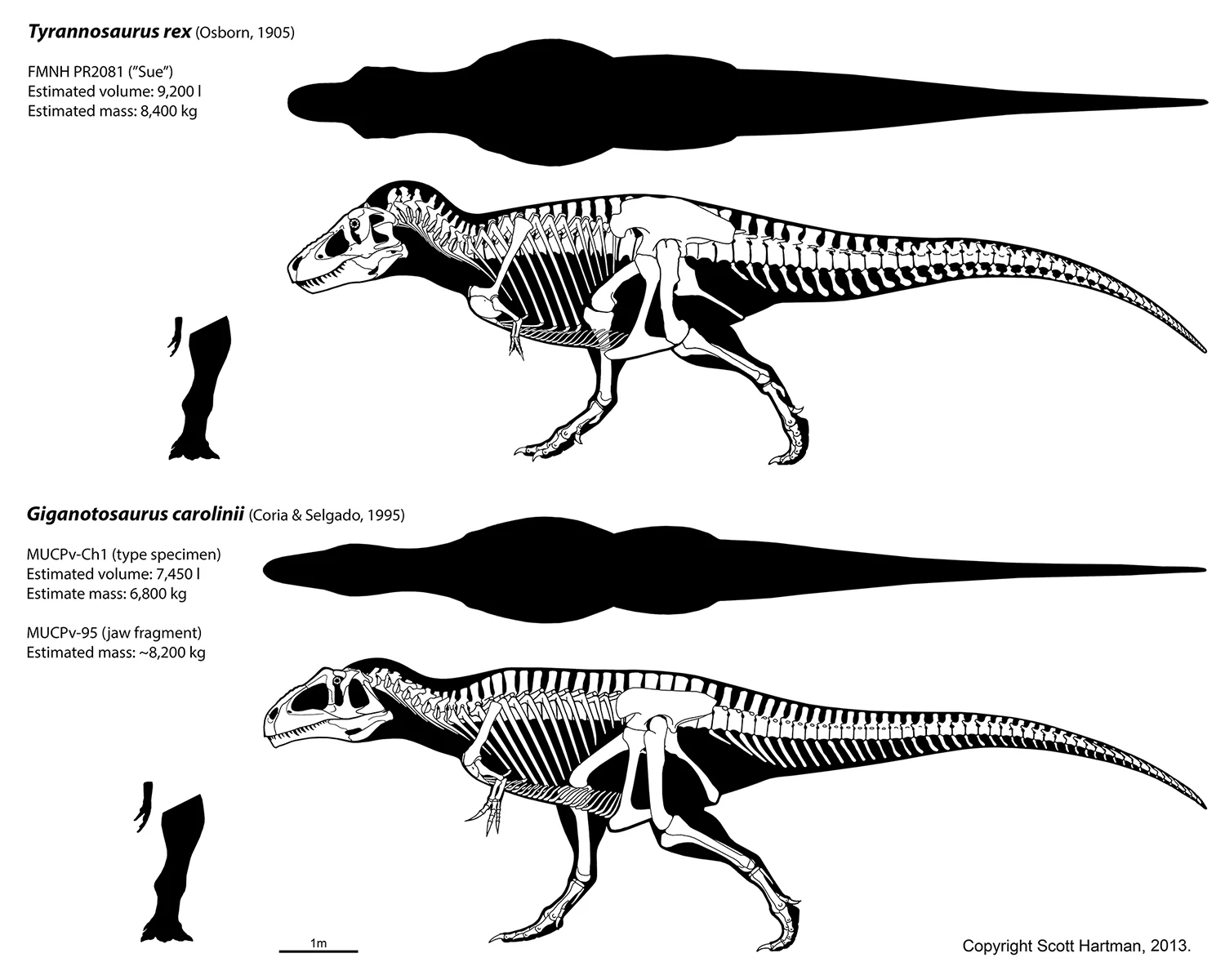
Back when I posted the original North vs South comparison I wrote up some general thoughts on the skeletals including:
- Sue almost certainly had a higher mass than the Giganotosaurus type specimen, as tyrannosaurs seem to have broader torsos for their size.
- So…that large isolated Giganotosaurus jaw? It’s not really clear how much bigger that individual is, because there isn’t perfect linear scaling between it and the type specimen (the isolated jaw is proportionately a bit deeper). My “best fit” version indicates an animal about 6.5% longer than the type. That would result in an animal over 13 meters in length, and also one that would be heavier than Sue.
I certainly hit point number three on the head, but it appears I was a bit too hasty when it came to proclaiming that there was evidence that MUCPv-95 was heavier than Sue. The reason this occurs can be seen in the top view silhouettes I show above (which, by the way, are the very images I used, so you have the “original data” so to speak). Tyrannosaurs have almost comically wide abdomens (and mine is not as broad as some other workers and some mounts show), while Giganotosaurus has the typical allosaur-grade torso.
I’m sure many of you will want at least a few more details, so here is another quick-hit list of items you may find of interest:
-
I used 46 equally-spaced sections front to aft. The tiny forelimbs only have a few cross-sections, while the hind legs have 10.
-
I added extra skin around both skeletals to avoid the “trying to make them as skinny as possible” concern (more on that in a future post).
-
The thighs and upper half of the forearms are measured as part of the torso.
-
I used a specific gravity of 1.0 (same as water) for the limbs and tail, and 0.9 for the neck and torso (remember that the torso includes part of the denser upper limbs in this GDI) . The head uses 0.8 to account for the sinuses and empty space in the mouth.
-
Although Tyrannosaurus seems likely to have had stronger calves I used the exact same muscle reconstruction to try and make the comparison more of an apples to apples affair
-
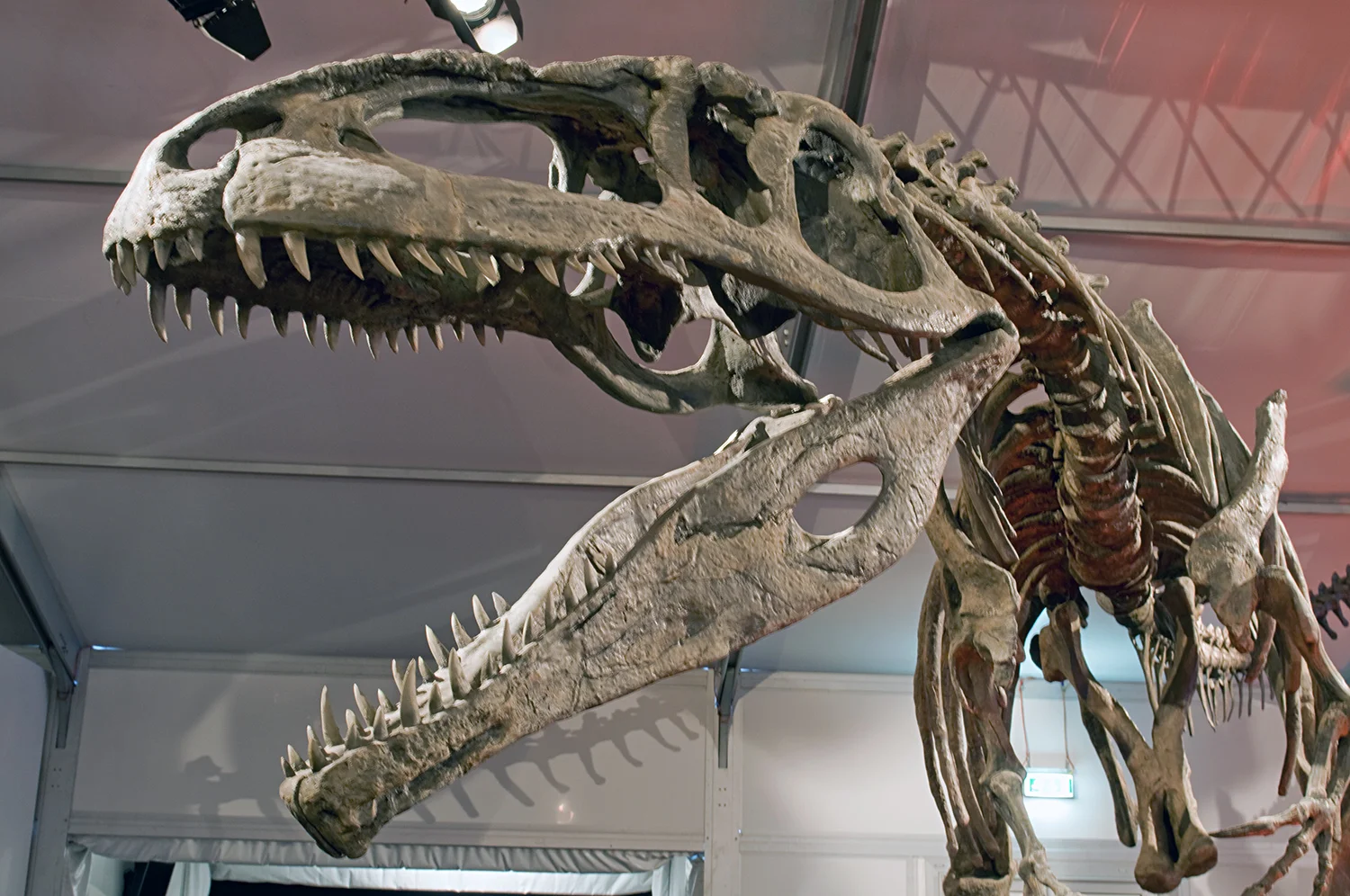
I’m sure that some will claim that Giganotosaurus should have a wider torso or head, but the skull is already substantially wider than in Acrocanthosaurus and matches up with more recent reconstructions of the skull, like the one you see here. Also note that if anything the torso should be smaller up front due to the diminutive pectoral girdle.
-
I must reiterate, the lower jaw fragment of MUCPv-95 does not come from an animal that is 8% larger than the type. In fact it honestly could be from an identically-sized animal that just has a more robust dentary, so scaling it up 6.5% (in linear dimensions) should if anything be seen as the upper bounds.
Conclusions:
As near as I can tell, despite Tyrannosaurus and Giganotosaurus appearing similar in size in side view, there is little question that T. rex is actually the larger theropod based on known specimens. To be fair, there’s only one good specimen of Giganotosaurus, and it took most of a century to find Sue, so it’s certainly possible that as additional specimens are collected we will find larger southern giants. As always, please remember we don’t have a statistically valid population of specimens from any of these large dinosaurs, so we are only comparing individuals, not species.
And finally, remember that no one study has magical knowledge of the “real” mass of extinct organisms. I feel confident that the GDI analysis I’ve performed accurately represents the volume of my own skeletal reconstructions, but obviously it reflects my own assumptions about skeletal articulation and soft-tissue anatomy. There is still substantial variation between published mass estimates; in particular the numbers I’m publishing here are a bit lower than those given in the recent (and excellent) paper on computational analysis of T. rex by John (of the freezer) Hutchinson and colleagues.
I’ll be taking a look at the underlying reasons for that, along with the unique challenges that Spinosaurus holds for GDI analysis in my next post. When that’s done I’ll get around to putting up my mass estimate of the Fisher King. Now I’d best go finish those calculations…
64 comments
Are you sure .9 isn't too high a density for a coelurosaurian theropod's torso and neck? If the lungs alone occupy at least 1/5 of the torso, including air sacs would seem to put the density closer to .75-.8. Is this reasonable??? The same might apply to Giganotosaurus.
Weren't you a bit too hasty?
"remember that the torso includes part of the denser upper limbs in this GDI"
I'm not 100% sure, though as Blaze notes below I chose this because the "torso" in my measurements includes a large chunk of the 1.0 density legs (e.g. combine a 0.8 density torso with big chunks of 1.0 density thigh and you get ~0.9 as a density). Perhaps it should be closer to 0.85, but in all likelihood the same thing would be true of Giganotosaurus, so it's unlikely to impact the overall comparison (indeed, there are still authors that would go with 1.0 across the board, and others that want something closer to 0.7 for the whole animal, which is why I included the volume as well as my own mass estimate).
Still, it seems kind of high for such a bird-like theropod...
Yes, I too would think Sue would stay comparatively heavier, but adjusting the torso to .85 in both theropods would shave off about 300 kilos off. (That's a back of the hand estimate) And if the tail also had pneumaticity that could knock off a tad more.
I get 8,100 kg rather than 8,400, so I'd say the back of your hand estimates pretty well.
I think 0.9 is pretty reasonable. Legs are mostly bones and muscle, both of which are heavier than water. So a 1.0 density thigh might even be too low.
Very interesting post, congratulations.
Wow! your Sue is really heavy!
No to much time back, I found out 7,200 liters of volume for Gregory Paul's Sue restoration (which has the dorsal view restored too) after applying the GDI method. I my humble opinion, may be the thorax region of your Sue is too wide respect to the pelvis region and the tail is too massively built in the dorsal view.
Best!
Thanks for the comment. Believe it or not Greg restores the thorax even wider - but he skimps like all get-out on his neck and tail muscles in top view - his version is just not consistent with what we see in comparable animals today. Also, his Sue skeletal has some other scaling issues, including the torso being too short and the legs too long.
As far as the torso vs the pelvic region, if I had the knees visible it would look a lot wider (that is, T. rex hind limbs sprawl quite a bit) but I cut off the legs before the torso for the measurement, so it doesn't look as it would in life (e.g., remember this is for a specific type of analysis, that's not a top-view skeletal reconstruction simply colored in black).
Also I should note that it's quite a bit lighter than the "minimum estimate" given by Hutchinson et al: http://www.plosone.org/arti...
Many thanks for your comments and explanations.
I'm going to apply the GDI method on your illustration, then we can compare the results ;-)
Perfect - that's why I provided the raw image data.
Hi again,
To my surprise, I find out 9,600 liters by GDI, very near to your results.
You are right about the tail, I see that the Sue's first caudals are around 50 cm in wide after (CHRISTOPHER A. BROCHU, 2002), but I still think that your tail might be too thick, reducing the dorsal view of the tail, considerably I get 9,150 litters.
Reducing the dorsal view of the tail makes a mockery of recent reconstructions of the musculature (In fact, find any extant diapsid where the tail is substantially taller than it is wide at the base). Also (and of importance) I'm restoring the musculature the same on both taxa relative to their anatomy, so again it won't change the relative comparison.
Sure, but I don't feel confident about methods based on mounted skeletons. Generally are wrongly mounted with leaving too much space between vertebrae and bones. Ribs are many times really bad mounted in most of the skeletons (specially the angle and the shape, in life animals, ribs would have been more curved and flexible than fossils).
All those things are definitely true. I just meant that in the big scheme of things my estimates are pretty smack dab in the middle. And while estimates from mounts are problematic, so are ones based on skeletals if the proportions are not correct.
Sue's hind limbs sprawled? Like an alligator?
So, MUPCv-95 isn't 13.2m?
Sure it is - the image I used for GDI is the type specimen at 12.4 meters, then I scaled up the mass estimate an appropriate amount for a 13.2 meter specimen.
Awesome!
Thanks :)
Will you be doing several estimates for Spinosaurus-One for "sail", one for "hump" and one for "ridge", perhaps?
http://upload.wikimedia.org...
http://www.dinosaurstore.co...
The surface of the neural spines of Spinosaurus vertebrae is smooth, the opposite of what you will expect if large muscles were attached to them, adding to the impossibility of that scenario (hump), the processes at the end of neural spines are much too small (Stromer, 1915).
The difference between "sail" and "ridge" IMO won't be really noticeable, if the cutoff point is spines visible/not visible it doesn't seem like it would add much more than a certain amount of kilograms that'll make little difference on multi-tonne animals.
Spinosaurus certainly presents its own set of challenges.
What about making a GDI of Spinosaurus excluding the dorsal crest/ridge. That way a minimum bound can be established.
You can read minds?!!
I don't necessarily think that would excuse the possibility of a hump, as I recall that Bison have a smooth texture to their elongated neural spines as well.
That does not really exclude the hump, a hump can be more than just large muscles. Also, a sail on an animals is basically skin stretched over the spine. A ridge is much more than that and the difference would be considerable.
It doesn't look smooth in images I've seen but I don't have any detailed descriptions of them, either way if the muscles don't also attach to the surface of the vertebrae they certainly attach to the processes on top of the spines, Spinosaurus's are pretty much inexistent.
A fat hump ? back in 1915 Stromer considered that idea impossible, and there's no known case of a tetrapod using that kind of structure to store fat.
About the ridge, how much is much more? how much flesh do you think you can put on both sides of those thin spines? on top of that how can you attach them to the smooth surface? I honestly can't see a realistic ridge adding much more than 100kg (just a wild guess though) which I think you will disagree with and that's fine.
Stromer "dismissed" the fat hump with a weak argument("no need for such a structure"), then proposed an even more ridiculous idea(a skin sail, which is one of those mainstream myths)
And aren't the spines noted to have been composed of dense, strong bone? I say that the amount of flesh they can hold isn't to be underestimated. And you are only looking at the "thin" part, it's broad, you already know that.
~100 kilograms is far too low, think about the size of the structure, really.
I would do a write-up on my blog stating the reasons why Spinosaurus is very likely a ridgeback. I'm sure it involves chameleons and the like.
I meant 100kg as in the extra amount of muscle, not the whole structure but on hindsight I also think that might be a bit too low, anyway, I don't see how a thin crest (or sail) is more ridiculous that a giant predatory bipedal animal storing fat in its back, why extra weight in a place that will increase its center of gravity and make it more susceptible to toppling over? IIRC crocodiles store fat in the belly, the base of the tail and the neck, much better places to store extra fat that over the back.
And yes, the spines are made of dense bone but they are also quite thin, I know that they are broad in lateral view but that doesn't make them that much stronger overall, mostly just more resistant to forces applied front to back.
Read this: http://sauropodomorphlair.b...
I have explained why a skin sail is a ridiculous and outlandish idea.
Now we need to see how Spino stacks up...I will toss out my BEST guess to see how close I come! Hmmm... let's say..11.4 tons based on your Spino, and 13.2 based on my own Spino reconstructions.
Another great post mr Hartman, bravo!
Altough this one follow the generale brand about the morphology of Allosauroid and Tyrannosaurid, band a couple of month ago I did an estimation near 6 tons forma the south giant and between 8/9 tons for Tyrannosauru (based on FMNH PR2081 of course), using the femur lenght and cirrcumference, the toracic cavity and the lenght of ribs (the real surpise was the 6 to 7 tons Stan BHI 3033).
Aniway I nave not the fragmentary-theropod fetish (I prefer girls in skirt and heels ;-)) so, in my opinioni, estimation based on Mapusaurus pubis, Giganotosaurus jaw or even huge T.rex fragmentary specimens are not very realistic.
In the end I nave rally appreciate tour post, compliment again!
6 tonnellate è troppo poco. Secondo i miei calcoli, MUPCv-ch1 è dell' 85 % il peso di "Sue", e ciò renderebbe MUPCv-ch1 pesante 7,200 chilogrammi, che mi sembra ragionevole per un Teropode lungo 12,4 metri. MUPCv-95, sempre secondo i miei calcoli, e del 3 % più pesante di "Sue". Ecco come la penso:
"Sue": 8 tonnellate
MUPCv-ch1: 7,2 tonnellate
MUPCv-95: ?8,2 tonnellate
No offense, but "my calculations" doesn't really help me figure out where you are arriving at a different answer than I am. It's also worth noting that length is not really a useful indicator of mass, so the length of Giganotosaurus is only tangentially related. That said, both of us essentially find the big jaw fragment tied with Sue (remember the size of the error bars we are dealing with here).
I'm based on your skeletal.
Morphology play its role..
Based on femur lenght equation every Carcharodontosaurid have a near to 5 tons mass, and the width of femur confirm this data.
Anyway Giganotosaurus seems to be bulkier than other shark teethed lizards, and based on a lot of skeletal elementents I propose a 6 tons estimated mass.
Mr Hartman GDI est. confirmed this general rule, and his detailed silhouette give you an idea about the 2 theropod morphology.
Phylogenetic analysis supporter this kind of trend too, 'cause Carcharodontosaurid are allosauroid, lighter predators.
Thanks for the clarification :) I personally have little faith in any sort of scaling equations based on overall length, femur size, etc., except as a very general range estimator. But I agree that ~6 tonnes is a good estimate.
You're welcome!
Anyway I think that if yours GDI est. are similar to the Hutchinson one for Tyrannosaurs and similar to mine for Giganotosaurus and alla of these are made with different method it would be that this are nearly accurate.
Thanks for your compliment mr Hartman.
I don't see how estimates based on femur width (or circunference), an estimate based on a single measure, can confirm another estimate based on a single measure.
In fact when using Tyrannosaurus to compare to the carcharodontosaurids using both methods it seems they contradict each other because while the large carcharodontosuarids end up pretty light by femur circumference estimates (from 2 (!) to 4 tonnes for A. atokensis and G. carolinii respectively) they are not that far off from those of the largest Tyrannosaurus (3-5.5 tonnes) obtained by the same method. Do femur length based estimates confirm them? hell no, they give completely opposite results because the large carcharodontosaurids have longer femora in absolute terms
While I agree that allosauroid theropods, in general appear to be narrower/less robust than Tyrannosaurus (I'm not really convinced on the other large tyrannosaurids) and thus lighter, femur length/width in conjunction don't predict this and separately, give pretty disparate results.
I suppose you misunderstood me again...
I agree about the error range of the femur measure (fora sauropod it change from 30 to 100 tons for the esame specimen!!) anyway this est. are very used in papers.
My est. are based on the morophology of a lot of skeletal element, and for many Carcharodontosaurid they according the papers one (near 5 tons).
But Giganotosaurus is more heavily built and so my own est. are about 6 tons (similar to mr Hartman est.).
Probably, I just didn't understand mentioning the estimates agreeing if you recognized that they give disparate results.
Can I ask you a question?
giganotosaurus is bigger its simple that isolated skull shows how much bigger giga is
Concerning MOR 008- the Montana State University skull, said to be 59 inches long, compared to Sue's 55.4 inches:
http://palaeoblog.blogspot....
might that affect high-end T.Rex weight estimates, in the same way the Giganotosaurus jaw fragment affects Giganotosaurus estimates?
MOR 008 was reconstructed too long. Visual representation courtesy of Blaze:
https://1kvzgw.bn1.livefile...
Compared to ~144cm for Sue.
Still that is a bigger skull than either Stan, AMNH 5027 or CM 9380, and the latter two would still suggest MOR 008 was an animal as large as Sue (just with a smaller head). AMNH 5027 and MOR 008 were both referred to "Tyrannosaurus X" by Larson, so AMNH is perhaps a better basis than Sue.
The measurements of the maxilla and dentary of Stan, AMNH 5027, CM 9380 and MOR 008 are all within a couple of centimeters of one another (much closer between the later 3) with Stan's being the biggest (maxilla 13% taller and 8% longer and dentary 4% longer than those of MOR 008) and yet AMNH 5027 and Stan both have skulls hovering around 130cm.
Yes, I got MOR 008 skull at 134cm long but I assumed the 150cm claim was a perfect measurement from tip to tip, I didn't corroborate with individual length measurements, the 150cm length claim could have been taken along the surface of the bone, making MOR 008 skull even smaller than what I estimated it, which will be more consistent with known measurements of its bones.
Hello M R Heartman,
your post is wonderful, but I do have some questions regarding it. Question number1:
why is your giganotosaurus so light? While
no volumetric analysis has tried to estimate the mass of gig, Bates et al
(2009) used laser scanning and 3D modelling to estimate acrocanthosaurus at
between 5750 and 7250 KG. Given this I’d expect gig to be a lot havier with the
holotype approaching 8 tons. Question number2: (this one’s about spinosaurus)
what length did you use for the mandibal fragment of the holotype, Stromer says
that it was 75 CM long. However since he italicised it the first time he mentioned
it in his paper people read the 7 as a 9. I read on an archived Wikipedia thread
that you gave a snout length of 95 CM based on this. Since you later made the mandibal
fragment shorter by about 6 percent it should be in the 89-90 CM range which is
further corroborated by your length estimate of 15.6M for the Dal Sasso specimen.
Correcting this error I get a length estimate of around 18.5M for the Dal Sasso
specimen. Also I have read that you gave your spino only 14 dorsels and only 9
servicals, but the theropod database says that suchomimus had 16 dorsals and 10
servicals. Here is my estimate for the holotype: assuming that the length of the
first sacrul is equal to the average length of the sacruls and the length of
all the vertebra not preserved by beryenyx is equal to the averaged length of
those vertebra directly anterior and posterior to it (definitely a departure
from reality but the difference is minimal), that Cau’s clame that the 10th
dorsal sentrum length of the holotype is 50 percent longer then that of
beryenyx (he rounds a lot so for all I know it could be over 60 percent), that
sentrum length is directly proportional to vertebral length and giving it a 1.25M scull I get a length of 7.5M
from the tip of the snout to the back of the hip. Assuming that the tale was as
long as the sum of the length of all the other axial parts of the body I get a
length of 15M for the holotype. Scaling it to have a snout length of around
99CM we get a titanic length of nearly 20M for the Dal Sasso specime n. So I think that a length of
under 16M is definitely out of the question for the Dal Sasso specimen.
Hello M R Heartman, your post is wonderful, but I do have
some questions regarding it. Question number1: why is your giganotosaurus so light? While no volumetric analysis
has tried to estimate the mass of gig, Bates et al (2009) used laser scanning and 3D modelling to estimate acrocanthosaurus at between 5750 and 7250 KG.
Given this I’d expect gig to be a lot havier with the holotype approaching 8 tons. Question number2: (this one’s about spinosaurus) what length did you use for the mandibal fragment of the holotype, Stromer says that it was 75 CM long.
However since he italicised it the first time he mentioned it in his paper people read the 7 as a 9. I read on an archived Wikipedia thread that you gave a snout length of 95 CM based on this. Since you later made the mandibal fragment shorter by about 6 percent it should be in the 89-90 CM range which is further corroborated by your length estimate of 15.6M for the Dal Sasso specimen. Correcting this error I get a length estimate of around 18.5M for the Dal Sasso specimen. Also I have read that you gave your spino only 14 dorsels and only 9 servicals, but the theropod database says that suchomimus had 16 dorsals and 10 servicals. Here is my estimate for the holotype: assuming that the length of the first sacrul is equal to the average length of the sacruls and the length of all the vertebra not preserved by beryenyx is equal to the averaged length of those vertebra directly anterior and posterior to it (definitely a departure from reality but the difference is minimal), that Cau’s
clame that the 10th dorsal sentrum length of the holotype is 50 percent longer then that of beryenyx (he rounds a lot so for all I know it could be over 60 percent), that sentrum length is directly proportional to vertebral length and giving it a 1.25M scull I get a length of 7.5M from the tip of the snout to the back of the hip. Assuming that the tale was as long as the sum of the length of all the other axial parts of the body I get a length of 15M for the holotype. Scaling it to have a snout length of
around 99CM we get a titanic length of nearly 20M for the Dal Sasso specime n. So I think that a length of under 16M is
definitely out of the question for the Dal Sasso specimen.
Keep in mind Bates et al. also estimated two Tyrannosaurus specimens, most notably Stan (at 7.6 tonnes), which would imply weights of over 9 tonnes when scaled up to Sue's size, corroborating the results in Hutchinson et al. 2011.
The 7 tonne estimate for Fran might be a bit too high, remeber though, that the estimate they ended up favoring was 6 tonnes which is similar to what you'll get if you scaled down Giganotosaurus holotype to the same length as Fran using Hartman's mass estimate.
The preserved dentary of the holotype of spinosaurus was 75cm long, it was not complete, previously he had it a bit oversized (though never 95cm even at complete estimate length, did he really said that or it was someone else?) giving the holotype a skull actually the same size as that of the Dal Sasso specimen, effectively making it only 14m long, correcting the error, which he already did, was not going to make it that gigantic, it was what allowed him to get it up to 15.6m in the first place.
The paper that the theropod database lists as source for the 10 cervicals doesn't actually say how many cervicals that specimen has, so that could be an error, furthermore, Sereno et al. 1998 doesn't mention the positions of the vertebrae either, it seems Mortimer based them on the skeletal in the paper, which, by comparing it to Hartman's own, we can see that at least two vertebrae that Sereno et al interpreted as dorsals were were reinterpreted as cervicals by Hartman, giving that the dorsal series is not complete, it is possible that Sereno might have added an extra dorsal too.
All in all, while in good faith, your 18-20m estimate for MSNM V4047 is fantasy.
Ehi Mr. Hartman, what do you think about the other giant Carcharodontosaurids' mass (Mapusaurus, Carcharodontosaurus and Tyrannotitan)?
Giganotosaurus si the bulkier one, so probably others were between 5-6 tons...
Well maybe something more forma Tyrannotitan..
Well, why Giganotosaurus is bulkier? Yes, it seems to be a very robust animal, but it really bulkier than his relatives?
Carcharodontosaurid fossils are pretty rare, but osteological analysis shows that the Giganotosaurus skeletal elements are more robust than the relative of others shark toothed lizards (I m not so sure about Tyrannotitan)
You have a source for this?
The measurament of the bones of G.carolinii and the relative found in Mapusaurus and Carcharodontosaurus.
That bones are not "smaller at all" but a little slender.
Anyway Giganotosaurus is far more complete than others Carcharodontosaurid but an est. of 5/6 tons is a good one.
A new paper about tyrannotitan support this animal was bulkier than its relatives, including Giganotosaurus, so for the paratype a 7/7.5 tons is a good est.
Hello, any news of the GDI body mass estimate for the 15.6 m Spinosaurus ?
Yes...I'm getting around to it.
Scott - Can you do a quick estimate for the mass/weight of "Celeste's Rex" (aka C-Rex) found by Horner. Those remains, while partial, I thought pretty conclusively showed an animal up to 10% larger than "Sue", didn't they? Backbone and upper part of the skull if I recall correctly ...
thank you, this has been very helpful in my own studies for determining the ability for these incredible animals to swim.
Join the discussion
Thanks — your comment is in the queue!
It'll appear here in about 5–10 minutes, once I've approved it — you'll need to refresh the page to see it. (Comments don't post instantly anymore.)