I.O.Yutyrannus
April 6, 2012
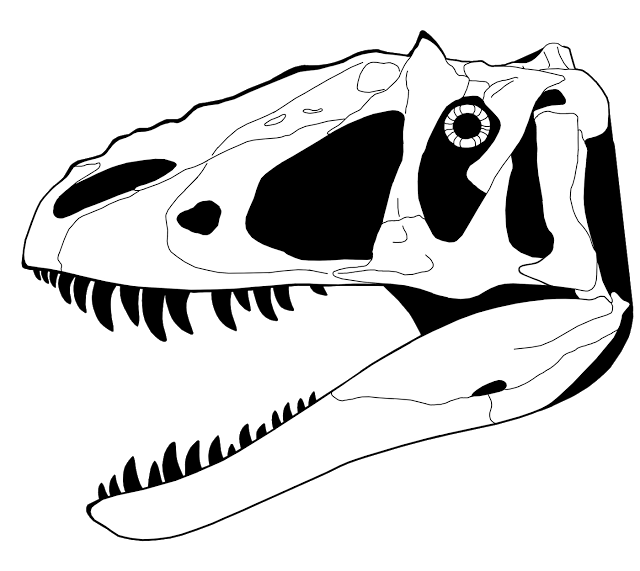
Hey, it’s not every day that a completely fuzzy, nearly 30-foot long meat-eating dinosaur is described, now is it? I’m afraid my current schedule won’t allow for a full skeletal of this critter for several more weeks, so consider the skull a down payment.
First, I should say that I’m not going to retread much of the excellent writing that has already been done on*Yutyrannus. If you’d like more in depth coverage, I highly recommend David Hone’s excellent write-up on his blog Archosaur Musings. For more coverage and some reasons to question whetherYutyrannus* is actually a tyrannosauroid, check out Darren Naish’s coverage on his Scientific American TetZoo blog. I’d also be remiss to not mention Brian Switek’s article over at the Smithsonian website.
Photograph by Roberto Appiani
What I will cover are some of the difficulties I’ve already observed in restoring Yutyrannus. The reconstruction above is based on one of the beautifully preserved skulls (there are 3!); like everything else found in the Yixian Formation, the specimens have been squashed flat. Relatively robust bones like a femur hold up fairly well, but skulls really don’t. They tend to be highly three-dimensional in shape, and are made out of relatively thin elements. In particular, on theropod skulls the top and rear of the skull tend to fold upward as the head undergoes the pancake treatment of diagenesis
.Small dinosaurs with larger eyes and brains (like the juvenile Scipionyx above seen at right) exaggerate the problem even more, and unsuspecting artists can restore the skulls as having huge domes over the eyes if they don’t know better. In Yutyrannus I suspect we are seeing something similar, which probably exaggerates the apparent size of the nasals (especially as you move closer to the eyes), as well as the top of the skull at the back.
If you check out the beautiful photograph of the head of juvenile specimen ELDM V1001 in David Hone’s blog (the same one I’ve restored above), you can probably see what I’m getting at.
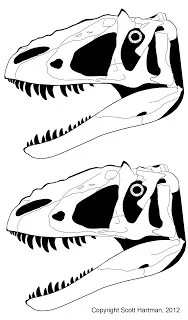
The skull restoration at the beginning of this article takes those things into account, attempting to return a 3-dimensional shape to the steam-rolled remains of the skull (by the way, the mandible is largely a place holder for now, the surangular is actually a fairly different shape). Below I’ve included a comparison of the skull with and without those “corrections”. Because there are three skulls, and because they have likely been subject to distortion from somewhat different angles, I should be able to double check this with greater precision once I get around to doing the full skeletal.
For those of you investing the time to study the comparison image, the top one is the restored version, while the bottom one treats the outline more literally. In both cases I’ve re-articulated the lacrimal (the bone in front of the eye) with the jugal (the bone underneath the orbit). In both cases the lower jaw is (as mentioned above) just a generic placeholder that is the correct size, but doesn’t take the information from other specimens into account.
That’s all the time I have to put into a new skeletal on my own whim for the moment. Until I get a chance to do the whole thing enjoy this Yutyrannus I.O.U.
8 comments
Great, as always!
This discovery is incredible i cannot really believe by looking such an amazing skeleton and specially it's skull.thanks to all these great scientists because for only these people we students are able to see such amazing things.i really don't have so much interest in biology but by looking it i really think i will also be like you people and i will also discover these amazing things HATS OFF to all the scientists those who have discovered this incredible thing.My name is Twisha Mukherjee(std-7).
Could it be possible that Yutyrannus is a fully grown Dilong?
Thanks Scott.
You'll be doing the full skeletal with jaw closed, I presume? I'd like to see it from that perspective.
Paul W.
Hi Paul - I don't generally do skeletals with the jaw closed, but it's easy enough to do one that way if there is a demand for it. I too like to see dinosaurs at little less snarling and a bit more like animals, but closing the jaw hides some of the anatomy of the mandible and lower teeth.
Still, I'll take it under consideration.
That's okay, I'm just trying to get a handle on any superficial resemblance it may have with carcharodontosaurids. I wonder too, if the more robust skull of the larger individual would increase or lesson that. I suppose seeing the whole skeletal will help, either way.
Paul W.
Of course, I meant 'lessen'.
Paul W.
nice drawing.....
Join the discussion
Thanks — your comment is in the queue!
It'll appear here in about 5–10 minutes, once I've approved it — you'll need to refresh the page to see it. (Comments don't post instantly anymore.)