You're doing it wrong
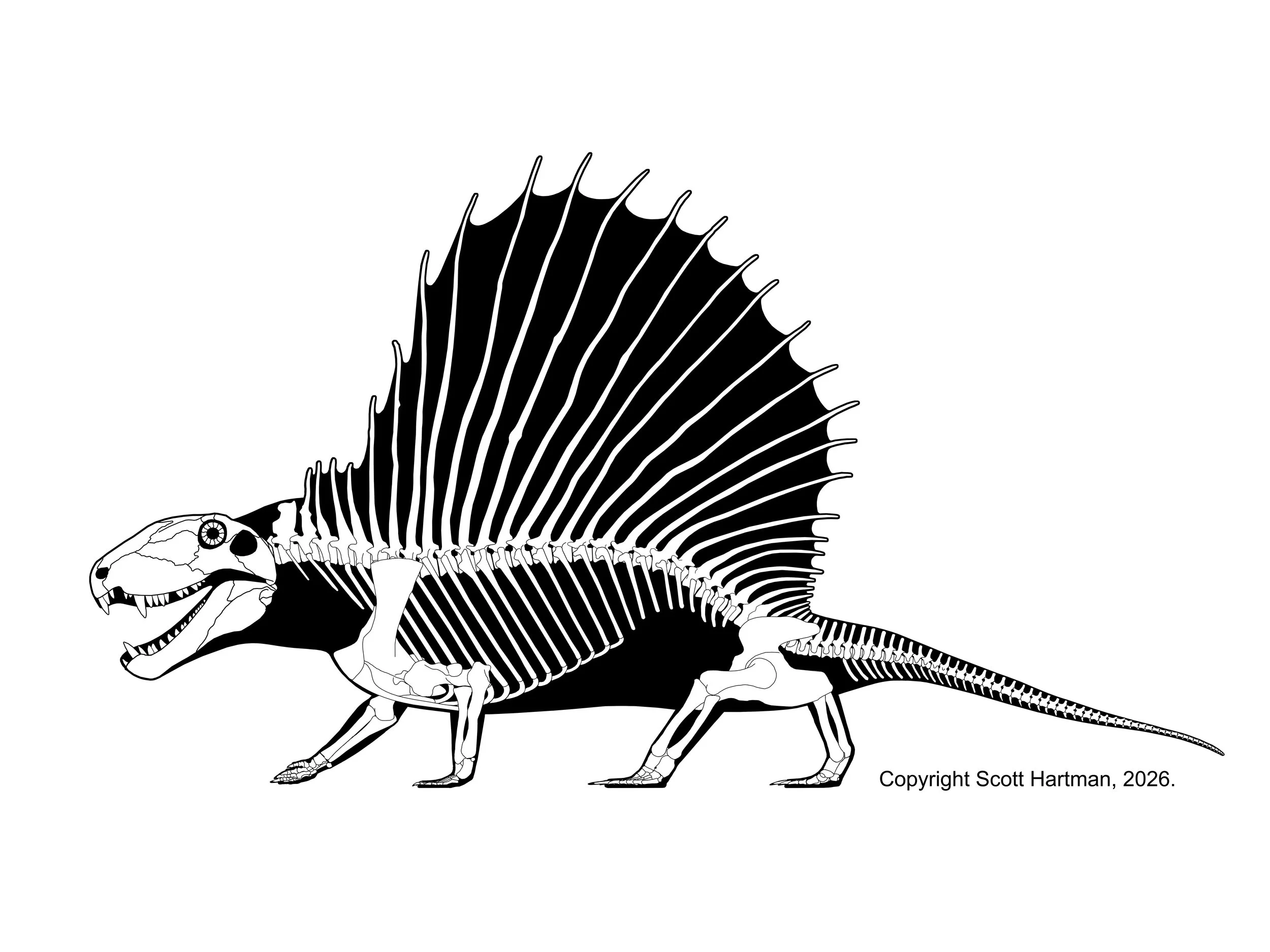
I did it wrong: Dimetrodon had a longer neck
February 19, 2026
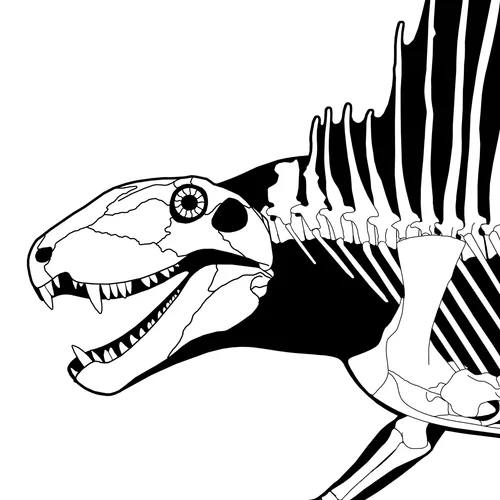
A bunch of years ago I carefully planned out how to do more short-form content for this blog, and one of those ideas was for a series of You’re Doing it Wrong… posts highlighting common errors in documentaries, art and museum mounts. Maybe I’ll still do some of those at some point, but I think it’s more interesting to highlight my own mistakes, and today we have one that I think is a doozy.
Back in 2017, I wrote a post about the challenges in reconstructing the skeleton of the sail-backed pelycosaur Dimetrodon. I noted several things, including that the curvature of the spine was strong by the pelvis, and that there was an unexpected dip further up by the shoulders.
I felt good about how I reconstructed the shape of the presacral column (the backbones in front of the hips) then, and I felt even better about it after talking to Matt Celesky at an SVP conference. He shared that while working on Gordodon he’d looked at other edaphosaurids (plant-eating pelycosaurs) and found a similar dip. Hurray!
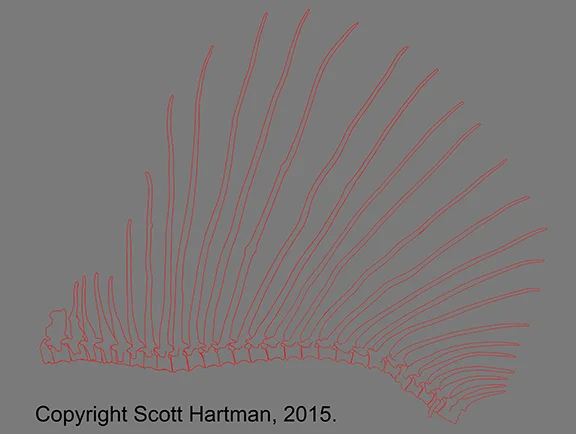
More recently as I was working on reconstructing Edaphosaurus (soon, I promise), I confirmed that sure enough, there was a definite dip again up near the shoulders (though not such a strong downturn by the hips). But looking at the articulated Gordodon fossil and my in-progress Edaphosaurus vertebral column, that “weird dip” is the transition between the back and the neck. Indeed, much of the discussion on Gordodon is on how its neck is elongate…which it is, but not by nearly as much when you put the pectoral girdle of Edaphosaurus in the same, correct place.
I’m not the first to make this observation (the entire Gordodon paper!), although short-necked reconstructions of Edaphosaurus are commonplace. But the thing is, this also reflects on the position of the neck/back transition in Dimetrodon, and where the shoulder girdle attaches. And to be frank, I had it too far forward in my initial version. The sad thing is that I’d considered this very thing a decade plus ago, but I hadn’t done as much comparative work on pelycosaurs at the time, and decided with all of the other changes I was making that I shouldn’t rock the boat without some sort of concrete data…data I just didn’t have at the time.
So I did it wrong. Now it’s updated in the gallery, and hopefully going forward we can all give Dimetrodon the neck it deserves.
10 comments
Gotta say I'm feeling very lucky that I chose a more foreshortened angle for the neck on my dimetrodon illustration from a couple years ago. The new neck looks way more natural to me!
Yeah, and that's a great piece so I'd hate to have ruined it for you.
I noticed that your Dimetrodon does not have an isolated postfrontal, which appears to be fusioned with the postorbital. Any reasons for this?
The suture wasn't clear in the specimen I was reconstructing. I'll probably add it at some point, since I'm not doing specimen-level reconstructions of Dimetrodon as this point.
Happy to finally see more of your content on prehistoric animal anatomy (now to just wait for Mark Witton to come back too). Do you have any plans on updating some of your theropod skeletals, like Dilophosaurus or Velociraptor? Or perhaps some other animal like Dunkleosteus?
The neck may be longer, but judging from the length of those ribs, it still looks like it was pretty meaty in cross-section.
Does this mean it had more neck vertebr
Does this mean it had more neck vertebrae than your earlier reconstruction?
No, it means I misjudged where the pectoral girdle should go...although I was in good company, as I put it where everyone else had been.
Dear Dr. Scott Hartman
I have illustrated a Spinosaurus Skeleton and would like you to review it with potential changes and feedback, furthermore has there been any recent updates with the lower limb proportions that Dr. Nizar Ibrahim had suggested, and that the particular specimen was a not a fully grown adult.
From DS
hope you can help
Join the discussion
Thanks — your comment is in the queue!
It'll appear here in about 5–10 minutes, once I've approved it — you'll need to refresh the page to see it. (Comments don't post instantly anymore.)