Website Tools
How'd you like to make your own size comparison chart?
August 28, 2026 · Updated August 30, 2026
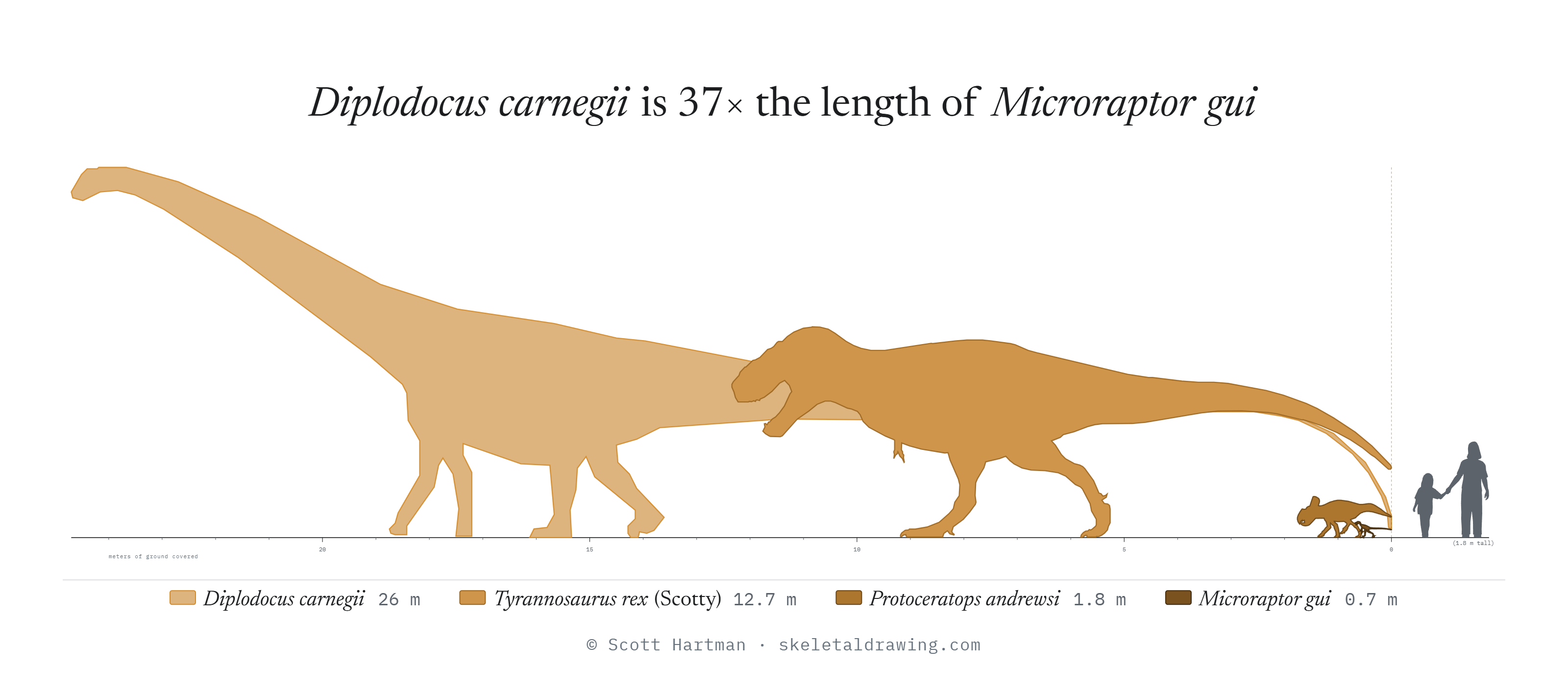
Have you ever wanted to assemble your favorite dinosaurs (or other extinct critters) into a size comparison chart? Well do I have a new website feature for you! Some of you are going to want to charge right off and try it, while others may have questions, so I’m going to introduce the new size comparison tool in a sort of FAQ format:
So…what is this?
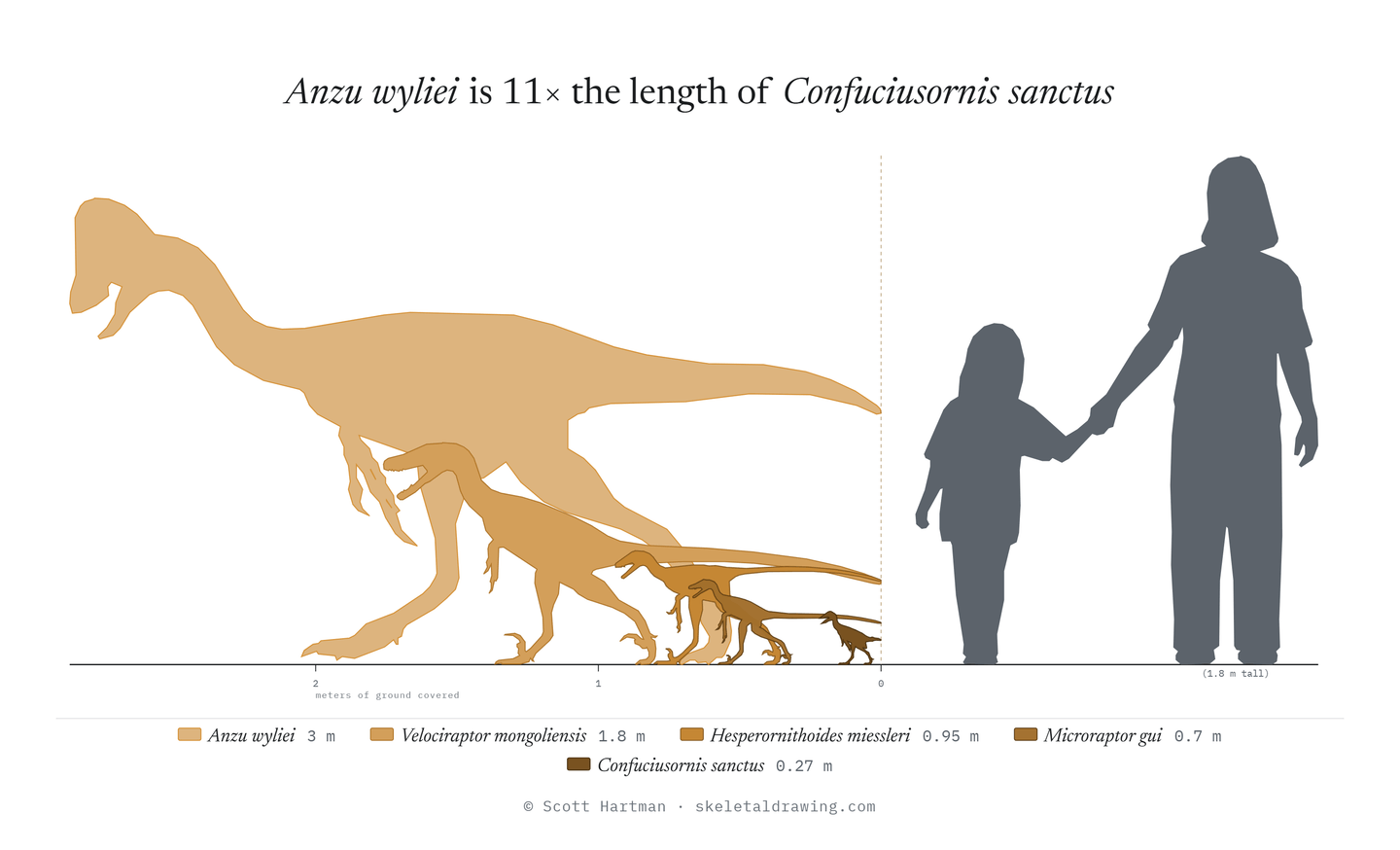
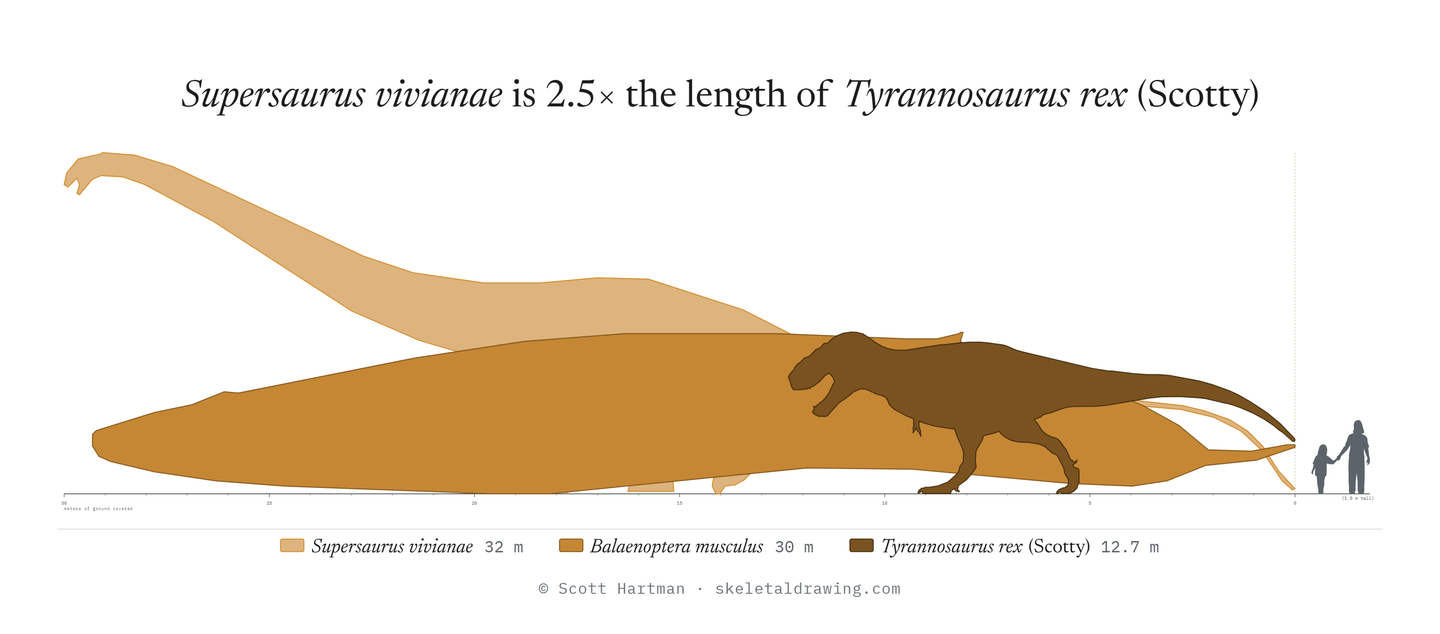
I created a tool specifically to allow you to make size comparison figures of one to five different animals (that I’ve created a skeletal for), and compare them to humans of two different ontogenetic stages (err, an adult and child). The extinct critters are all aligned with their tails to the right, and the ground plane is also a sort of ruler. It has a color legend with the taxa names and lengths, and a title that compares the largest and smallest animals that you choose. Like this:
Why did you make it?
When making the species and genus hubs, I wanted to add a little flair to them! Alongside a sortable data table, I wanted to add something visual that wasn’t just more skeletals - hence silhouette-based size comparisons. But as a static website, this worked best with vector silhouettes that weren’t very heavy, which meant creating a pipeline to trace and vectorize them.
At that point it occurred to me that there wasn’t anything stopping me from being able to compare any of them. Well, aside from having to make and maintain a database of all of their lengths, and creating a usable interface on the web for picking your critters. That’s why it didn’t launch mid-summer with the rest of the website.
I don’t want people in my diagram!
You’re in luck, there’s a checkbox where you can turn them off.
My dinosaur isn’t as long as I think it should be!
One of two things is probably happening. First, these are all based on my skeletals, and whenever possible on specific specimens. They aren’t always going to agree with other published numbers, and sometimes the specimen I restored just isn’t the largest specimen known (this is true for Giganotosaurus, for example).
But also, sometimes animals are taller than they are long. Brachiosaurus famously has a long, upright neck. The official length measurement is from the snout, along the neck down the back to the tail - that is, it’s not measured in a straight line. So if you are looking at the ground plane, a lot of its 24 meter length is eaten up by its tall neck, so unless it stretched out horizontally, it’s not going to cover 24 meters along the ground.
But I don’t like the Metric System, what about Freedom Units?
The tool is made for everyone, there’s a toggle where you can select Old English units (feet) rather than meters.
What can I do with the images I make?
Download and enjoy them. These are made for personal use, although educational use in a classroom is also fine. Feel free to share them on social media, discussion forums or Discord if that’s your jam, but kindly keep my copyright on them. If you want to include these in a scientific paper, a book, a museum display or a TV show drop me a line and we’ll work something out. At some point I may add the option to print your comparisons out on nice poster paper so you can hang them on your wall, but that’s a problem for future Scott.
Hey, why is Velociraptor naked???
Yeah, about that. This is technically just a fancy stretch from the workflow designed for fairly simple hub comparisons within a species or genus. But I agree that it’s a potential problem, as the non-feathered dinosaur silhouettes can pass for in-life reconstructions, while a bunch of the coelurosaurs should be shaggy or have wings. I plan to add this as an option in the future, but it means creating feathered silhouettes for all of the appropriate species, and also expanding the scale measurement database (since e.g. feathered tails make the animals longer). It’s going to take a while, and with a new semester full of students arriving next week, it’s probably going to take months rather than days or weeks. I’ll be sure to post when the properly feathered option is available.
I have an idea to make this better
Cool, either leave feedback in a comment below, or send it to me through the contact form (or on my various social media accounts).
Is that it?
Yup. Most importantly, have fun!
Update
After helpful feedback, I have a few updates for the tool. You can now choose to have a vertical measurement with grid-lines (in either metric or freedom units). You will also see (non-adult) growth stages reflected in the title and legend now, so when a skeletal drawing is based on a juvenile or subadult it will be more obvious what is being compared. There were also a couple of errors present, causing some taxa to be present twice, and Ceratosaurus to only show one of three specimens (along with the incorrect silhouette!). Anyone wanting a Ceratosaurus comparison is encouraged to make it again. Thanks again for your feedback.
18 comments
Dear Dr Scott,
Your new size-comparison charts are excellent and highly engaging.
However, I would like to make an inquiry regarding the size listed for Spinosaurus aegyptiacus.The current listing of 13.4 metres appears to underestimate the largest known individuals. According to sources like Fossil Era and Britannica, maximum estimates suggest these dinosaurs could reach lengths of 15 to nearly 18 metres, with the upper sizes sometimes attributed to exceptional or fully grown individuals. Given this data, I do not doubt that giant Spinosaurus specimens like the T. rex specimens Sue and Scotty that are waiting to be uncovered in the future.
I highly appreciate your work and the skeletal reconstructions,
From DS,
I discussed that above - these are based on my skeletals, and so are based on specific specimens, so it's not intended to settle "who is the absolute biggest" types of questions. The Giganotosaurus is the type and not based on the broken mandible, for example. It would require an entire additional database to let you choose "biggest known specimens" (and one I'd have to update frequently), so that's probably not going to be a feature any time soon.
Dear Dr. Scott
What an amazing tool you have given our little “Paleoculture” niche. Thank you so much for your work.
. I’ll also keep in touch with the website, to see more skeletals that you have given us and when the limit sillouettes get up to six or seven animals at a time, so we can have the full “1993 JP. roster”, lulz.
Best regards,
Gustavo/guscarmaz
I liked it.
First of all, we deeply appreciate you for making such a thing. This is very useful for people having hard time with estimating sizes between different dinosaurs.
When I checked the list, I've seen some taxa without skeletals (e.g. Ornitholestes, Avaceratops and others) are not included.
This is my personal thoughts and might be different from what you think - but have you ever considered adding these animals on the size comparison chart?
I know these skeletals will be changed eventually but I thnk adding the silhouette would be cool for checking the size.
Looking forward to know your opinion about this.
Thank you.
Nice tool! I could not resist to test it with 4 taxa I published about (Aurornis, Eotyrannus, Allosaurus, Spinosaurus).
I really enjoy the new size comparison charts. I wonder if you will do sizes for the more larger and mature specimens of Archaeopteryx (like the Berlin or Solnhofen specimens) in the near future?
I'd like to bring up an issue I found which might be worth reviewing: not all the animal skeletals seem to be measured in the same way. Some seem to have their straight-line standing lengths listed while others have their axial lengths along the centra. This might have affected how the tool scales them, which could lead to inconsistent scaling when using the tool vs manual scaling using the gallery skeletals for the same specimens.
You mentioned Giganotosaurus in the post and comments, so I wish to bring up that this one seems to be among the examples where this is noticeable and can be quickly checked with your other illustrations: you've listed the holotype specimen at 12.4 m in your 2013 'North vs South' comparison, but the gallery and tool has it listed at 11.8 m, its straight-line standing length (checked via Photoshop). Taking the type G. carolinii and Sue (which is listed at 12.3 m, same as the NvS 2013 comparison) directly from your gallery and placing them together at the same scale manually, the G. carolinii type ends up being a bit longer which agrees with the 'North vs South' comparison. However using the tool, Sue ends up noticeably longer on the other hand, which is not consistent with both the raw skeletal comparisons and the 2013 comparison.
I've put together this quick illustration with the skeletals themselves to scale, superimposed, and compared with the comparison generated by the tool: https://imgur.com/MBY7Sfc
Hope this helps, and best regards.
This is very convenient, although as soon as I decided to look at the size of deinosuchus, I immediately got an individual of 9.1 meters. Although, as far as I know, the average size is estimated at 5.5-6.5 meters.
Good
I have a random question, do you think Inostrancevia's upper canines would've been concealed like in Life on Our Planet or exposed like in Surviving Earth?
Thanks to Andrea and others who commented. There are several questions about what gets added in the future - basically it's down to how much time I have to devote to skeletals. I would love to draw all of them, but of course most of the time (outside of large commissions) this isn't my primary responsibility. So I will continue to chip away at adding more, but it's going to take time.
@Kolin - I tend to favor lips concealing the canines as the default assumption, but to really know someone should look at the microstructure of the teeth to see if they are weathering like they are covered or not.
@Altair - the Deinosuchus skeletal (and silhouette) are scaled to the largest specimens in this case.
@Aimee - nothing should be wrong because of a differing measurement style - I literally have different database columns for actual length (measured along the curve and the number reported on the site) and straight-line pixel length (for scaling the image within the tool). Also, I've updated both Sue and Giganotosaurus since that 2013 blog post. That said, I know a lot of people are concerned about it, so it IS on my list of items to check, but I'm going from the big things (that impact all users, like the vertical ruler grid) to smaller reports, so it'll be a couple of days.
Hello
What tool do you use for your skeletal drawings? I am looking for a wide range of tools to use.
@DS - I use Adobe Photoshop. Not because it's the only (or even the best) tool for the job, but because I have over 30 years of experience with it. I draw on a Wacom Cintiq Pro 27, and build desktop PCs with lots of RAM, and lots of SSDs for scratch disks to keep everything running as fast as possible. It's sort of hitting a walnut with a computing sledgehammer, but it works for me.
Hello Dr Scott
Sorry to bother you again, I found something very off about the 2014 Spinosaurus that was published and featured in the 2014 NOVA Bigger than T.Rex we see multiple parts where Spinosaurus is shown to be a short legged animal and has to be quadrupedal to walk otherwise its going to fall on its snout because of the center of balance which is highly off Dr Paul Sereno I recall said this himself. But it is represented in some scenes as walking clearly and well on only 2 legs and the legs are much larger than what is shown on the skeleton, even transitioning between quadrupedal to bipedal locomotion. In the ending scene if the documentary and in the PBS trailer it is shown running upright and opening its mouth into the screen contradicting what they had just purposed, I am not sure whether this was a editing error as I have heard that they used the base model of Prehistoric planet. Of course we now know that it did not walk on 4 legs and somehow the center of balance has been shifted once more due to the 2020 paddle tail find, I just wanted to know what were your thoughts on this and does this change anything about the debate?
DS
Genial
Me gusto
Join the discussion
Thanks — your comment is in the queue!
It'll appear here in about 5–10 minutes, once I've approved it — you'll need to refresh the page to see it. (Comments don't post instantly anymore.)