Hesperornithoides: Frequently Asked Questions
July 10, 2019
I’ve seen many questions raised about our recent publication of the Lori specimen, so here are some responses to the most common queries:
What is this about?
It is my pleasure to introduce Hesperornithoides miessleri, a small paravian theropod from the Late Jurassic Morrison Formation of Wyoming.
Where’s the paper? Gimme, gimme!
You can find the scientific publication here: Peerj
Finally!
I know, right?
Wait, what??
Oh, sorry! For those of you who don’t know, over a decade ago I and some coauthors presented a phylogenetic analysis of a small maniraptoran theropod dinosaur at SVP, where we found it was likely a troodontid. Known informally as “the Lori specimen”, the process of actually getting the specimen published has taken…more time than expected.
Why “Lori”?
It was named after a volunteer on the dig when the specimen was discovered.
OK, so tell me about Lor…Hesperornithoides?
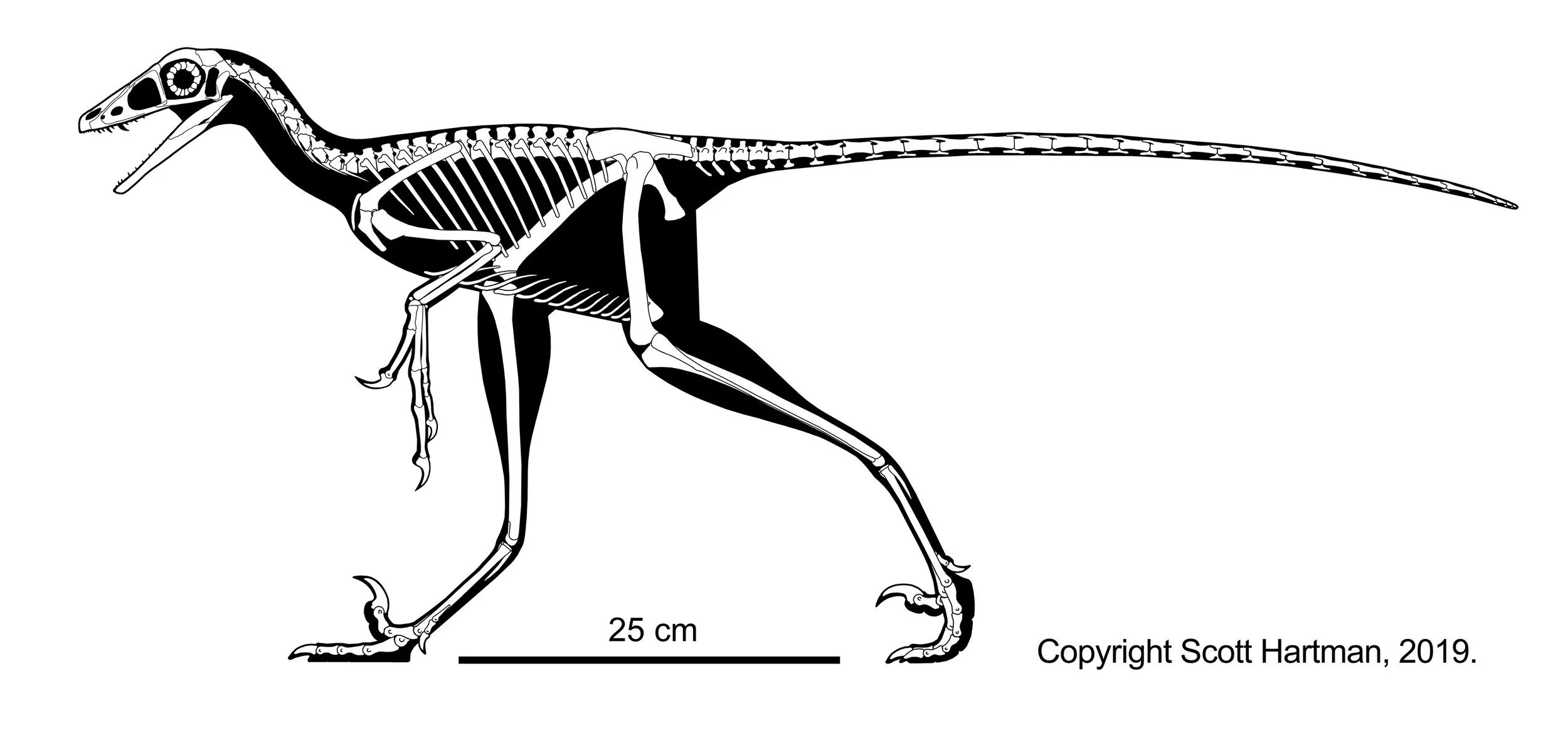
Hesperornithoides is a small (less than 3 feet / 1m long) theropod that lived around 150 million years ago in the western United States. It has a well developed wishbone, some surprisingly large, bladed teeth, and a sickle-claw on its hind feet like Velociraptor and Troodon.
Did you do a skeletal drawing of it?
Like you had to ask! Here it is:
What sort of environment did Hesperornithoides live in?
You have to always be cautious with assuming that animals lived where they were buried, but in this case we have pretty solid evidence this was in fact the case. The specimen was found in a semi-arid wetland (sounds like a contradiction, I know), with no evidence of flowing water. Also, the specimen was found curled up, not unlike the resting posture found in other troodontids such as Mei and Sinornithoides. This suggests that Hesperornithoides lived where it was buried (at least for a portion of its life!). The structure and chemicals of the rocks Lori was found in suggest the area was semi-arid, but with a fairly high water table. So patches of shallow, standing water that was dominated by horsetails, ferns, cycads and herbaceous conifers (i.e. not many trees). It’s unknown, but also reasonable that Lori may have hunted small prey in and among these patches of plants.
Was Hesperornithoides feathered?
Without a doubt. While no skin impressions were preserved, the specimen’s family relationships show it deeply embedded within the group of birdlike theropods (pennaraptorans) that had not just feathers, but wings. It also has a nicely preserved wrist, including the enlarged semi-lunate wrist bone that winged theropods use to fold up their feathery arms.
So…could Hesperornithoides fly?
Definitely not. The arms are much too short.
If it didn’t fly, what were the wings for?
Several answers have been suggested. Enlarged wing feathers (even on the hind legs) can maintain ideal thermal conditions for eggs, which increases reproductive success. Wing feathers can be used for display, to win friends and scare your enemies. They can be flapped vigorously to aid in stabilization (e.g. for Raptor Prey Restraint style hunting) or they can be used to help an animal turn (or brake, or stick a landing with more accuracy) by pushing against the air. It’s likely that more than one of these hypotheses (and quite possibly all of them) played a role in driving the evolution of wings prior to flight.
But wait, what if winged theropods like Hesperornithoides evolved from flying ancestors?
Ah, very clever! That’s called the neoflightless hypothesis and it has several supporters, perhaps most famously Greg Paul who is largely responsible for popularizing it. The idea would require an earlier origin of bird flight, and then all of these winged theropods would have evolved from flying ancestors and subsequently lost flight (like the ostriches or dodos of the Mesozoic). It’s not an unreasonable idea, but we found little support for it.
Why don’t you think the neoflightless hypothesis is correct?
Ultimately it boils down to a question of phylogeny (who is related to whom) - either there are species that use aerial behavior at the base of winged theropods, or there isn’t. We found convincing evidence not just that the earliest winged theropods didn’t fly, but also that the most primitive members of each winged subgroup were flightless. In fact, we found evidence suggesting that the earliest avialans (dinosaurs closer to birds than to dromaeosaurs and troodontids) didn’t fly.
So, how does this compare to other phylogenetic analyses?
It hasn’t been uncommon for other scientists to find similar results to ours, but it hasn’t been universal either. One concern we had was trying to increase the number of species in our analysis. “Exciting” winged theropods like Microraptor and Archaeopteryx are always included in past analyses, while lesser known or less complete species are often left out. We were concerned this had the potential to bias results, so we dramatically expanded the number of species in our analysis. The results (as stated above) was a clear preference for flight showing up higher in the family tree, long after wings had evolved.
Have other questions? Email me or post them below and I’ll write up a second post to answer them.
19 comments
1. Why the big furcula?
2. Why lack of sternum?
3. Why the big maxillary teeth?
4. Possible coloration?
5. What was the snout covered with? Scales, keratinous sheath, skin...?
6. Second and third fingers were united in a mitten?
7. What about the braincase? Was it intelligent or like me?
1) Good question. Maybe Lori was engaging in fairly vigorous RPR flapping, or making use of the wings to turn at while running speeds, or had a particularly vigorous mating dance, and the stabilizing of the pectoral girdle and extra muscles may have been useful in any (or all) of those scenarios.
2) It's possibly it simply wasn't preserved, or failing that it could have been cartilaginous. But recent work (e.g. Zheng et al, 2014) has suggested that the sternum may actually be lost in some paravian taxa, so I didn't want to be presumptuous and add it (for now).
3) Presumably something related to food acquisition. Maybe they were suited for catching small prey that was particularly furry or feathery?
4) Your guess is as good as mine, though I'd draw inspiration from wetland or semi-wetland birds that stalk prey (e.g. egrets and herons).
5) Keratin is generally viewed as less likely to cover the whole snout in toothed taxa. Some feathered paravians from China have fluff that continues onto much of the snout, so that's possible. The remaining portion would presumably have been skin or scaly, but there's no direct evidence at this point in time.
6) Possibly! Quite a few theropods (even outside of coelurosaurs) have hinges that line up between the second and (some of) the third digit, which could be linked to syndactyly. And in pennaraptorans having soft-tissue that supports and manipulates the protowing feathers might be seen as increasing the odds of encasing digits II and III at least in part. Hopefully more paravians with soft-tissue outlines like Anchiornis will help answer this question in the future.
7) The braincase is a bit squished so it's hard to say right now. Given its phylogenetic position it was likely to have been in the upper range for Mesozoic dinosaurs, but there's still a wide range of plausible EQs it could fall into.
Did Lori live at the same time as that specimen of Supersaurus, or hundreds (thousands?) of years later? Is it possible that she scavenged on his body?
Lori would have lived too much later in time to have scavenged Jimbo. David Lovelace has done some really nice stratigraphic work there, and the environment changes a fair bit between Jimbo's time and Lori's time (whether that was hundreds, thousands, or tens of thousands of years is less obvious because deposition rates are not constant in terrestrial environments like this).
Awesome, thank you!
Will the matrix expand to accomodate more basal theropods? Will expanding it resolve some of the stranger relationships (e;g alvarezsaur Pelicanimimus)?
It's not impossible, but the matrix is mostly designed for coelurosaurs. It's not really feasible to design a super-matrix that is all things to all taxa, so most likely additional work would focus on including more coelurosaur taxa, or adding new characters relevant to them. Part of the reason for including so many more basal taxa was to ensure proper outgroup sampling for likelihood-based phylogenetic methods (and, you know, to see how well a matrix designed for coelurosaurs performs with more stemward taxa...and the answer is surprisingly well).
As for Pelicanimimus - I'm not 100% convinced that an alvarezsaurid Pelicanimimus should be a shocking result, but the specimen is in need of an expanded description and that would almost certainly help resolve its position (e.g move it back to ornithomimids...if that's what it really is).
In terms of the handful of "strange" results in the phylogenetic analysis, ask yourself why they seem strange? The point we were making in the paper is that many published phylogenies reuse TWiG matrices and just adding in a handful of new taxa and/or a few more characters to test the position of a new species (and those additions are often not carried on to subsequent studies). That has the advantage of making comparisons to other papers more direct (not to mention it's a lot easier), but it also means that in many of these studies 99% of the matrix is the same. So a lot of "consensus" coelurosaur assumptions are not being independently tested each time a new phylogeny is published, but the repetition makes it seem like it is (obvious exceptions for major revisions or additions to the TWiG data set, and also for independent data sets by Cau, etc.). Having said that, we don't think most of the coelurosaur "consensus" is wrong (or at least not wrong by very much), but by adding in a lot of taxa (and a lot of character information that wasn't previously scored) we do get some less usual results - and we think it's important to publish those so others can test them in future studies. After all, if the main result of this is we get a really good description of Pelicanimimus that results in it definitively grouping back as a basal ornithomimid...well that would be just fine with me.
Scott gave a great answer. I'll just add that adding characters relevant to more basal theropods won't help Pelecanimimus move anywhere else. As we wrote, "Constraining it as an ornithomimosaur only requires two additional steps, however, where it emerges just above Shenzhousaurus as in Macdonald & Currie (2018). As only two of their characters supporting an ornithomimosaurian identification were not used by us, and only one from Brusatte et al. (2014), ..." So even if these three characters each work out to favor an ornithomimosaurian Pelecanimimus, that just gets us one step favoring it. Which might as well be ambiguous. Perez-Moreno wrote a detailed description which could help us solve the problem, but no one with copies will make it public. So we're stuck for now.
One more I missed,
Are you adding lips to this skeletal?
I will, yes. Just been a bit too busy so far.
Wonderful. And thanks for the other answers!
I like the idea (both scientifically and intuitively) that powered flight evolved many times in pennaraptorans. I predict there to be pushback though, with some folks preferring the neoflightless hypothesis (I don't). They could argue that paleognath birds lost flight multiple times independently, so why not basal pennaraptorans?
Of course I agree with you, but I have two thoughts on this:
1) We don't know that powered flight evolved more than once - it's not clear that either Archaeopteryx or Microraptor were powered fliers (as opposed to WAIR specialists, gliding death-from-above specialists, or short duration ground-launch specialists). And at this point we are at a very early stage of understanding what (some?) scansoriopterygids were doing. For that reason we were careful to only claim "aerial behavior" evolved multiple times. Of course I have some ideas, but what those aerial behaviors were will undoubtedly be debated for years to come.
2) I've seen the "paleognath model" for neoflightless argument. One major problem with it is we know paleognaths had ancestors that were volant at one time or another (same with anserimorphs) - the entire point for pennaraptorans (and paravians...and avialans) is we don't know that, so it has to be tested. We just produced a major test of that hypothesis and it very clearly does not side with neoflightlessness. Moreover, we supplied an answer for why people have gotten variable results about the neoflightless hypothesis previously (reduced and potentially biased taxonomic sampling). The idea of pennaraptorans being neoflightless isn't unreasonable, but to my mind neoflightless claims can't be taken more seriously at this point in time than "it seems possible" until someone produces a phylogenetic study with similar taxonomic sampling that supports it. Wishing the data away doesn't work just because people have an analogous model they aesthetically prefer.
Thanks for the response. Personally, I prefer "short duration ground-launch specialists" for Archaeopteryx, Microraptor etc - as a hypothesis, i think it fits the evidence best. I'd say that short duration ground-launches qualify as powered flight - powered (because there is a thrust as well as a lift component), but not sustained.
I'm looking forward to further work on scansoriopterygids.
Ah, classifying ground launch as powered flight is reasonable. In that sense then you are right, we are predicting multiple origins of powered flight. I strongly agree about short duration ground launches for Archaeopteryx, to the point where I have a hard time entertaining alternatives at this point in time. I think it's also a reasonable model for Microraptor, but if they could WAIR up trees simply to roost (though clearly not to clamber around in them once up there) then it also seems reasonable that Microraptor was using a death-from-above controlled flap-glide onto prey, ala the mechanics presented by Hall, et al in 2012. I don't have a strong preference between those two. Scanoriopterygids are...interesting. But whatever they were doing it clearly didn't give direct rise to avian flight. So depending on what they did (and what Rahonavis did, if anything) that is indeed several (1-4) independent origins of powered flight outside of the line that gave rise to modern bird flight. What's interesting is that means among known taxa you get up towards jeholornithids and confuciusornithids to find actual powered flight that is on the true avian line...and confuciusornithids show actual evidence of incipient arboreality. So while trees may not have driven the origin of wings, or even other independent origins of powered flight, they may have played a key role in the changes that resulted in avians eventually becoming the dominant flighted theropods.
Yep, I completely agree that 'short duration ground launches' is by far the best fit for Archaeopteryx, to such an extent that alternatives don't appear biomechanically or ecolomorphogically viable. I'd say the same is true for Microraptor and Rahonavis. So all three could be hypothesized to be powered fliers. (Maybe more, If Alcomonavis and others are similarly nested among non-flighted taxa.)
I don't see any role at all for WAIR in Mesozoic paravians - I found Dececchi et al. (2016) very persuasive on this point (i.e. WAIR is a derived avian behavior in certain precocial crown taxa, not an incipient pre-flight behavior). If small paravians wanted to get into a tree, they could launch from the ground. Having said that, I'm not convinced that Archaeopteryx or Microraptor spent much time (if any time at all) in trees. The so-called "arboreal" characters described for Microraptor don't strike me as arboreal (even incipient).
But confuciusornithids (especially Changchengornis) and sapeornithids do show arboreal adaptations, so arboreality might be the one thing that sets the Avialae apart from Archaeopteryx, Microraptor etc. Again, avialans wouldn't need WAIR to get into trees - aerial launches would do the trick.
So I definitely agree with your last sentence - that trees may have played a key role in the changes that resulted in avians eventually becoming the dominant flighted theropods. I'd say that powered flight facilitated arboreality, not the other way round.
BTW, I thought this was a great paper, and I enjoyed reading it (still am) - so well done to you, Mickey, et al.
Thanks Tim! Interestingly, I was basing my own comments in part on Decesschi et al. (2016). They are almost certainly right that WAIR played no part in driving the origin of, or most of the expansion of wings in non-avialan theropods, but Microraptor consistently grouped in the Stage 2 WAIR range so it's not clear to me why their paper would rule this out as a specialized adaptation found within some microraptorines. Of course that doesn't mean Microraptor had to be utilizing WAIR, but their data doesn't preclude it as near as I can tell. I don't know what to make of Rahonavis because I'm not 100% convinced the forearms go to it (as opposed to one of the more derived avialans in the bonebed). But assuming they do, I agree that ground launch seems the most likely explanation.
Once you get into early bird-line flight (e.g. confuciusornithids) I think it's less clear that ground launch is better than WAIR to get into trees. Not impossible mind you, but ground launch requires landing in trees at a fairly high rate of speed, which is itself a difficult thing to do as a biped with a COG fairly far from the landing substrate. Without well-developed breaking (e.g. alulas) and well-muscled "perching" feet (i.e. those with a reversed and well-muscled digit 1) to arrest forward momentum then landing in trees is also potentially problematic. The large wings (low wing loading) and hypertrophied shoulder muscles of confuciusornithids could also be suggestive of specialized WAIR behavior, right at the place where avialans finally show incipient (rather than derived) levels of arboreality. I'm not wedded to this mind you, but I think given our current level of understanding it's as reasonable as a ground launch mode of getting into trees.
Ah yes, I see what you're getting at - good point, I hadn't thought of that. Perching on a branch (especially 'sticking' the landing) could be tricky for paravians with only rudimentary flight abilities, landing at fairly high speed. So WAIR could possibly be used to scale a trunk and reach a branch.
Although Microraptor had an alula, so maybe better at braking; but the feet are poorly adapted for perching. Frankly, I'm not convinced Microraptor spent any time in trees.
However, one argument against WAIR is that WAIR is highly demanding, and requires an 'advanced' flight stroke - so maybe beyond the 'musculoskeletal morphology' of basal avialans. Dececchi et al. 2016 make this argument, but I think there are other sources (that I can't recall atm). Even Confucisuornithids lacked a sternal keel (apart from a tiny ridge in some specimens, iirc).
Join the discussion
Thanks — your comment is in the queue!
It'll appear here in about 5–10 minutes, once I've approved it — you'll need to refresh the page to see it. (Comments don't post instantly anymore.)