Giant theropods: North vs South
March 26, 2013
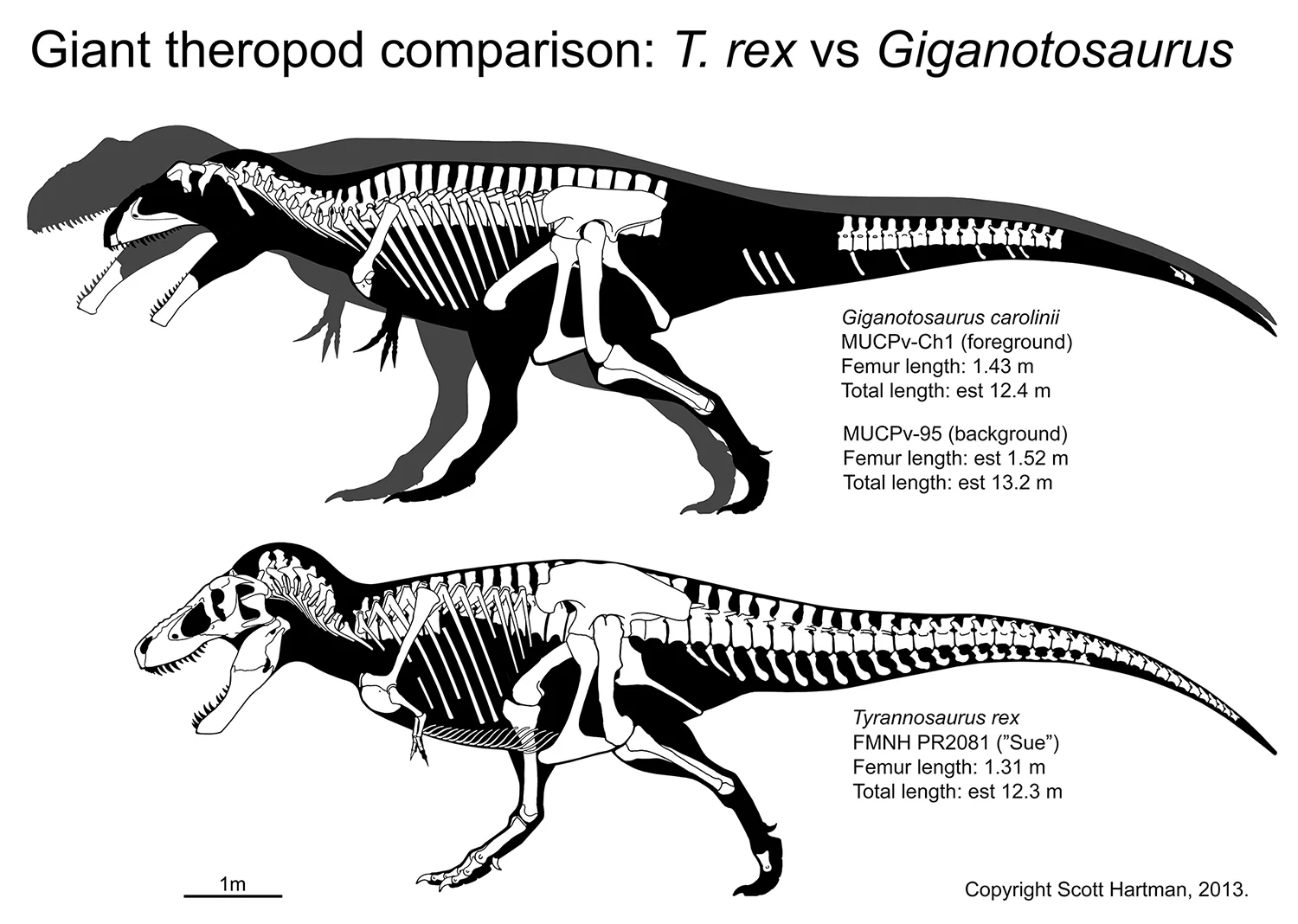
Ok, wading into the always contentious issue of who was the biggest (which on ‘teh internetz’ seems to loosely translate into “who was more awesome?”) I’m presenting my analysis of the always popular Tyrannosaurus vs Giganotosaurus issue.
A few things worth noting:
-
It appears that the type specimen of Giganotosaurus is essentially the same size as Sue despite having a somewhat longer femur. This is sort of surprising, since T. rex is generally thought of as having longer legs (in reality Sue simply has a proportionately longer lower leg relative to her upper leg, not longer legs overall).
-
We really don’t know which of the two was longer, as there is enough of a margin of error in restoring tail lengths that the margin of error could allow either one to eek out a “who’s the longest” win here (we’re ignoring other theropods for the time being). A good discussion on this topic can be found here: [link]
-
Sue almost certainly had a higher mass than the Giganotosaurus type specimen, as tyrannosaurs seem to have broader torsos for their size.
-
So…that large isolated Giganotosaurus jaw? It’s not really clear how much bigger that individual is, because there isn’t perfect linear scaling between it and the type specimen (the isolated jaw is proportionately a bit deeper). My “best fit” version appears above, and indicates an animal about 6.5% longer than the type. That would result in an animal over 13 meters in length, and also one that would be heavier than Sue.
-
Yes, I know there are also fragments of even larger T. rex specimens. Unfortunately things like toe bones are even harder to try and scale up reliably, so I haven’t attempted it (also I really would want to see the things first hand before I tried it).
-
So in conclusion, between the specimens that are well enough known to estimate reliably, Tyrannosaurus and Giganotosaurus are about the same length, and T. rex was probably a bit heavier. The big jawed Giganotosaurus appears to be from a larger animal, but the nature of fragmentary specimens being what it is you simply aren’t going to get to know which species was “truly the biggest”.
Sorry, the data just doesn’t allow this sort of thing to be done conclusively at this point in time, no matter how much we wish it were otherwise.
1 comment
Hi Scott,
If a Tyrannosaurus specimen (i.e B-rex) have a wider femur circumference than Stan (another Tyrannosaurus specimen), does it mean that B-rex is heavier than Stan despite Stan's femur is longer than B-rex's? Do you agree with Peter Larson's statement in his 2008 book, "Tyrannosaurus Rex, the Tyrant King" when he said tyrannosaurs with the so-called "robust morphotype" is indeed bigger and heavier than the so-called "gracile" tyrannosaurs? He also said the tyrannosaurus specimen found with an assumed medullary bone in its femur, B-rex is also a "robust morphotype" so it is true that female tyrannosaurs are indeed bigger and heavier than male tyrannosaurs. But, he is quick to dismissed the fact that it could be caused by geographical variation rather than sexual dimorphism. He also don't know that B-rex is actually an adult specimen (B-rex is an 18-19 years old female tyrannosaurus if the tissue found in its femur were indeed medullary bone) and it is much smaller than the assumed "gracile" specimen like Stan. I think male tyrannosaurs are much bigger and heavier than female tyrannosaurs given the fact that the majority of land carnivores, it is male that is bigger, heavier, stronger and more dominant than the females. Thoughts?
Join the discussion
Thanks — your comment is in the queue!
It'll appear here in about 5–10 minutes, once I've approved it — you'll need to refresh the page to see it. (Comments don't post instantly anymore.)