Theropods
Falcarius: bizarre sickle-cutter
November 18, 2011
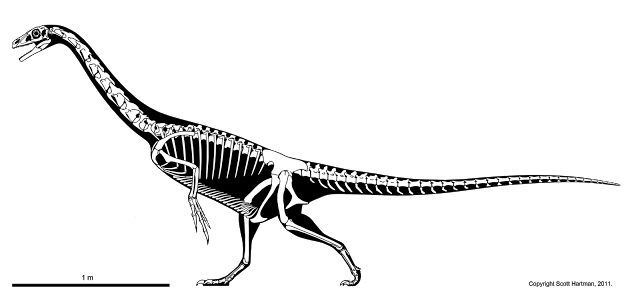
The truly strange looking animal above is Falcarius utahensis. It’s an early, omnivorous member of the theropod clade known as therizinosaurs. Not only does it look weird, it’s also a bit different from other skeletals you may have seen on the web. Join me after the break for a bit of a discussion about Falcarius, and the challenges I faced with this reconstruction.
I should warn you, this won’t be a tutorial on how I make my skeletal reconstructions. That would certainly be a fun series, but it would require quite a lot of time to do properly, so for now it’ll have to wait. But there are still several points worthy of discussion.
First off, the animal was discovered in a bone bed of disarticulated individuals. The good news is that most of the individual elements are known, but the down side is the bones aren’t all from the same sized animals. That means that cross-scaling is needed to restore the skeleton, but even that presents a challenge; the usual method of cross-scaling involves double-checking the results against the proportions of close relatives. Alas, in this case the fossil record for the base of the therizinosaur family tree isn’t well known, and what is known makes it clear that Falcarius has very different proportions than it’s closest known relative: Beipiaosaurus.
(Image copyright Greg Paul)
When the original description of Falcarius was published in 2005, it came with the skeletal drawing at left. Obviously I don’t agree with those proportions now, but at the time it had been done when fewer bones had been excavated, prepared, and described in detail, so Greg Paul had to try and scale them based on a smaller amount of material to compare with.
In fact, given the difficulty of restoring the proportions I intentionally avoided doing a Falcarius skeletal reconstruction for several years. I might have avoided it all together, but towards the end of my tenure at the WDC we mounted a cast of Falcarius that Gaston Design produced. Working on that skeleton I was able to not only measure and photograph all of the elements, but spend time looking at how the individual elements were matched up. Some parts of the cast’s vertebral column are from different sized individuals (an unavoidable consequence of trying to piece together a skeleton from several different individuals). In other cases, vertebrae I had assumed to be from different sized animals were in fact crushed.
In addition to the hands-on data, Lindsay Zanno had been hard at work publishing more detailed information on Falcarius (this is actually notable, as not all researchers are as timely with getting more detailed descriptions of a new animal into print).
As the information piled up I felt that a skeletal was possible to be done. I still didn’t tackle it though, as there were plenty of “low-hanging fruit” skeletals that could be done from less-challenging animals.
As luck would have it, I ended up being asked to produce a skeletal of Falcarius for a display in the new Utah Museum of Natural History building (side note: the new UMNH building just opened, and houses one of the most impressive natural history displays in North America, go see it!).
Since I was working with the UMNH, I got valuable input from several of the researchers who worked on the specimens. They were able to provide additional information - I won’t go into the nitty-gritty of it (although you may if you would like), but I wanted to point out that the end result was quite a surprise to me. And little is more satisfying than when you are really surprised at the end of a skeletal reconstruction.
Resulting skeletal in hand, you can compare it to the most recent studies of the therizinosaur family tree, as well as the excellent research being done by Lindsay Zanno and Peter Makovicky on the origin of plant-eating in theropod dinosaurs, and Falcarius starts to tell an interesting tail about the order in which therizinosaur traits appeared.
Falcarius appears to already be specialized for browsing for high forage. Given the lack of an enlarged gut for fermentation it probably preferred to seek out higher-quality plant matter, like fruiting bodies or seeds. The partially upright stance appears concurrently with a widening of the passage through the pelvis (not visible in side view) allowing more guts into that area, causing the center of gravity to sit further back despite the elongation of the neck.
The large hand claws (from which the authors derived the name “sickle-cutter”) may have allowed Falcarius to pick up small prey, but they also may have served as defense for a fairly slow animal with small teeth. The first toe is low and long enough to start interacting with the ground, perhaps to provide balance and stability when browsing high. All of these features would be carried to extremes in advanced therizinosaurs, but they seem to already be playing the same (albeit incipient) functional roles in Falcarius.
So with Falcarius we have an animal that at first glance appears inexplicably strange, but when viewed through the lens of where it was coming from (long-bodied small-headed meat eaters) and where it ends up (the upright, pot-bellied therizinosaurs) the combination of traits start to make a lot of sense.
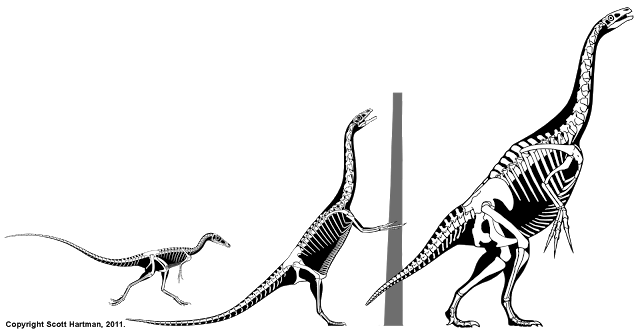
Isn’t science grand?
References:
Kirkland, J. I., Zanno, L. E., Sampson, S. D., Clark, J. M. & DeBlieux, D. D., 2005. A primitive therizinosauroid dinosaur from the Early Cretaceous of Utah. Nature, v435, pp 84-87.
Zanno, L. E. 2006. The pectoral girdle and forelimb of the primitive therizinosauroid Falcarius utahensis (Theropoda, Maniraptora): Analyzing evolutionary trends within Therizinosauroidea. Journal of Vertebrate Paleontology, v26 n3, pp 636-650.
Zanno, L. E. 2010. Osteology of Falcarius utahensis (Dinosauria: Theropoda): characterizing the anatomy of basal therizinosaurs. Zoological Journal of the Linnean Society. v158, pp 196-230.
Zanno, L. E. & Makovicky, P. J., 2011. Herbivorous ecomorphology and specialization patterns in theropod dinosaur evolution. Proceedings of the National Academy of Sciences. v108 m1, pp 232-237.
8 comments
Any commentary on the tail length, which seems to be the biggest departure from Paul's recon? Yours certainly makes more sense for a maniraptoriform, and I know the disarticulation means we can't be sure how many it had, but Paul's does look better balanced. Biomechanics really isn't my thing, but would your Falcarius be able to balance easily, especially considering the neck looks even larger? Maybe all the presacral airsacs would save it...
The best answer I can give you for how Greg came up with that length was that he assumed that a mid-tail section from a smaller individual was the correct size. Having seen the sacrum and other caudals all I can say is they aren't that small.
There aren't any fully articulated tails, so the caudal count is based on its phylogenetic position - there's no justification for such a high count (which would obviously be homoplastic).
As for balance, the shorter tail that I restore actually is more massive than Greg's, so you aren't losing anything in terms of balance. The neck, as you say, is not very dense, and as I mentioned the pelvic canal of Falcarius is already enlarged quite a bit, so the mass in the abdomen has already begun to shift backwards.
Despite all that, the center of gravity is just behind the right foot, not under the pelvis. But there isn't any theropod that has its center of gravity below the hips, so that's not strange either.
As a quick addition to Scott's reply, there is actually no biomechanical requirement that balance be achieved in a bipedal animal (or any terrestrial critter, for that matter) by purely passive means - negative pitching moments can be overcome by the intrinsic back musculature. Humans, for example, are intrinsically unstable any time we are on one foot, but our abductors keep us from falling over.
The trick, of course, is that the muscles can only do so much - as a result, the center of gravity needs to be in a reasonable position to begin with, or else the animal is in trouble. The cg need not be lined up exactly, however.
Since it has a small head we can guess it had low bite power More of a rake feeder & more mussle in the neck for pulling on plants.Though (I dont know how much the hands could stabelised the food) I get the feeling the tail would need to have slightly more mussel & wieght to it to counter these movement and stip it falling over.(Thinking bird and worm)But just a thought Im no expert. Like you lot are.
@Nikola - head size doesn't correlate in a straight-forward manner with bite strength, because factors like the leverage the muscles have can offset the reduction of muscle mass. That said, I doubt Falcarius crushed it's food, so you are probably correct.
The hands could not play any significant role in food stabilizing, as they don't reach close enough to the mouth. I think the hands could have stabilized the animal when it was browsing up against a tree or some other vertical substrate, and probably served a defensive role.
Thanks for the response Your right about the arms.I was imaging it forcing down saplings to feed
But the more I see it the more it does not work.
It's a confusing creature though. II wonder if larger plant eaters lived along side it.Helping make a viable habitat for it? I cant see it in a confirer forest if larger dinos had a higher browes line, Or did it eat the damages plants they tore down?.Feeding off lower ground ferns.This would depend on the wrist support and flexiblity of course. It makes me wonder alot about the feeding habits of the creature.
How flexible do you think it's spine was & do you think it would have been a flexible mover, or more sloth like?
Thanks for getting my brain thinking. Im enjoying this!
Oh Bother! ignore my nievity this critter was an omnivore was'nt it!! sorry I have no idea why i thought it was a solid plant eater sorry!
It would make sense to me that the animal's long claws would be for grazing, the same way a panda bear's claws help it eat bamboo. It also could help also help this animal scrape bark off trees if that is something he ate. Also it would make sense to me that this animal was a solid plant eater, for one most of the fossil evidence support it and also, with the exception of the creature's claws, there aren't any substantial evidence that you mentioned, for this animal to be omnivorous.
Join the discussion
Thanks — your comment is in the queue!
It'll appear here in about 5–10 minutes, once I've approved it — you'll need to refresh the page to see it. (Comments don't post instantly anymore.)