Deinocheirus - Therizinosaur or hadrosaur mimic?
July 10, 2015
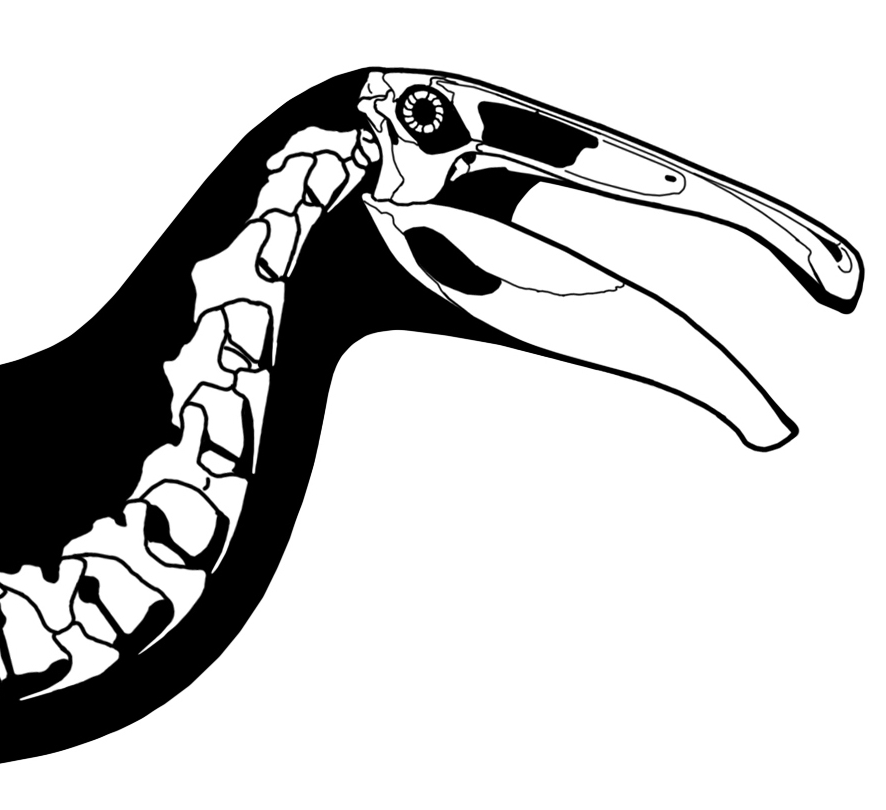
When the skull and body of Deinocheirus were revealed there was a lot of talk about how much it looked like a hadrosaur. I did not really agree with this analogy, as the upright posture and large, clawed hands seemed to indicate that it was an ornithomimid trying its best to be a therizinosaur rather than a hadrosaur. Now I’m not so sure.
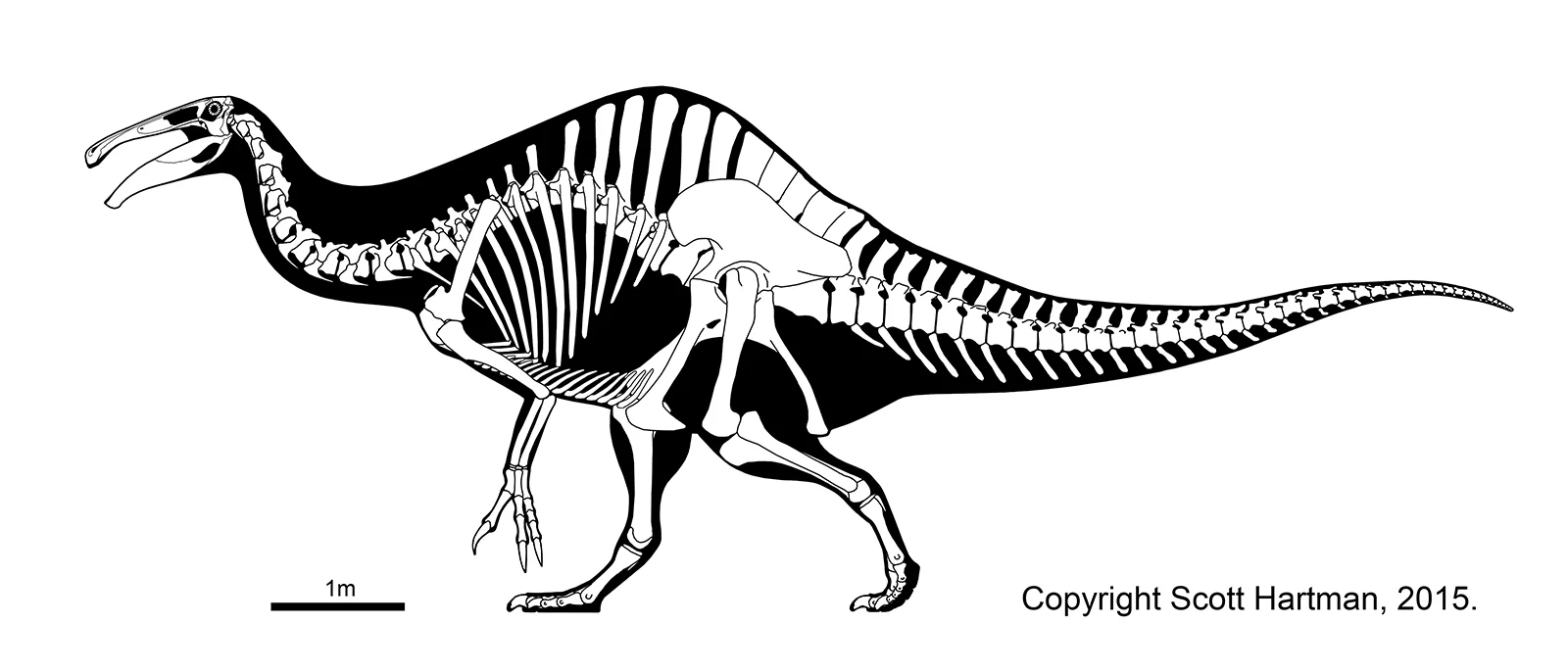
Restoring the skeleton of Deinocheirus was something of a treat compared to more difficult taxa. The two recently described skeletons (one adult and one subadult) combined with the type specimen meant that almost every part of the animal is known. There was a lot of overlap between the two specimens, so cross-scaling between elements was quite easy, as was adjusting for ontogenetic changes in the proportions of the vertebrae. The skeletal reconstruction published with the Nature paper nails the proportions pretty well. Maybe that’s faint praise when they had two really nice skeletons, but it’s sadly uncommon in skeletals that accompany technical publications.
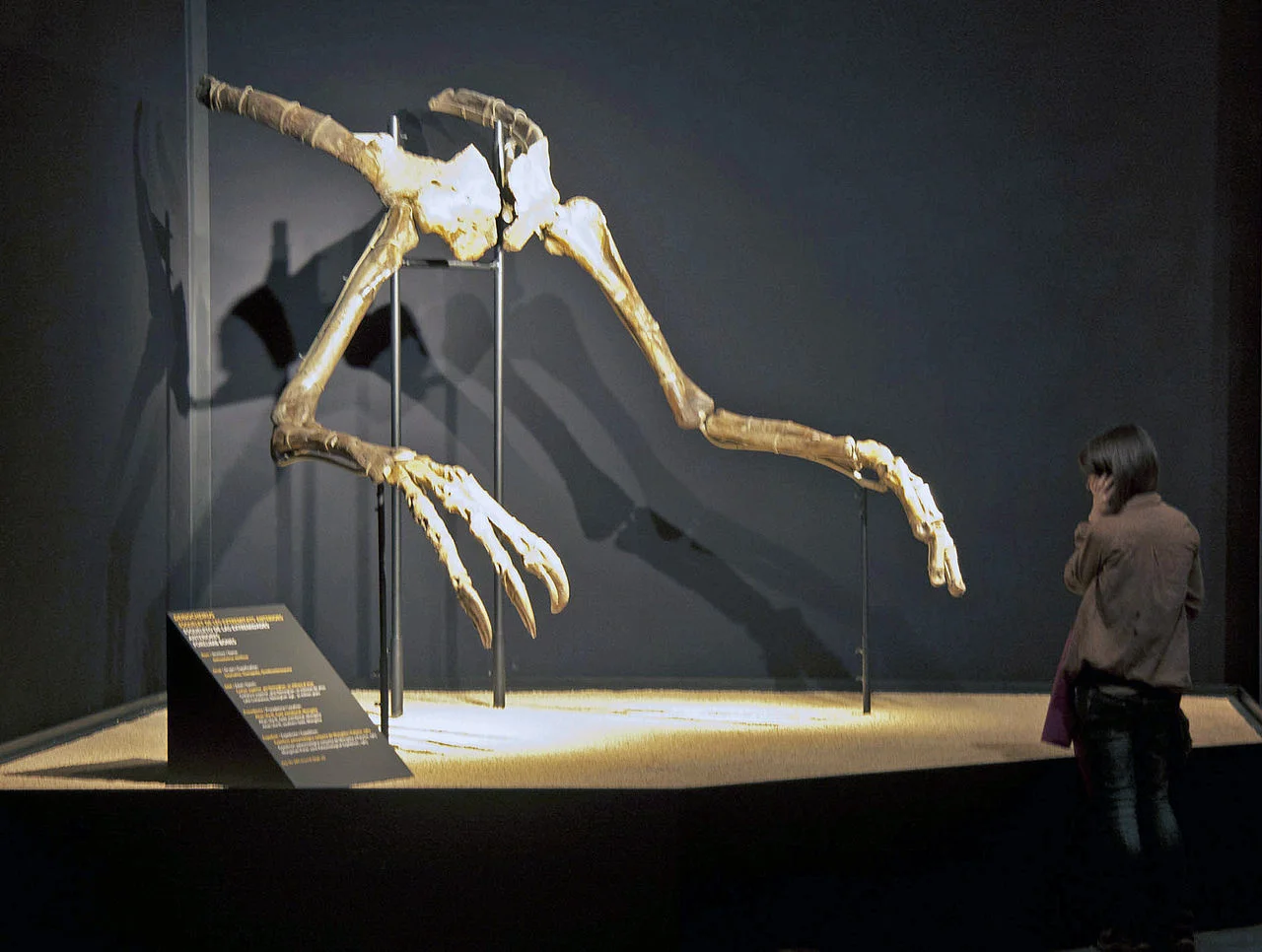
One thing I spent a lot of time on while producing this skeletal reconstruction was the articulation of the vertebral column. The results of course were weird - any attempt to restore Deinocheirus was doomed to weirdness of course, it’s just an odd duck. But I no longer agree with my own first impressions of the animal. First off, I’m not convinced that Deinocheirus actually walked with the pelvis tilted up like early reconstructions suggested - the pelvis lacks the adaptations seen in therizinosaurs that would suggest habitually being tilted upright. Also, when the tail vertebrae of the adult are carefully placed in a neutral articulation, they don’t show any more of an upright curve than other “ordinary” theropods*.
The back vertebrae do emerge at a high angle, but they also curve back down dramatically; combined with the tall neural spines of the sacrum and posterior this leads to the “humpback” look that is becoming familiar. But why would Deinocheirus do such a thing? My best guess is that it’s being a hadrosaur-mimic in the back - with the strong down curve and the high neural spines it could support a thicker neck musculature for holding up that meter-long skull at the end of such spindly vertebrae
You can see that reflected in my skeletal. I also wanted to add that I don’t think the tall neural spines supported a sail, nor do I think it supported a fatty hump. I think it was mostly there to support its musculature and provide better leverage. In particular, note how large and curved the front part of the ilium is (aka the preacetabular ala)? In other animals that would support the iliocostalis muscles, and if that’s the case here it would support powerful muscles running up the back that would occupy at least half the height of the tall neural spines in front of the hips. As the neural spines decrease in height there would be a transition to the neck musculature (and perhaps long nuchal ligaments) to support the head on the end of that long neck.
Tl;dr for paleoartists: there would be more of a hump than a sail, but probably not a fatty one.
So there you have it. Sometimes my own initial impression following a quick read of a publication changes when I’m forced to do a detailed skeletal reconstruction. I still think Deinocheirus is a wonderfully weird critter, but in a lot of ways the initial “hadrosaur-mimic” moniker ended up being more accurate than “therizinosaur-mimic”.
Edit: For another interesting analogy, go check out this post by Andrea Cau comparing Deinocheirus to Spinosaurus. Though I’m not convinced of the overall proportions of Spinosaurus yet, he raises interesting parallels between them in having enlarged neural spines, long heads at the end of long necks, and fish eating.
*The juvenile specimen does seem to show some extra curvature, but the back end of the sacrum emerges at a different angle, so it looks like the difference comes out in the wash.
9 comments
It delights me that the mystery of the arms has been solved and even more so that the solution was so peculiar. I love your interpretation of the hips as head support like the extended shoulder verts of a horse - really changes the silhouette of the animal. A while back when we only had photos I did a dodgy draft illustration filling in the proportions from a photo of the arms at the NHM - I'll have to go back and revise that in light of this.
I look forward to seeing that!
I suggested a similar link between head size, neck curvature and dorsal neural spine elongation in Spinosaurus. So, perhaps Deinocheirus is a Spinosaurus-mimic: fish diet, long snout, giant size, huge claws, tall neural spines. See my old post: http://theropoda.blogspot.b...
Oh weird, I remember seeing your post on Spinosaurus and neck posture, but I didn't see this one. You make some great points, I'll add it to text!
Note that even if Spinosaurus was not that weird as the Ibrahim et al paper suggests, the shared features with Deinocheirus remain as valid.
Oh I agree - that's why I added a link to your post, it's definitely food for thought.
As Andrea mentioned earlier, do you think that the possibility of a muscle-pulley system function for elongate dorsal neural spines within Dinosauria is a good possibility? Because it seems rather convincing to me.
But then again, why do some allosauroids like Acrocanthosaurus have such an adaptation of the axial column while other related taxa ( e.g Eocarcharia and Allosaurus) don't? What use would a large, terrestrial-based carcharodontosaurid have for a set of hypertrophied dorsal neural spines? And the same goes for some diplodocids.
EDIT : I just realized that the elongation of the dorsal neural spines occurs mostly only on the dorsals and sacrals of Deinocheirus and Spinosaurus, whereas in Acrocanthosaurus, the elongation already begins on the cervicals and continue all the way to the sacrals. What could this mean?
If Deinocheirus was a hadrosaur mimic more than a therizinosaur mimic, it would explain how both Therizinosaurus and Deinocheirus were able to both coexist in the Nemegt Formation. Are there any hadrosaurids known from the Nemegt? Wikipedia lists one, Barsboldia, but as we all known wikis are not the most trustworthy source of information.
There's Saurolophus also (which is also listed by Wikipedia). But I was only making a functional analogy to hadrosaurs, not an ecological one. It would seem that Deinocheirus is filling an omnivore/fish eater role that would not directly compete with hadrosaurs or therizinosaurs.
Join the discussion
Thanks — your comment is in the queue!
It'll appear here in about 5–10 minutes, once I've approved it — you'll need to refresh the page to see it. (Comments don't post instantly anymore.)