Dawn Thief
January 24, 2012
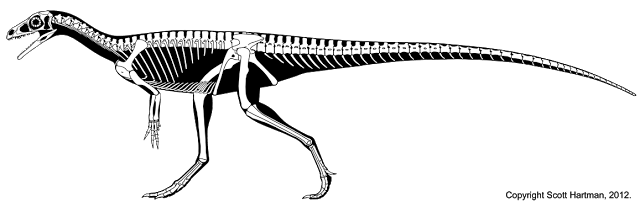
A quick post (and a new skeletal) today, while I apply a bit more polish to the Acrocanthosaurus series. To satisfy all of your skeletal-drawing-based-amusement needs I give you Eoraptor lunensis, one of the most primitive dinosaurs yet discovered.
How primitive? So primitive that we can’t actually answer that question with any certainty right now. Eoraptor is one of those taxa that bounces around a lot in different studies. When it was originally described, it was thought to be one of the most primitive theropods known. Other studies suggested it might be more primitive than the split between theropods and sauropods. Recently, some have even found it to be on the line leading to sauropods!
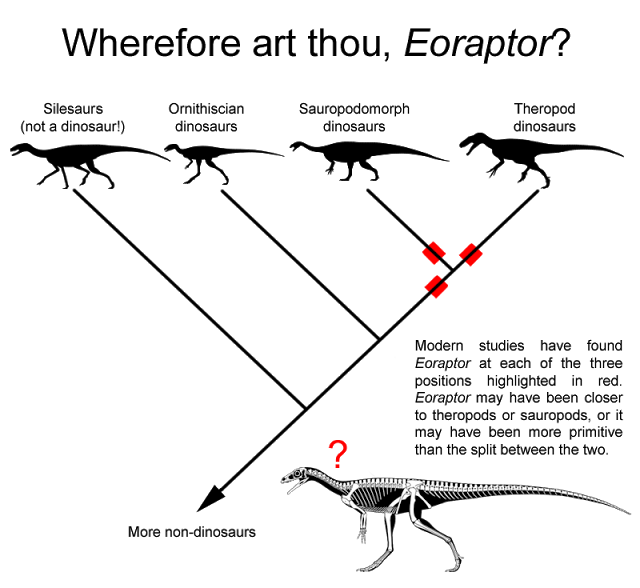
All three positions have shown up in recent studies, so for now at least the answer is “we’re not sure”. Why all the trouble figuring out who is Eoraptor’s closest relative? Basically what it boils down to is that Eoraptor is so primitive that this is what the common ancestor of theropods and sauropodomorphs would look like. No matter where Eoraptor ends up on the dinosaur family tree, the difference between it and animals at the other position will be very small indeed.
If you compare Eoraptor to Panphagia (which I examined in this post), which is a well-supported basal sauropodomorph, you can see just how similar the two are. The problem is sort of like being handed photographs of all of the Kennedy’s when they were two years old and being asked which one was closest in age to JFK - there’s a correct answer, but it’s awfully hard to tell from the information you have.

As for the skeletal reconstruction, Eoraptor didn’t present nearly as many challenges as some other taxa do. For one, it’s known from fairly complete remains. It would have been nice to have a more detailed description of the animal in print (the original papers leave something to be desired along those lines), but luckily the specimen is available in detailed orthographic photos, which do a nice job of supplementing the published data.
That’s all for now!
4 comments
Are these detailed orthographic photos publically available?
Alas no, sorry.
So the closer a certain species is to being the actual common ancestor population of a clade, the less likely researchers are to ever uncover a stable phylogenetic position for it?
(even as new, closely related material surfaces)
I think that as we get more specimens it will become more stable - the problem here is we have a couple of really well represented taxa, and then several fragmentary ones. If the outgroups to dinosaurs (or to saurischians) were better known, for example, we'd be in a much stronger position to resolve these relationships.
Join the discussion
Thanks — your comment is in the queue!
It'll appear here in about 5–10 minutes, once I've approved it — you'll need to refresh the page to see it. (Comments don't post instantly anymore.)