Carnotaurus - delving into self-parody?
March 29, 2012
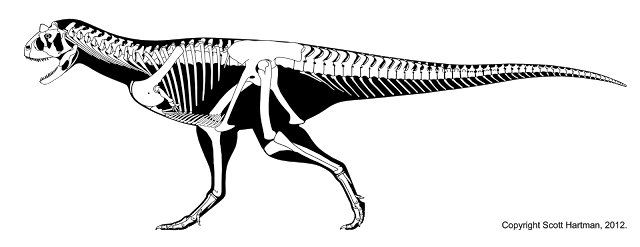
This is Carnotaurus sastrei, a theropod that seems to be little more than a mouth with a set of legs to carry it around. Carnotaurus belongs to an aberrant group of theropods called abelisaurs, which dominated much of the southern hemisphere during the Cretaceous. While all abelisaurs appear odd to our tetanuran-biased eyes, it seems like Carnotaurus is striving for weirdness as a means to its own end; as if it were making some sort of meta-commentary on abelisaur diversity.
I should take a moment to make a public service announcement: I apologize for my absence from blogging and other social media that last several weeks - I’ve been producing more than a few new skeletals (on a schedule), so time has become a scarce resource. On the upshot, several of the new skeletals address blog-worthy topics, so I’m going to produce some shorter posts that examine them.
One of the questions raised in the comments of a previous post involved the hyoid bones - the bones that support several muscles, including in dinosaurs the tongue musculature. Being long, slender bones that don’t directly articulate to other bones, hyoids are often not found (and other times are probably not collected or mis-identified). Even when they are found, their lack of a direct connection to other bones makes restoring them problematic. In Carnotaurus this wasn’t a problem, as they were found in direct association with the underside of the mandible, apparently in their life position. The fact that extensive skin impressions were found with Carnotaurus reinforces the likelihood that the soft tissue holding the hyoid in place had not been disturbed.
In the skeletal above you can see part of the hyoid sticking out from under the bottom-rear part of the jaw. Part of the hyoid is obscured, but there’s not much I can do about that. Having the hyoid is actually pretty useful - the trachea and esophagus have to pass through it (or above it), so having a properly positioned hyoid constrains the throat tissue.
Carnotaurus is also striking due to its advanced arm reduction - in side view the arms almost disappear, as they don’t even extend past the stomach. What on Earth could such arms be used for? Hold on to that thought, as I’m not ready to go public with my thoughts on that just yet. But it sure reinforces the “legs carrying a head” image.
Finally, for those of you paleo-artists out there considering Carnotaurus as your next paleo-subject, I wanted to point out something not obvious in side view: Carnotaurus is really flat on top. The transverse processes on the tail actually stick up in a V-shape that reaches just about to the level of the neural spine. Persons & Currie recently describedhow this impacts the tail muscles (TL;DR version is the tail is very wide at the base, and quite flat on top).
From Person’s & Currie
The back and neck also have osteological structures that raise up to, or above the level of the neural spine. So most of the animal should be restored as having a remarkably flat top. Given how narrow the head is, this must have produced a really strange life appearance.
A final note on the skeletal itself: while Carnotaurus is a wonderfully complete specimen, the lower legs and much of the tail is missing, so those elements were restored after its close cousin Aucasaurus.
3 comments
A carnotaurine paleoartist from a parallel universe, while drawing skilfully with the mouth a Homo skeletal reconstruction, should say: "What on Earth could such tail be used for?".
That's fantastic Andrea!
That's a very interesting insight on the creature. Thanks for sharing. Also, did you ever thought about doing front view pictures of the skeletons? You only need to work on a side and mirror it; I don't think all dinosaurs were asymmetrical. Just saying since it would be helpful for 3D reference and people will probably stop making/drawing dinosaurs as wide as tables, but it is up to you to decide if the extra work is worth the effort. I'm a fan of your work but sometimes the smaller bones like those of the manus lose detail at this resolution so I hope you can release bigger .SVG ones one day in the future.
Join the discussion
Thanks — your comment is in the queue!
It'll appear here in about 5–10 minutes, once I've approved it — you'll need to refresh the page to see it. (Comments don't post instantly anymore.)