At long last... Utahraptor
March 30, 2017
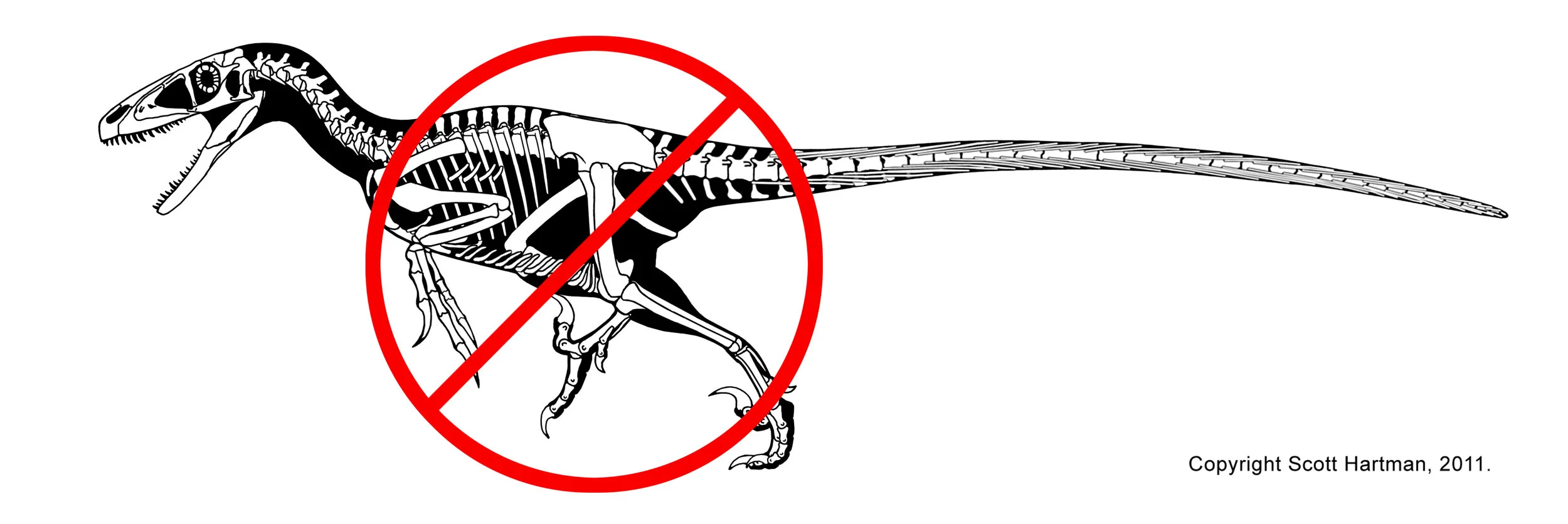
As some of you are surely aware, back in 2010/2011 I worked up a skeletal reconstruction of Utahraptor based on the limited data available from the holotype, using Achillobator and Deinonychus (in that order) to fill in the many gaps that remained. Not long after I was generously given a peek at unpublished material which allowed me to revise (and greatly improved) the skeletal, but I couldn’t share it because the material wasn’t published.
This left me in a bit of a bind - I always have several skeletals on my hard drive awaiting publication, but in this case I’d already posted an earlier version that I now knew was wrong, and that others were using to base life reconstructions on. So I invented my own “option 3” and posted this image and a note to warn people that the old skeletal was no longer current, even though I couldn’t share the new one.
Since summer 2012, the question I have been asked more than any other was, “When will you be able to share the new Utahraptor skeletal???” Well, today is that day. All of the material I used has dribbled out in one form or another, and after speaking with some of the primary researchers (and in honor of #UtahraptorWeek) I am at long last able to present the updated skeletal reconstruction to the world:
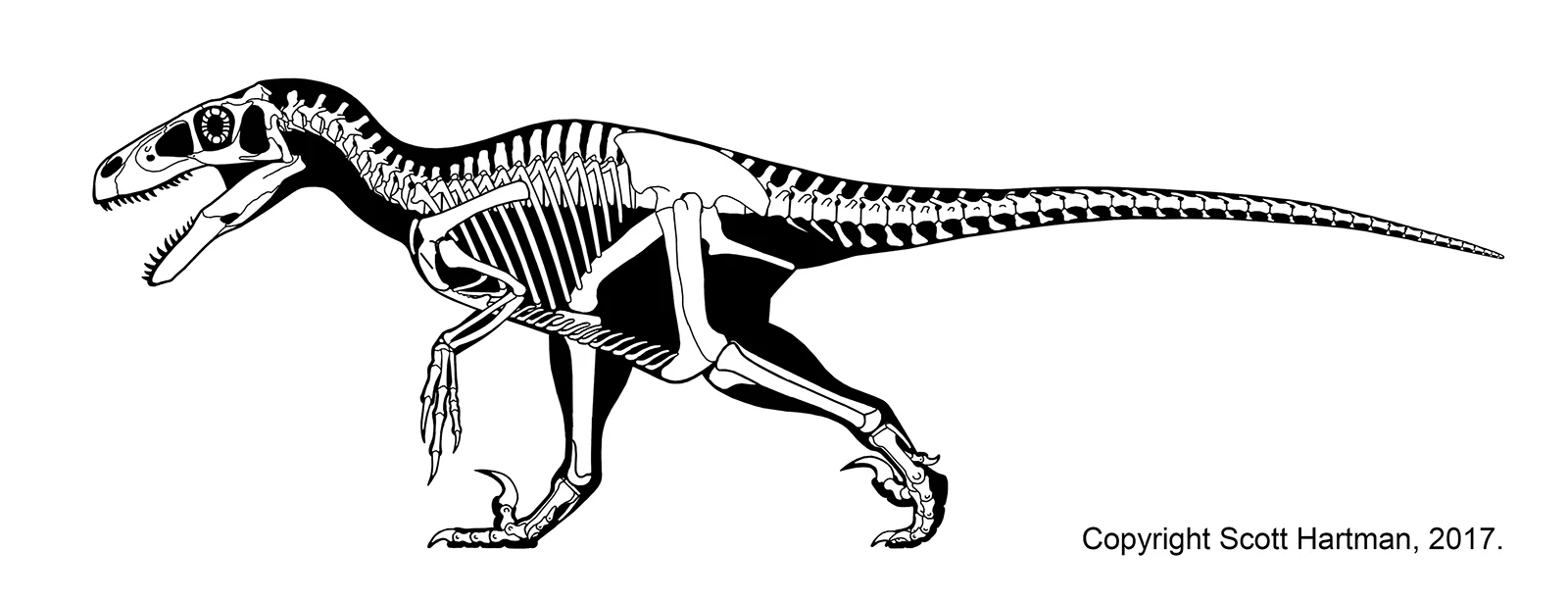
Them there are some crazy proportions, right? Utahraptor turns out to be incredibly robust and stocky. It’s tail was reduced in length, but also more mobile than other dromaeosaurs. Its torso was really short front-to-back, but had tall neural spines that must have supported powerful back muscles. The legs are clearly not those of a swift long-distance runner, but they are also remarkably robust, and must have been able to withstand (or dish out?) a tremendous amount of force.
Please check out the excellent website for the Utahraptor Project, whose work makes this possible (and is hard at work collecting, preparing, and publishing new data!). If you are able to, I highly recommend supporting them on their GoFundMe page as well.
Special thanks to Jim Kirkland, Mark Loewen, and everyone who has worked on the Utahraptor Project over the years!
53 comments
Wow, that is one stocky beast!
WHOOOA !!! Did not expect that. Two or three of these could have taken down a 30' carnosaur. I see hyaena written all over it. What a dromaeosaur !!!
Yeah, it was pretty surprising to me as well.
The robustness of the skeleton makes me think that Utahraptor may have been an apex predator in the Yellow Cat Member, since no larger theropod remains are known so far from that member of Cedar Mountain.
Could be. Improved sampling never hurts, but it might be that there's a larger theropod gap being filled in by Utahraptor.
Wondering if we should render this new Utah raptor look with Feathering.
Almost certainly - there's no evidence of eumaniraptorans losing feathers so far.
Great. What wpuld be the total lenght?
5-6 meters (not counting tail feathers).
Ok, thank you very much.
wow built to take some hits aswell unlike other raptors that are toothpicks to herbivors
It could take a lick and keep on ticking.
well it certainly wasnt a dainty creature like most small raptors was it? damn it must have been a remarkably strong creature and even before this new evidence it was speculated to weigh about the same as a polar bear.
That is a BIG skull Scott!
It is, but since there are cranial elements associated with the type specimen I don't think there's a lot of wiggle room there. Deinonychus has a really long head also, it's just not as robust. And of course we don't know how big the heads were on Achillobator and Yurgovuchia, so maybe Utahraptor is normal for its branch of the dromaeosaur family tree?
Jonah Choiniere is taking the lead on describing the braincase (Mark Norrell & Mark Loewen are in on it too). Bug the hell out of them!! Wierd giant long braincase. Loewen kept insisting that it was tyrannosaur until we got Jonah to point out derived dromaeosaur characters. Big heads have lots of point of convergence!
I've dreamed about this guy from a young age. Weird but really cool to see it in this light. The tank of dromaeosaurs, built to kick the sh*t out of inferior creatures.
If I may ask, how many gaps are we still looking at? Is there material for pretty much everything at this point? Or should I just go check out the Utahraptor Project already?
The skull is fairly complete, though the lacrimal and jugal are missing, so the exact angle of snout to back of the skull isn't known. There aren't any cervicals either, but the back and tail are well constrained. There's some cross-scaling necessary from other specimens, but nothing too bad - I wouldn't expect any radical changes at this point, but hey, we'll see what more data brings!
That's quite decent. Thanks for sharing your work.
Well this is just awesome! So great to see a more complete picture of what Utahraptor looked like after so many years of guesswork. It's certainly much stranger and more powerful-looking than I could have imagined (would not like to be on the receiving end of a kick from that foot). Are there any theories as to what those odd teeth in the lower jaw were used for?
Not at this point. Procumbent teeth in Masiakasaurus are thought to be associated with piscivory, but I'm not sure anyone is suggesting that for Utahraptor.
What's good for water-fish is good for land-fish (tetrapods).
That Masiakasaurus-like dentary toothrow really surprised me quite a bit. Is it reasonable to think this thing was grappling and attacking large ornithopods like Iguanodon? Smilodon is remarkably robust and muscular compared to other felids as an adaptation for preying on giant herbivores like megatheriids and such. Is Smilodon a good comparison?
I think conceptually Smilodon might be an OK comparison, but not because it's grappling in the same way - just that they are both robust and can take and give out a beating. Smilodon seems to have been extending quadrupedal feline-style grappling in terms of holding on with forelimbs, etc., while Utahraptor presumably was extending bipedal RPR-style grappling.
Based on the length of ~6.5 meters, what's a good estimate on the mass of this thing? Something over 600kg or closer to 800kg? I'm getting over 700kg (762 to be exact) scaling from a 3 meter long, 75kg Deinonychus but that ~700kg figure is based on Deinonychus proportions. If I didn't know any better, I might say this thing could easily approach 800+ kg.
I think 6.5 is a bit long for the known specimens - remember that those length estimates were usually assuming Deinonychus-like tail proportions. Since Utahraptor seems to have a short tail, we might be closer to 5 meters for the known specimens. But in the case of a 6.5 meter long specimen 700+ kg sounds about right.
I don not believe Achillibatar is a dromaeosaur based on its way primitive pelvis; is it even a coelurosaur?? I have shared a picture of a big complete pelvis of Yurgovuchia, that I'm working on with Mike Pittman. It seems to fit the role of a older sister taxon to Utahraptor. I think only size links Achillibatar to Utahraptor (a dromaeosaurine).
https://uploads.disquscdn.c...
https://uploads.disquscdn.c... These guys way closer to birds than Achillibatar! https://uploads.disquscdn.c...
That's a pretty unusual opinion right now Jim, but it's fine either way with me - there's no Achillobator in the new Utahraptor skeletal.
Do you think this pelvis is somewhat oviraptorosaur-like, with its anteriorly concave pubis etc?
It's interesting, specially considering it is short in everything but the head. Couldn't run very fast with those short legs and the hands and feet are puny in comparison. The predator scenario is difficult for me to imagine right now. Most of the force lies in the head, neck and torso.
And the hind legs. They aren't fast, but man could they take a beating (and deliver one as well)!
I'm curious what your thoughts are on those oddly short arms--pretty reduced for a dromaeosaur, no? Would they be enough to help it balance on the back of a prey animal as suggested in Fowler et al (2011)?
I think so. I also think the more flexible tail would help, but that's a post for another day.
Wow! 'Stocky' is exactly the word on the tip of my tongue, and even seems inadequate. 'Brick outhouse', to put it politely, springs to mind too.
I guess Matthew Martyniuk could update his old 2011 Dinogoss post - http://dinogoss.blogspot.co... - looks like Utahraptor was a waddler too? I wonder what it did; I imagine it trundling up to iguanodonts and tipping them like cows, with a flick of that head!
Interesting developments and great skeletal, as usual. Thanks!
I've waited for SO LONG. And the day has FINALLY COME!!!
Hope it was worth the wait!
Bit of an odd question, do you think a person would be able to ride a Utahraptor?
If you could train it to not eat you it could certainly hold up the mass of a rider.
Well all the people that called achilobator unusual, take this! Utah also has a weird hips!
Also, how does the new proportions change the length?
That's a good question - the only thing that might have a significant impact is the shorter tail (which usually makes up most of a dinosaurs' length). Perhaps it was a tab bit heavier and a tad shorter than previous estimates? But nothing to get excited about, especially with our current sample size.
I got to say this new skeletal makes a lot of sense when I think about it. It resembles that of Dromaeosaurus albertensis, more so than the old - which makes sense, considering U. ostrommaysorum was a closely related Dromaeosaurine - but I'm wandering; would A. giganticus and D. steini have looked more like this than previously considered?
I mean, both A. giganticus and D. steini are - to my knowledge- known from relatively fragmentary remains.
Hard to say - that's the nature of fragmentary remains :(
Considering the fragmentary nature of Achillobator and Dakotaraptor remains, are their phylogenetic positions in dromaeosaurinae debatable, then? I'm very curious now as to whether (either of) those genera could even represent possible sister taxons to Utahraptor; it would probably mean a fairly significant change in their reconstructions, too, if that's the case. I can't imagine their morphology would be too different from a close relative.
now a new length and weight estimate would be nice :)
as a "next post" idea ;)
This thing, aside from the arrangement of the forearms and pedal unguals, doesn't look like anything else known in all of dienonychusauria, and that troubles me. That leads me to believe their arrangement is misinterpreted and we are most likely looking at parts of a primitive tyrannosaur, theriznosaur (and God knows what else fauna you could throw into the Gaston and Dalton Wells quaries) and forcefully molding them into a dromaeosaur. Dr. Kirk must of had that Jurassic Park fever back in 93', I know I did. Lol...
Gotta admit, that torso is a lot stockier than I would have thought. Those muscles around the legs are equally as surprising.
Hey Scott, I pixelated your Utahraptor!
https://myeeeeerf.deviantar...
What do you think?
Where are you Scott?
Thicc boi.
It is very interesting how our view of one species of Dinosauria can change over the course of a few years. Your new skeletal is a very different shape than the outdated one.
PS: Your skeletals are amazing! ;D
Hmm. Looks great.
Join the discussion
Thanks — your comment is in the queue!
It'll appear here in about 5–10 minutes, once I've approved it — you'll need to refresh the page to see it. (Comments don't post instantly anymore.)