Assessing Alamosaurus
June 21, 2013
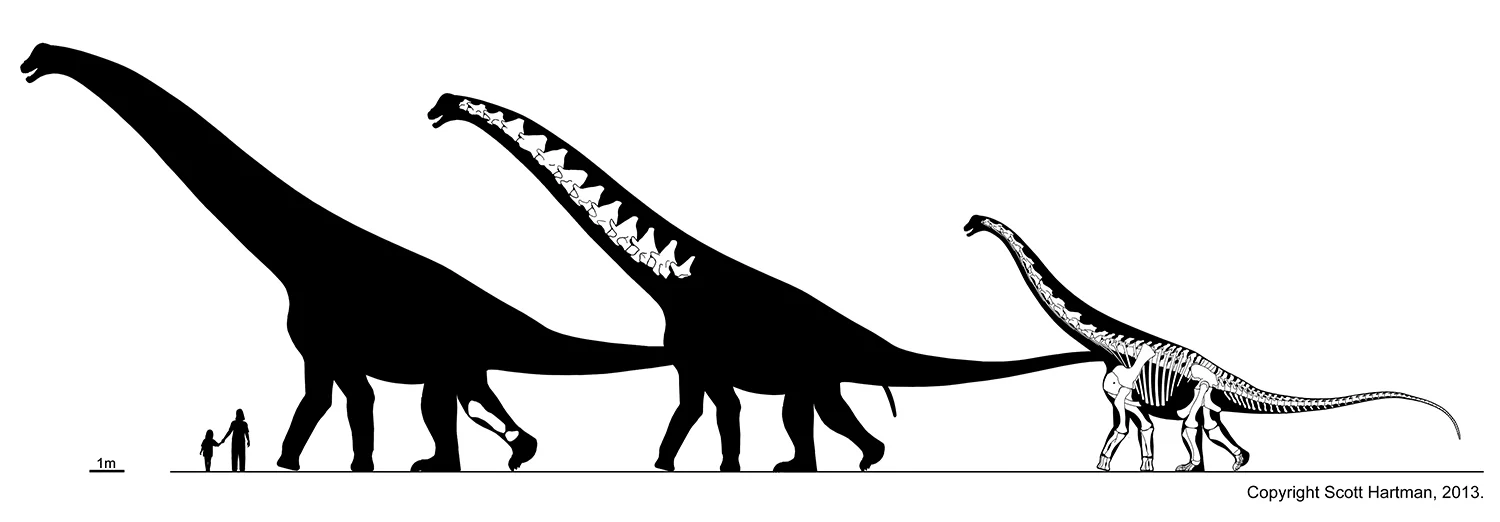
Today let’s look at another one of our thundering giants, Alamosaurus sanjuanensis. Alamosaurus is known from quite good remains (for a titanosaur), and some fragmentary remains may be close to the largest known dinosaur. How certain is this reconstruction? Much better than Puertasaurus, but there are still a couple of layers of inference needed to get there.
Until recently Alamosaurus remains were all from varying sizes of subadults and juveniles. Since no one specimen is complete, it also requires a lot of cross-scaling. How to best cross-scale Alamosaurus is in and of itself something of a debate. A lot of the material has only been described in graduate theses or is referred to without being figured in scientific papers, so the choice is whether to believe those numbers or pursue a scaling closer to that of Opisthocoelicaudia, a titanosaur that is often recovered as a close relative of Alamosaurus.
I am more closely following the traditional limb proportions for Alamosaurus for a couple of reasons. For starters I see little reason to doubt that the authors involved measured the specimens correctly, and if they did then I think they chose well when cross-scaling elements. Second, while I’m not involved enough with researching titanosaur family tree positions to take issue with aligning Alamosaurus with Opisthocoelicaudia, I do wonder how representative it is of the group, as in many ways it’s just a bizarre titanosaur.
Cross-scaling assumptions in hand, cobbling the specimens together yields a skeleton that is known from good material almost everywhere except the skull, which results in the skeletal you see on the right. The last few years the Perot Museum of Nature and Science has been working on a very large specimen, that included an almost complete neck. Working from photos of the neck I was able to create the skeletal that I’m using in the poster and sauropod skeletal gallery. The neck seems to get more robust with age, which is interesting but perhaps not terribly surprising. There may be more of the PMNS skeleton preserved, but it has not been formally written up yet, so I’m only showing the bones that I was able to use.
Finally, there’s the incomplete tibia from Mexico described in 2006. It’s truly a monster in size - even a conservative estimate yields a length of 165 cm - that’s a shin bone that is almost as tall as I am! Assuming that this really is Alamosaurus, scaling up the adult specimen results in an animal that could have stretched 28-30 meters, and tipped the scales with the likes of Argentinosaurus and Puertasaurus.
Now that’s a thunder lizard!
References:
Rivera-Sylva, Guzman-Guitierrez, & Palomino-Sanchez, 2006. Preliminary Report on a vertebrate fossil assemblage from the Late Cretaceous of Chihuahua, Mexico. Hantkeniana 5.
Lehman and Coulson, 2002. A juvenile specimen of the sauropod dinosaur Alamosaurus sanjuanensis from the Upper Cretaceous of Big Bend National Park, Texas. Journal of Paleontology 76: 156–172.
7 comments
What about the giant cervical described in 2011 by Sullivan and Fowler? If it isn't the largest cervical it appears to come from a 30m+ specimen...
Actually I did scale those, and I did not find it to be as large. Of the three specimens described (isolated partial cervical, caudal, and femur fragment) the caudal was from the largest of the three individuals, and the femur was the smallest. The idea that the cervical from Sullivan and Fowler was bigger than puertasaurus was due to the width of the cotyle, but with an actual neck to check it against (the Perot specimen) it looks like Alamosaurus just had wide cotyles.
Hi Mr. Hartman. I simply wanted to ask for your opinion for reconstructions of Alamosaurus like this one.
https://getawaytrike.devian...
Cause lately many reconstructions of Alamosaurus with a disproportionaly massive neck have been circulating Deviantart.
Hi Scott, i admire both you and your job . I was wondering if there's any way we can tell which one of these giants Puertasaurus, Alamosaurus, Argentinosaurus and Patagotitan was the longest or the heaviest???
Hi, Mr. Hartman. I'm an amateur paleoartist from Greece. Seeing that your Alamosaurus skeletal hasn't been updated in a long time, I wanted to ask what is your opinion on some recent skeletals that depict it with a proportionally massive neck? Here is an example: https://www.deviantart.com/...
I'm not
Sorry, I'm not sure, but in 2020 book I have by Ruben Molina Perez, and Asier Larrameni,
Join the discussion
Thanks — your comment is in the queue!
It'll appear here in about 5–10 minutes, once I've approved it — you'll need to refresh the page to see it. (Comments don't post instantly anymore.)