Aquatic Spinosaurus - The authors respond
September 19, 2014
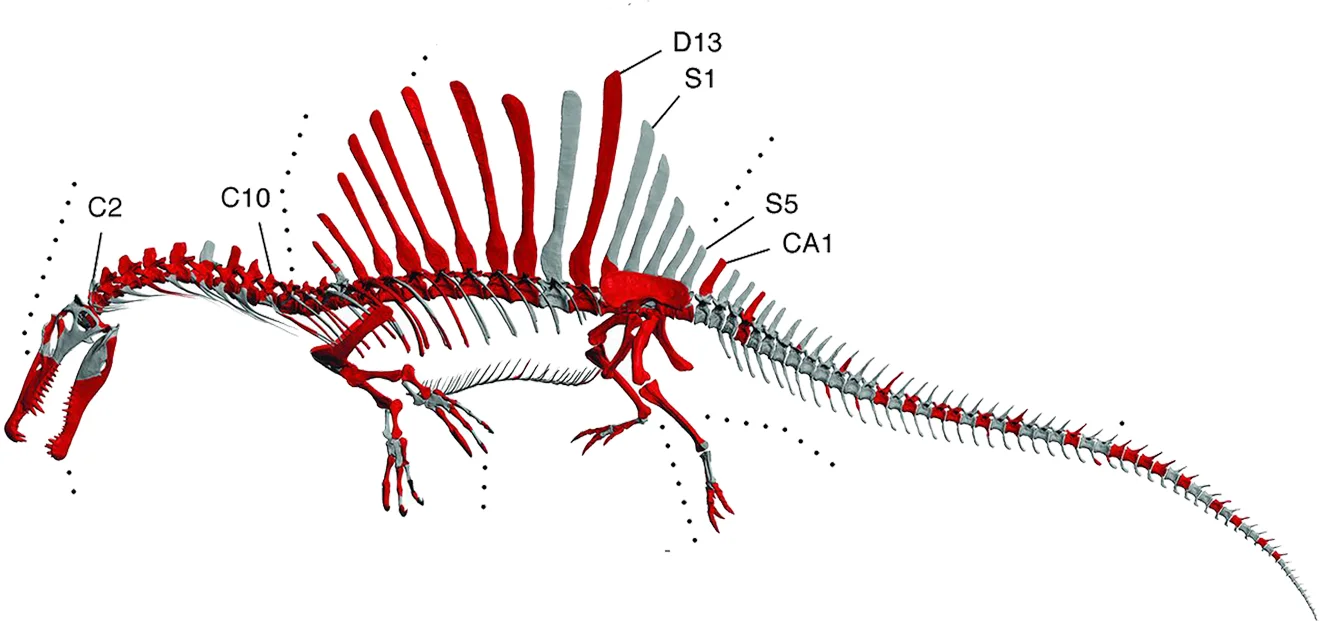
As most of you reading this will know, I’ve written two posts on Spinosaurus - the first one questioned the proportions of the composite skeleton that recently gained fame through a paper in Science, the second one discussing a photo that has been used for and against those proportions. In the comments section on the second post Nizar Ibrahim wrote a lengthy response, which (with his kind permission) I would like to elevate to a full post. As is often true in these debates there are parts I agree with and others I disagree with, but I will address those at a future date. For now I think it’s only fair to give their comments the floor:
Hi Scott,
We are writing to clarify some aspects of the new skeletal reconstruction of Spinosaurus.
It is with a certain sense of surprise that we found out that, a few hours after publication some people thought they had solved all the mysteries of Spinosaurus (without examining the original material that is).
It has been brought to our attention that your “corrected” skeleton, assembled within a day or so of our publication, has suggested to some that the actual reconstruction, based on the fossil material, was “fishy”. That is not the case.
All the bones used in the digital model were CT scanned using the same parameters. The proportions of the digital skeleton are correct, according to our identifications. The new remains come from a site with just one individual (also remember that there are only 2 other associated dinosaur skeletons from the Kem Kem assemblage mentioned in the literature, it’s definitely not the kind of place where lots of associated skeletons are found) and additional remains of the same animal were found at the site on return expeditions, including partial spines, teeth and other elements. Note also that the thin sections we made represent the same ontogenetic stage (that includes the first remains collected and those collected on later expeditions).
In summary we have evidence for one skeleton, one individual, and one ontogenetic stage. One other thing that many people seem to have missed is that Stromer’s “Spinosaurus B”, almost certainly associated material (see Stromer’s account), shows the same axial/appendicular proportions. Several elements of Spinosaurus B overlap with our material – which in turn overlaps with the holotype.
Let’s look at the methods you used in your reconstruction. Measurements are subjective: if you want to compare the anteroposterior length of D8 to that of the ilium you have to take into account the landmarks we used to measure the vertebrae. This detail was omitted from the table legend - we are measuring from rim to rim, not including the anterior condyle. You suggested that the measurements of the hind limb and the pelvic girdle do not match those of the vertebrae: can this be a consequence of the fact that you used different landmarks? This could significantly affect the proportions. Also, keep in mind that the neotype bones have crushing and distortions, asymmetry, etc that were not removed (we wanted to include these imperfections in the finished model). Some of these distortions, for example the medial/lateral crushing/compression of the distal femur, make it look different (narrower) from the less crushed Spinosaurus B distal femur in posterior view (while by contrast the lateral views are very close) – this is relevant to some other posts online that pointed to the more “slender” profile of our femur compared to “Spinosaurus B”. Also, in the 3D model, the femur is not hanging straight down - it is angled outward/laterally slightly and so foreshortened slightly in lateral view, making it look shorter.
One other word of caution: too much is being made of photographs of the specimen in Italy, which were taken before the specimens were fully prepared in Chicago (preparation made them smaller by removing matrix at the articular ends), and also before identifications were made to place the bones on the skeleton in different locations than the Italian photo
depicts. Also, some camera angles create distortions. It was a rough draft, but people now seem to be attempting to get data from it…
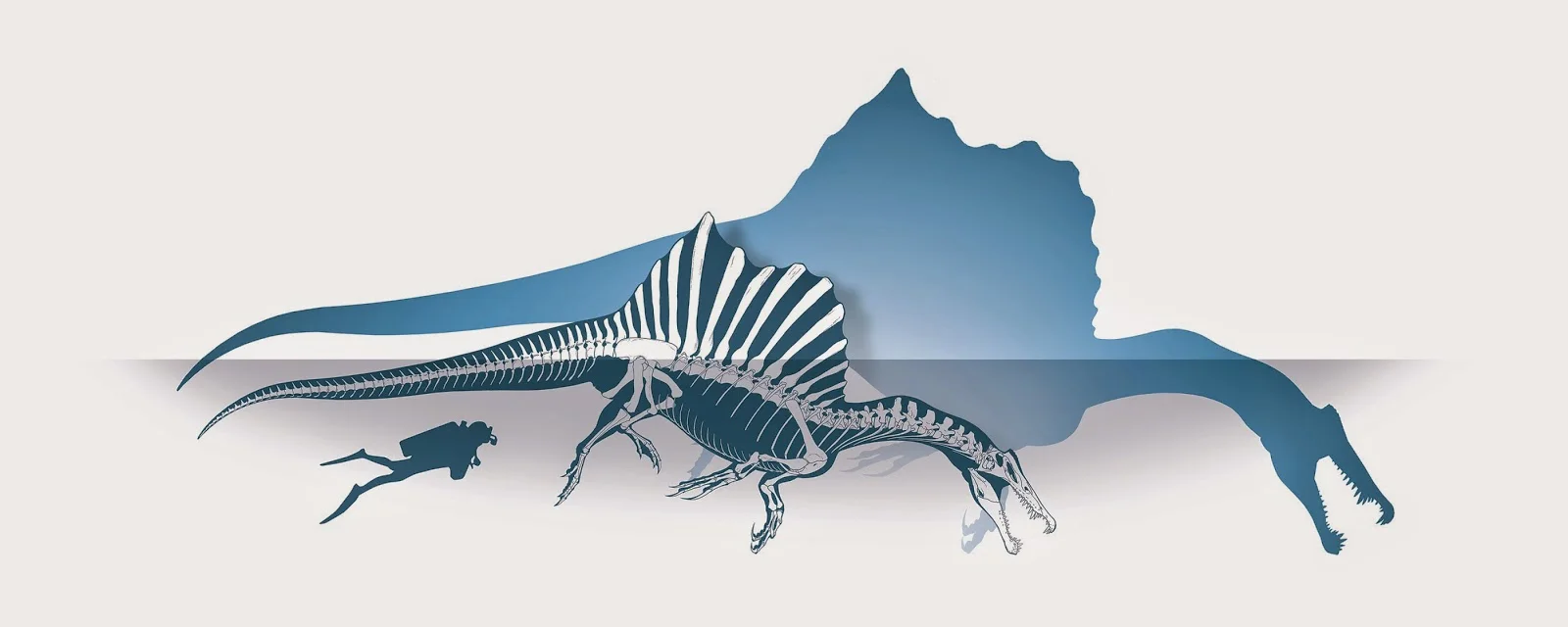
For an independent reconstruction effort, also see the skeletal reconstruction by Marco Auditore (on the Theropoda blog);
Marco is part of our team and, using the same data set, independently obtained a reconstruction that matches the proportions of the digital skeleton.
We will detail our methods in upcoming papers. Let me just say that we went to great lengths to ensure that the different specimens were sized correctly - we examined the material many times, from the tiniest zygapophyses to the most fragmentary rib pieces. We examined hundreds of bones referred to Spinosaurus, and gathered a surprising amount of
information from isolated elements, some of which overlap with our remains. The “core” reconstruction rests on the neotype and holotype (which are very close in size).
We have also gathered information from numerous specimens of other spinosaurids from Europe and Asia, including unpublished material currently under study; this includes an articulated c2-d4 series of Suchomimus that matches the cervical proportions in Spinosaurus rather well (the neck/skull proportions in our model also take into account Stromer’s material), as well as additional juvenile, sub-adult and adult material of spinosaurids. We also know from several lines of evidence that the vertebrae of “Sigilmassasaurus” belong to Spinosaurus – much of this will be published soon.
We are not saying that our reconstruction is 100% perfect – of course it isn’t, and I don’t think this claim has been made by one of the authors - but paleontologists and paleoartists in particular should finally accept that there is no such thing as a “final word” in dinosaur reconstructions, weight estimates and behavioral interpretations. Look at Tyrannosaurus, Quetzalcoatlus or Diplodocus reconstructions and count the number of changes in posture and proportions and interpretations (scavenger, not scavenger, necks held low, necks held up, terrestrial stalkers, fish eaters etc etc). All we can do as paleontologists is present a reconstruction that best fits the available data. And then it is refined as more material comes to light. If we find a long legged Spinosaurus in Morocco, we will tell you, rest assured. But right now we have two associated skeletons with the same proportions. And if we find more forelimb material, we will refine our model if necessary.
We have been very transparent about our approach and have presented strong evidence in favor of our interpretations. The skull of Spinosaurus has “fish eating” written all over it, one of the best matches for the bone compactness profile is a penguin, and we have paddle like feet and a “river of giants” full of car sized coelacanths, giant lungfish, sawfish and many other aquatic forms. Suggesting that Spinosaurus took full advantage of this, and reduced its hind limbs in the way other lineages have done as they spent more and more time in the water is the best hypothesis we have – taken together, all of the evidence suggests that Spinosaurus spent a substantial amount of time in the water. We are working on a monograph that
will include detailed descriptions and more measurements, as well as large amounts of unpublished data. So you will soon have access to more data to inform your beautiful skeletal drawings.
Nizar Ibrahim, Simone Maganuco, Tyler Keillor, Matteo Fabbri.
28 comments
I would suggest using EDXRF to destructively look at the bones. I did this at the Dinosaur center last summer to compare TYA, FS, BB, and other sites. Unsurprisingly, some sites had quite different trace elements (both presence and absence and quantity) than others. Presumably a skeleton that comes from the same animal and fossilized via the same diagenetic event will have the same rare element tracers (Uranium, Yttrium, Lead, Arsenic, etc) that could be ratioed to provide an ID for the site. We do this kind of thing all the time with stone tools in archaeology. It isn't a guarantee, but it at least would be an empirical way to approach these kinds of problems from a different angle.
Hi Thalesian. Can you guide me into the world of EDXRF to test taphonomic issues? (i.e. classical papers) I will be very, very thankful.
Yess!
More data!
There seems to be a lot of ad hominem remarks and personal jabs in this response.
"We will detail our methods in upcoming papers."
Isn't detailing the methods you used to get the results an important part of any scientific paper? If space was an issue you could always have posted it as supplementary information.
"In summary we have evidence for one skeleton, one individual, and one ontogenetic stage."
I don't think anyone is doubting that the neotype represents a single individual. However, the reconstruction is made from several individuals, including some that may not necessarily belong to the same species.
"We have been very transparent about our approach and have presented strong evidence in favor of our interpretations. The skull of Spinosaurus has "fish eating" written all over it, one of the best matches for the bone compactness profile is a penguin, and we have paddle like feet and a "river of giants" full of car sized coelacanths, giant lungfish, sawfish and many other aquatic forms."
From what I can tell, Scott isn't . All I have seen him say is that the hind limbs are probably not as short as indicated in the reconstruction. Indeed, as he said...
"I am not advocating the wholesale rejection of their data - the new specimen certainly helps fill in some osteological gaps, and the taxonomic revision they undertook was desperately needed. Likewise, the bone density data (and previously published isotope work) make a strong case for Spinosaurus eating fish and spending most of its time in and around the water."
"We are not saying that our reconstruction is 100% perfect – of course it isn’t, and I don't think this claim has been made by one of the authors - but paleontologists and paleoartists in particular should finally accept that there is no such thing as a "final word" in dinosaur reconstructions, weight estimates and behavioral interpretations."
Are you implying that the only reason Scott has criticized the Spinosaurus reconstruction in your paper is because he is somehow wedded to the idea of Spinosaurus as a terrestrial super-predator?
"One other thing that many people seem to have missed is that Stromer's "Spinosaurus B", almost certainly associated material (see Stromer's account), shows the same axial/appendicular proportions. Several elements of Spinosaurus B overlap with our material – which in turn overlaps with the holotype."
This wasn't clear in the reconstruction at all. Indeed, the figure from the paper made it seem like the elements of the hind limb were only known from the subadult neotype.
" It was a rough draft, but people now seem to be attempting to get data from it..."
If the photos were only supposed to be a "rough draft", why did you use them in the description of your specimen?
"For an independent reconstruction effort, also see the skeletal reconstruction by Marco Auditore (on the Theropoda blog);
Marco is part of our team and, using the same data set, independently obtained a reconstruction that matches the proportions of the digital skeleton."
If Marco Auditore is part of your team and using the same data (you mean measurements, not specimens, right?) then by definition his reconstruction would not be independent.
Hi anonymous,
Scott Hartmann sent me a very kind and honest email, and I can tell you there was no mention of 'ad hominem attacks'. I did refer to specimens, not measurements - so, yes, Marco Auditore's reconstruction is independent. There is a figure in the supplemental information that shows Spinosaurus B and our material side by side - this was included to make it very clear that this second associated set of remains includes appendicular and axial elements.
Best,
Nizar
Hi Anonymous,
While the authors' response clearly was aimed at several of my criticisms I suspect that they also were addressing the broader discussion on the internet since, as you note, I am in agreement with parts of it. That's fine by me, as there is a lot of discussion going on and a finite number of places to make their voices heard.
I also wanted to say that I don't feel they are making ad hominem attacks (i.e. they are not attacking me as a proxy to discredit my claims), and in particular my private communication with Nizar has been nothing but pleasant. I do think that parts of their response utilize an argument from authority in place of providing data. Of course with other papers in progress there may be limits to what can be shared without compromising their ability to publish it. While that is an understandable position to be in, I naturally find those parts to be unpersuasive, and in particular I remain unconvinced that they have properly scaled the hind limbs and pelvis (elsewhere Mark Witton has already anticipated part of why that is).
But that will be a topic for another day.
Okay. There must have been some misinterpretation on my part in that case.
Nizar, was Spinosaurus in your view quadropedal? Or walking with a wierd bipedal gait like a tail dragging pangolin or giant armadillo?
Darren Naish told me that the forelimbs and shoulder girdles are poorly adapted for bearing weight so that knuckle walking and pronation are both out of the question.
First off I would like to thank the authors for finally bringing to the public forefront the most incredible of all dinosaurs, Spinosaurus. I would also like to share my own opinion, which is based on firsthand experience.
Based on an extensive working knowledge of the Kem Kem formation and Spinosaurus, I am going to agree that this composite "Spiosaurus" can not be accurate as described. I have in my lab a Spinosaurus Femur that is nearly 2.5 feet longer than the one that supposedly came from this huge dinosaur. If their reconstruction is accurate, based on my bone, you would be looking a dinosaur nearly 2 times larger than their projected size. I also have a full sacrum and a large number of vertebrae that would suggest thei their findings are not accurate, not to mention the fact that in their reconstruction, the all of the vertebrae, with the exception of the last few caudal verts are much larger in diameter than the femur, and the tiny Tib and Fib would be crushed by the immense weight of the animal, even in the water given the reduced factor given by the water, that the authors are proposing.
Also, being very familiar with Kem Kem, Their story does not add up. Because of the way the deposits there form, in all my years, and those of nealy every individual I work with in Morocco, you never find more than a few associated bones. This sediment has been broken up and redeposited many times over the millions of years it has been in existence. This is not to say you will not have bones from many individuals ane even various species that end up together because of the movement of water and fluid soil, but I do not believe that they can be considered part of any one individual. I have uncovered associated bones, but in many cases they do not even come from the same species. Unless they were full articulated, one cannot suppose that they are from a single individual. (I yield up Brontosaurus as an example. Bones in proximity did not play out in that case either) Also, to use any assertion that bone or matrix color can be used to determine that bones have come from the same location in Kem Kem is not a safe one. I have bones and teeth from miles apart that look identical, including the matrix they were found in, and others that were found within inches that look nothing alike.
This is not to say I disagree with everything in the article. There are some things I agree with and the truth may lie somewhere other than any of our theories. I respect the work the authors have done and can honestly say that I share their love of this great spined lizzard. It too helped inspire my passion for dinosaurs and has been a lifelong passion of mine.
I would also add that in my many years of research I also believe that there were wither two distinct species of Spinosaurus, or a large amount of sexual dimorphism. This is based on both teeth and bone comparison. Some day soon My group will be donating a collection to a local university and publishing a piece on our findings, as well as several dinosaurs from the Phosphates in Morocco.
Seth
Hi
Note that Deltadromeus is an associated skeleton. My team found associated remains of Onchopristis. Rebbachisaurus is also associated material. It is not true that associated remains are never found in the Kem Kem. I am looking forward to reading the technical description of your femur once it is donated to a museum (my understanding is that you have a private collection?), but please understand that we have to stick with the data we collected in the field and in museum collections. These discussions are not settled on blogs - and with that I will retreat to the world of peer reviewed literature (working on several upcoming Kem Kem publications).
Best,
Nizar
I know this is a little late to post a comment, but yeah, you might want to look into publishing a description of that femur as it would probably come in handy for reconstructing the animal. And Nizar, congrats on the TED fellow award! I just found out that you gave a lecture at the Brooklyn Museum, which is an hour away from where I work at the Stamford Museum.
I'm loving this discussion; science at its best.
First off, as a layman with a life long interest in dinosaurs, I think that all of the principals in this discussion have been very forthcoming and have behaved above board during the debate started by Scott's analysis. This debate is a useful and necessary part of every major find and is, as Scott has alluded, a key part of getting as close to the truth as we can, given the evidence before us.
Standing on the outside looking in, I have a few observations to make that I hope that Nizar and the other gentlemen involved in this find and its analysis will consider:
1. The new evidence establishes, I think without question, that we are dealing with an animal that was indeed "semi-aquatic", primarily piscivorous, and adapted to a life in the water. The bone density analysis, the unique (for a theropod) feet suggesting paddling as a way of locomotion (and the resulting equally likely webbing of the feet) all seem pretty sound to me and, best of all "make sense" in light of the other attributes of this weird, wonderful animal.
2. Scott has hit the nail on the head in, I believe, acknowledging most or all of these points, as well as clearly stating that there is no doubt that Spinosaurus did have a smaller pelvic/leg size ratio than any known theropod, and that this fact appears to be directly related to its unique lifestyle.
So, here is my message to Nizar and the rest of the authors here:
1. Debate is good; the massive debate that has descended here is in a way acknowledgement of the massiveness of the find and the resulting shift in the analysis of the animal - that is all to the good;
2. None of the debates that I have read seems to seriously question the most significant fact that your discovery and analysis has now established - the unique nature of the niche/lifestyle of this animal (see above), and that is also good because while there is a lot of talk regarding the leg/hip/size/walking on land ability, do not allow that to obscure the fact that just about everyone now must acknowledge the uniqueness of his animal.
Whether it could walk on two legs as the revised skeletal reconstruction done by Scott indicates it could do, or not, it was EITHER WAY CLEARLY a SEMI_AQUATIC PISCIVORE. A staggering finding! Monumental in dino-annals.
So, gentlemen, you have already "hit a homerun" that cannot be taken away. This business about the size of the hips/legs is - dare I say - minutiae compared to the real import of your discoveries.
Lets not allow the debate regarding this to obscure the unchallengeable and truly revolutionary aspect of the discovery.
In closing, I would kindly implore Nizar and his fellow discoverers, to go over all of your data with a fine-toothed comb, and to take as seriously as possible the suggestions regarding the scaling of parts of the skeleton made by Scott and other paleontologists.
Yes, these folks have not actually seen or studied the fossils the way that you have, but sometimes the simplest things can be missed because of being "too close" to the subject, and a pair of fresh eyes from the outside can discern a detail here and there that may have been overlooked.
Having said that, I await with great interest further commentary and analysis from Scott, as well as from Nizar and the rest of the discoverers of this critter.
The way I see it, as there is no disagreement here regarding the truly important aspects of this find, your further mutual discussion can only serve the interest of science in a positive manner - either by helping to "tweak" the find "around the edges" to give us a more accurate portrayal of this creature, or - should Scott be convinced by your further papers - confirming the finders' initial analysis.
This ain't a "Predator/Scavenger" debate. Everyone here is already on the same boat regarding the findings that really matter. It ought to turn into a "WIN-WIN" scenario in the end, with the truth being more firmly established as a result of the debate.
Personally I don't see why Spinosaurus couldn't have been a generalist like most crocodiles.
Because it isn't a crocodile
There's a post on reddit which addresses the issue from a wider angle. The takeaway seems to be that Spinosaurus would've been the most atypical Theropod by far, an aberration of sorts, if its legs were actually that small. Could you give your input on that reasoning if you have time and/or disposition? Thank you.
http://www.reddit.com/r/Din...
Scott, I've longly followed the discussion. My wonder would be regarding Spinosaurus estimated body mass. It has not yet been published (it's planned for a future paper) but the team has estimated, using 3D model, a body mass between 6 and 7 metric tons for the adult Spinosaurus. My question, other than do you agree with it, would be do the changes you suggest, if they were confirmed, would greatly modify this figure ? With this new material, is a 11 metric tons Spinosaurus still likely ?
I for one am open to the possibility of reduced hind limbs, but I'm extremely skeptical of the idea of a quadrapedal Spinosaurus. There has never been a confirmed case of a theropod species which was primarily quadrapedal. Furthermore, to my knowledge, al known spinosaurid remains which included limb bones were bipedal. Although the discovery of limb bones from members of this fascinating family are rare, all of the evidence seems to point to these animals being bipeds. Until further evidence is found, I find it safer to assume that Spinosaurus was a biped with shorter hind limbs than most therapods. Neverthless, I'm looking forward to the aforementioned papers. I want to here more about these new remains he mentioned. Specimens of this animal are so rare that any new remains they find is big news.
I've just looked at the Therapoda blog (note... it's in Italian and has a lot of technical words) and found what could be the answer to the questions. Andrea Cau, the author, states that the neck of Spinosaurus , at the base, would be in a U shape and the skull would be rigidly sticking straight up, reclined against or near the sail. I'm not completely sure of the soundness of this approach, but this may be another way of thinking of it.
Here is the website:
http://theropoda.blogspot.c...
If Spinosaurus weighed 8 to 10 tons, I reckon I'd eat my hat- sure its a big animal, but looking at the new restoration compared to Tyrannosaurus which it is now supposed to be bigger than, it has:
1. A longer tail
2. A longer neck
3.A long lightly built skull
4. A shallow torso
5. If its to be believed, a pair of puny legs ( compared to T.rex)
All this adds up in my opinion to an animal that might have weighed 5 or 6 tons.
Now about those legs, if evolution had done its thing to reduce the size of the rear legs, bring on pachyostosis and other changes to accomodate a more aquatic lifestyle, why didn't it change its forelimbs to be more useful for locomotion- swimming or walking?Knuckle or wrist walking? Its the worst of both worlds not much good for swimming and not much good for walking unlike for example a sea lion which has at least one of those bases covered. How about the large thumb claw? A good gaff for fishing, but of what use if the animal would have had to use the forelimbs for locomotion? I don't think it would have had the strength to use one arm to hold a fish and the other to stand on the back of the wrist.
I've never doubted the piscivorous lifestyle, but those legs....
I think that the key here is bone density. The recent findings seem to indicate that Spinosaurus had much denser, less pneumatic bones than other large theropods like T. rex. Size-wise, I'd max out T. rex between 12 and 13 meters, and Spinosaurus around 15 tops (none of the 17 or 18 meter nonsense some fanboys like to spew out). If we weigh said Tyrannosaurus rex at around 6 or 7 tons, then I could see a Spinosaur of similar size with denser bones feasibly approaching 9 or 10 tons, especially if it were a largely aquatic animal.
It's true Spinosaurus had very dense leg bones, but it's vertebra are to "thin" to support anymore weight than 5-7 tons. Its legs may have been heavy to weigh it down in the water.
Matt Wedel has a conference abstract on this (the extended bone pneumacity saves body weight), he estimated that the hollow bones of a Tyrannosaurus would only reduce it's mass by 7%, that's a weight reduction of about 600 kilos compared to a hypothetical 9 tonne rex (for FMNH PR 2081). Spinosaurus probably wouldn't have been heavier because of that, if I had to guess, I'd say MSNM V4047's mass could be 6 - 7.5 tonnes, due to the reasons listed above.
My main question is the sail. Why did they place that tall spine in the sacral position? In my opinion it is more likely that it was a caudal since it lacks characteristics of sacrals.
It's a shame that we are left guessing since the paper was essentially an extended abstract disguised as a paper.
So take your time on the monograph Ibrahim et al. but not too much time.
I do believe much like crocodilians of today Spinosaurus was a ambush predator and fisher eating anything it could get.
My response to Mr, Ibrahim: I have also sifted through the evidence you presented, and using my 30 years' experience of legal analysis and reconciliation of often seemingly conflicting mountains of data, I have come to 2 conclusions:
a. Yes, Spinosaurus was indeed a semi-aquatic dinosaur, the first such beastie found to date; and
b. The illustration below shows what Spinosaurus most likely looked like on land based on that evidence;
Job well done, Mr. Ibrahim. Now please don't screw it up by insisting on this "knuckle-walking" nonsense.
That's a Jp3 spinosaurus it's legs are way too long and it seems as if you just keep ignoring all fossil evidence of the spinosaurus having shorter legs.
A JP3 Spinosaurus? Did we watch the same movie? Here's a couple more profile photos of the same model, which is based on the evidence:
[URL=http://s155.photobucket.com...][IMG]http://i155.photobucket.com...[/img][/URL]
[URL=http://s155.photobucket.com...][IMG]http://i155.photobucket.com...[/img][/URL]
[URL=http://s155.photobucket.com...][IMG]http://i155.photobucket.com...[/img][/URL]
A good ergonomical illustration is worth a thousand words, isn't it?
To elaborate - the tail weighs much more than the head and neck, and the greatest concentration of weight is in the hips area. Now walking the animal looks "front-heavy" but as Gerschwin put it, that "ain't necessarily so". Besides, the walking forward motion requires a parallel body to the ground. The moving legs and feet ensure that even if the animal is slightly front-heavy in this position, it doesn't fall over. If it stops, then the back arches slightly upwards and the center of gravity moves backwards to a point of equilibrium.
This ain't rocket science. Just basic physics and gravity. What IS totally impossible given the build of the animals arms, is 'knuckle walking'.
Join the discussion
Thanks — your comment is in the queue!
It'll appear here in about 5–10 minutes, once I've approved it — you'll need to refresh the page to see it. (Comments don't post instantly anymore.)