Anchiornis: Putting skin on the bones...with science!
March 1, 2017
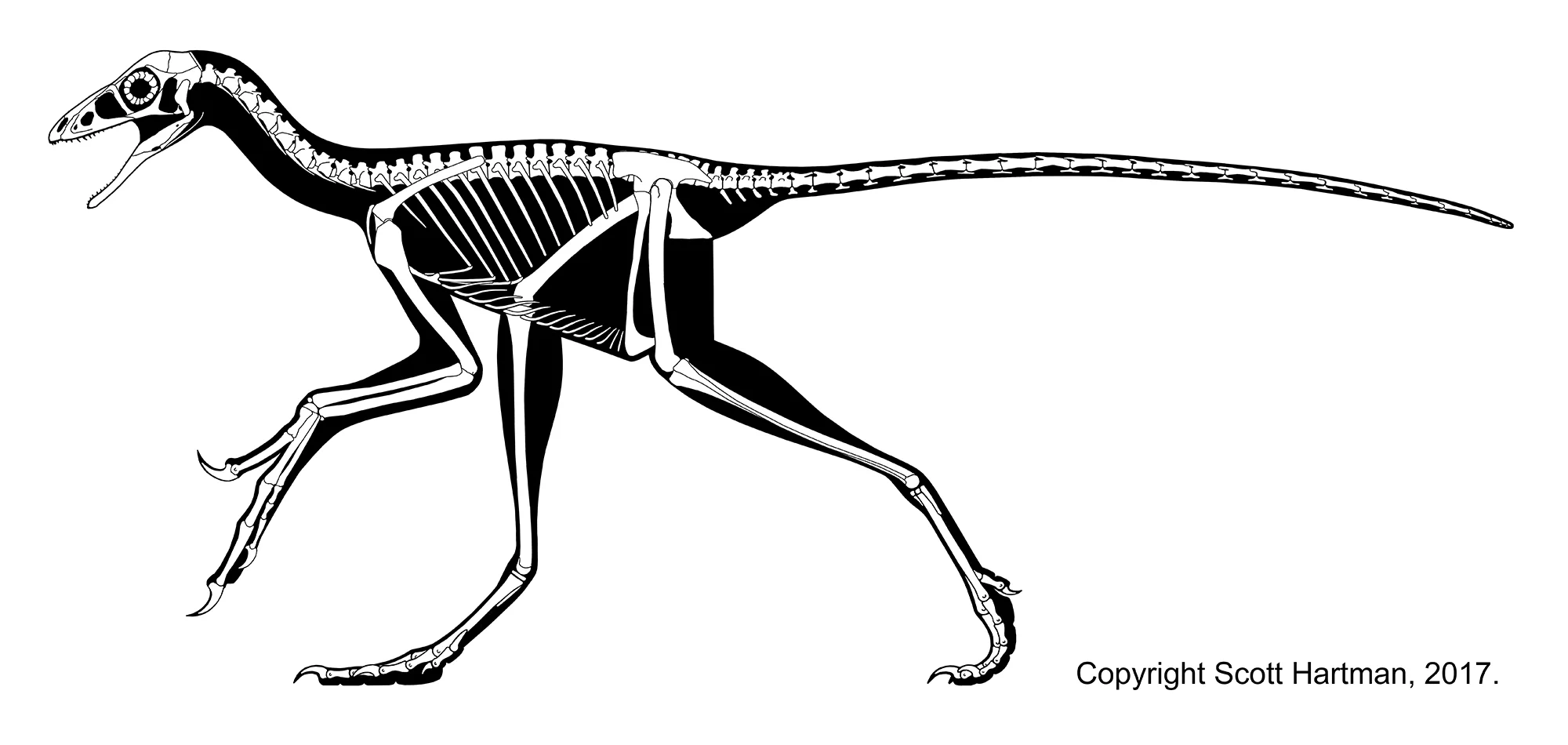
For paleoartists (and the scientists who work with them), properly restoring the skeleton is merely the beginning of figuring out how a dinosaur looked in life, since muscles, tendons, and other soft tissues that make up the final shape of an animal can be quite different than the skeleton alone. This requires an extensive knowledge of comparative anatomy from living organisms, a technique which has become more formalized in recent years with the application of Extant Phylogenetic Bracketing (EPB), which leverages the work of phylogenetics (the science of who is related to whom) to test inferences about muscle origins and insertions, and other soft-tissue hypotheses.
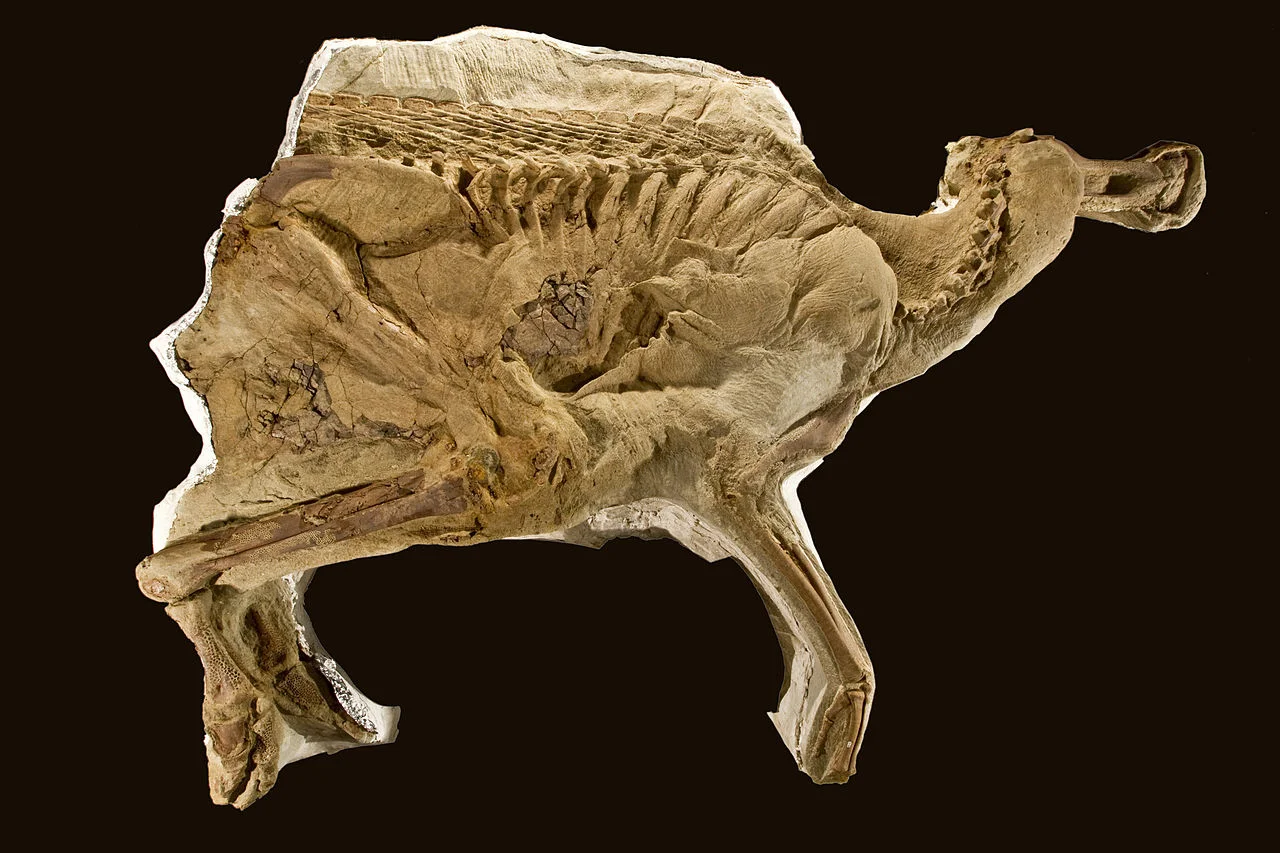
When we are really lucky these hypotheses can be tested directly, such as when we find extensive soft-tissue preservations of a fossil like the “mummified” hadrosaurs. For stem birds we have had an embarrassment of riches when it comes to their epidermal coverings (fur, feathers and other fluff), but their fuzziness has generally covered up any information that might have been preserved about the shape of the underlying soft-tissues, or about the non-feathered skin structures.
That’s all about to change. In a paper published today by my colleagues and I, dozens of Anchiornis specimens were studied using laser-stimulated fluorescence (LSF), a technique that can reveal preserved soft-tissue details that are not clearly evident in normal lighting conditions. Although no one specimen revealed an entire outline, by cobbling together the best of the dozen or so specimens with LSF-revealed skin tissues we now have a much better idea of what Anchiornis looked like, as well as a good test of how well EPB works. For paleoartists, and those who simply want to know exactly what a dinosaur looked like when alive, this clarifies many important details of the skin and muscular anatomy.
Much will be (rightfully!) written around the web on how laser-fluorescence works, or how these findings impact hypotheses on the origin of birds and flight, but for this article I’m going to concentrate on what the paper tells us about the anatomy and appearance of Anchiornis.
About Anchiornis: If Anchiornis is not a familiar dinosaur to you, you should know that it’s a small paravian theropod dinosaur - that is, it’s closely related to troodontids, dromaeosaurs, and the lineage that lead to birds. I can’t be more precise than this, because exactly which of those three branches it’s on has been the subject of some debate and does not yet have a consensus view. But given it’s location we would have already known that it was a feathered and winged theropod.
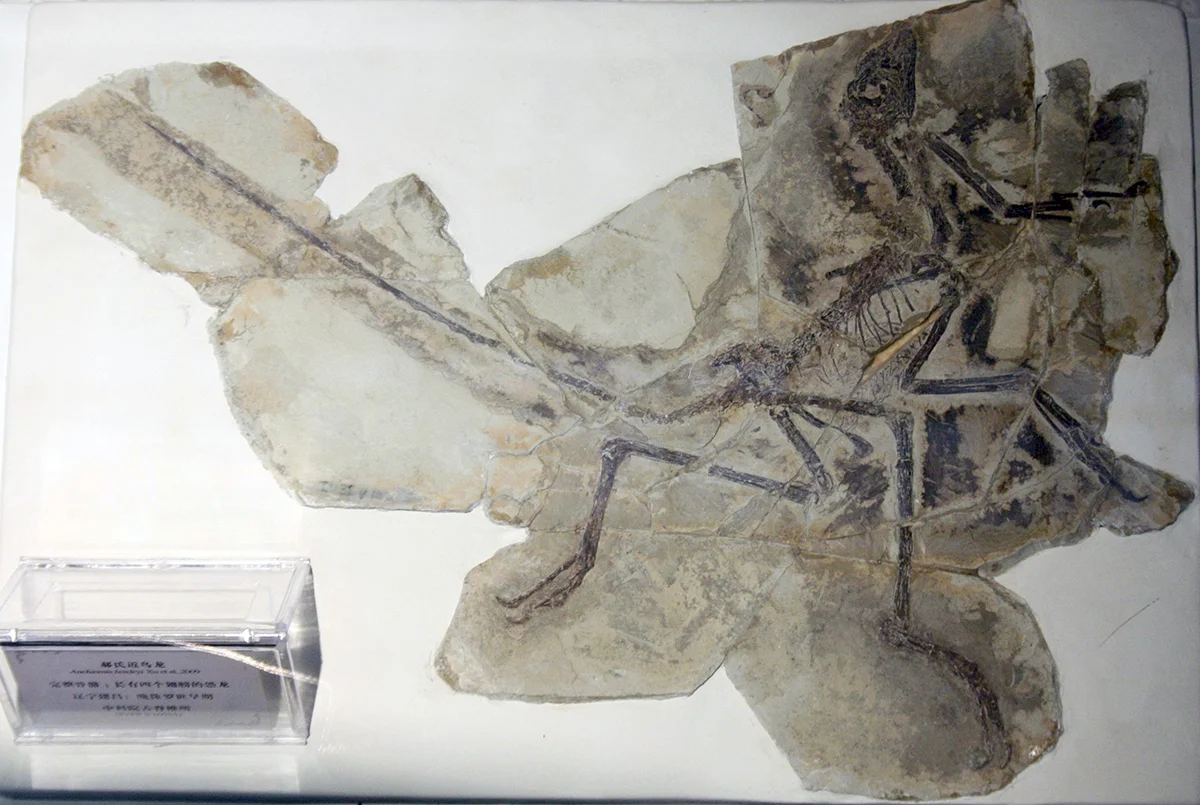
We don’t have to assume this, however, as early specimens of Anchiornis were found with feather impressions, including branching feathers on the hind legs. This sometime leads people to refer to Anchiornis as a four-winged theropod, sort of like Microraptor, but it should be noted that the feathers on the hind legs of Anchiornis are not nearly as large or “wing-like” as what we see in Microraptor. The feathers were exquisitely preserved, however, right down to the distribution of melanosomes, the cellular organelles that determine the color of a feather. As a result, Anchiornis has the designation of being the first non-avian dinosaur to have its color scheme scientifically reconstructed.
OK, so what’s new already? With so much awesomeness already known for one dinosaur, you might be wondering what could be left to find? As it turns out quite a lot! Using the laser-fluorescence technique developed by Tom Kaye, dozens of specimens were scanned at the Shandong Tianyu Museum of Nature, and many of them revealed details of skin and scales that otherwise would have been missed. Take this image for instance:
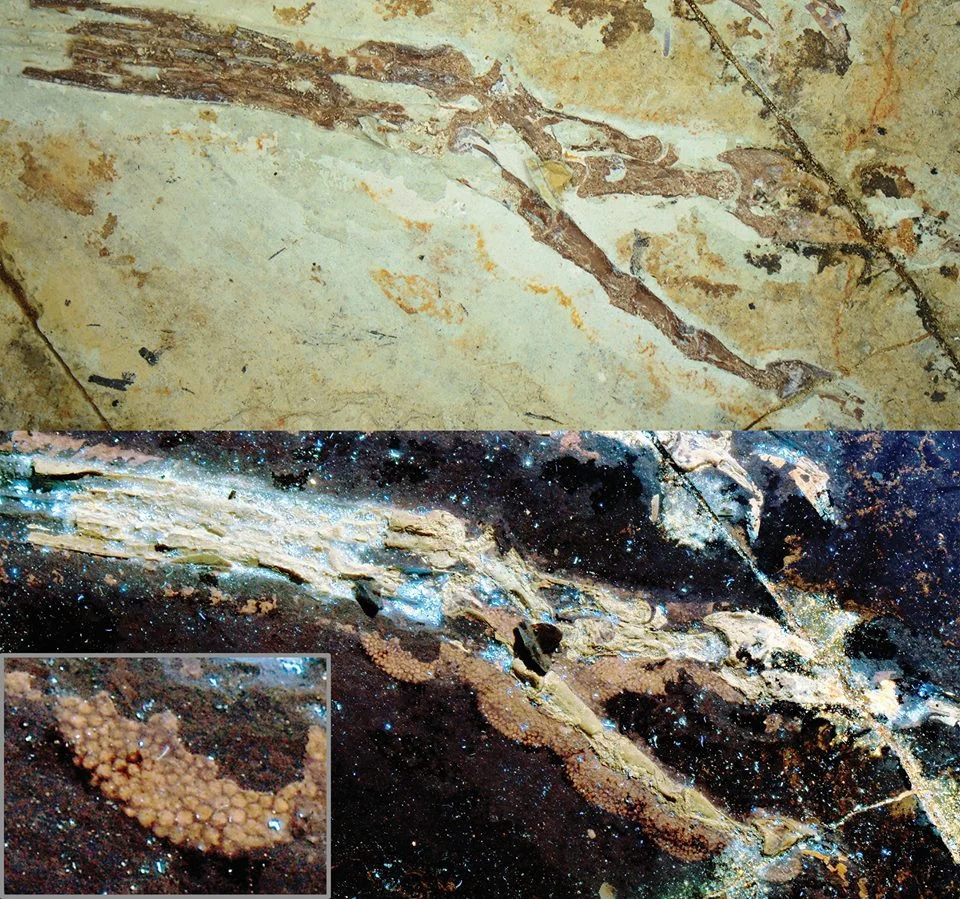
First of all, let me take a moment to point out how ludicrously awesome that bottom image is. You can see the scales on all of the foot pads! Notice on top of metatarsals on the upper left you can see what appear to be enlarged scales like you see in many living birds. Unfortunately they are minimally exposed in this specimen, so it’s sadly equivocal as to what is going on. There are also some scales found up on the tibia in other specimens, suggesting an interesting interplay of scales and feathers on the hind limbs.
Some other specimens also showed the full extent of the keratinous sheaths on the hand and toe claws. I was particularly pleased to see that the toe pads overlapped the joints between each toe bone - exactly the way we have inferred based on trackway evidence and comparisons with living dinosaurs (you know, birds).
Another image making the media rounds shows off some skin details from the arm:
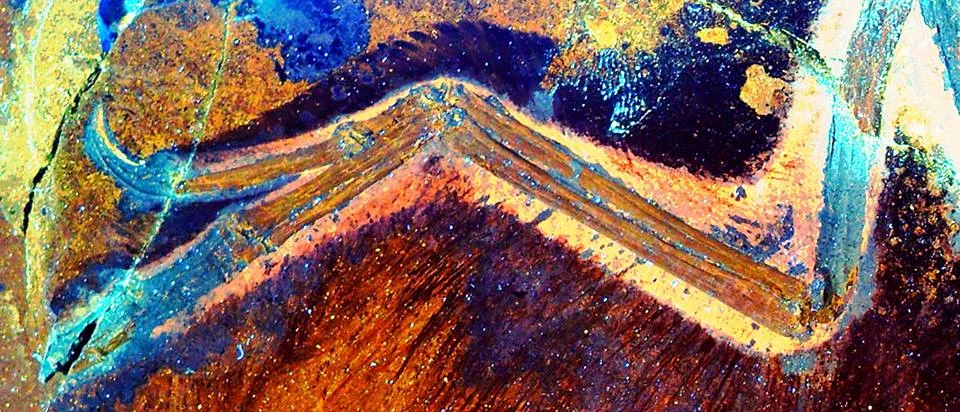
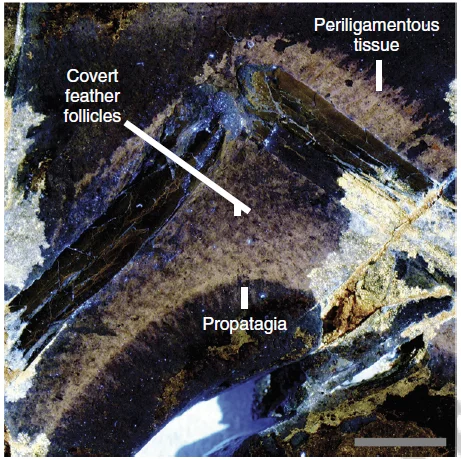
Here you can see the claw sheath on the thumb claw. You can also see how thick the soft-tissue is on the front (palmar) side of the thumb. In retrospect this makes sense given how large the tendon insertion is on the thumb claw, but it’s something that is almost always underemphasized in skeletal and life reconstructions. Another surprise is the extent of the patagium (skin flap) in front of the elbow. This feature is seen in living birds (you buffalo wing fans have eaten your fair share of it), but it had usually been assumed to have evolved in dinosaurs closer to birds - those that were capable fliers. Now we will have to reassess the role of the patagium on the arm (since there is a tendon involved it plays a role in increased leverage) pre-flight. And artists will need to consider expanding the animals they restore with a patagium, potentially including at least all paravians, and (more speculatively) perhaps all winged theropods.
Here is the take-home figure from the paper:
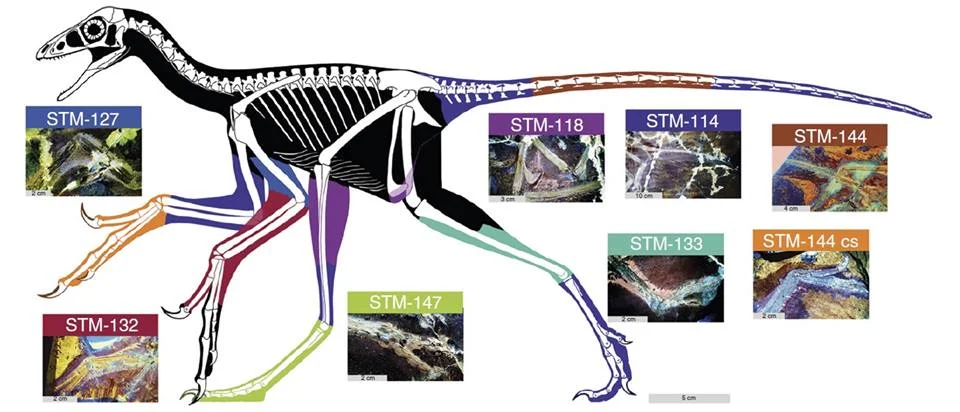
When looking at this figure, the colored portions of the skeletal correlate with the color at the top of the photos - indicating the specimen that best showed off the shape of the skin underneath. The first thing I should note is that strictly-speaking, this figure (and the skeletal at the top of the page) are not showing the same sort of information as the other skeletal drawings on the site. Normally my skeletal reconstructions are done without skin or scale depth added - they are basically flayed. The Anchiornis skeletals here do incorporate skin depth wherever possible.
There are many topics worth covering, but as this is already a giant wall O’text I’ll just hit on the major topics that artists and dinosaur-fans should take note of:
Drumsticks: For quite a while paleoartists “in the know” have been illustrating theropod knees with large, avian-style drumsticks. STM-133 and STM-118 shows this inference is correct, as both show calve muscles that rapidly increase in size as you move up the shin towards the knee.
Fat ankles: Several specimens, including STM-133 show a surprising amount of soft-tissue in front of the ankle joint. This certainly wouldn’t be due to muscle mass, but instead some combination of tendons and connective tissues seems to pad it out, and suggests that theropod ankles (and maybe all dinosaur ankles?) should be fatter than they are normally illustrated. Likewise, many skeletal reconstructions show the skin hugging the long ankle bones (the metatarsals), but several specimens (including STM-147 and STM-114) show a lot of tissue on the back side of the metatarsals, where thick tendons must have run from the drumstick muscles down to operate the feet.
The pubis: There has often been debate over how to restore the large, sometimes-retroverted pubic boot of paravians. STM-118 preserves a clear outline of the lower body cavity around the pelvic region, and though it suggests a thicker pad of tissue under the boot than most skeletal restorations show, it none the less shows the body largely following the shape of the boot, not covering it up in giant mounds of flesh. Also note that after the boot (on the posterior side) the body margin turns upwards at almost a right angle, continuing up towards the ischium rather than completely burying it.
The tail base: While the skin from the pubis does not extend onto the tail, there is a significant belly of soft-tissue extending from the ischium to the base of the tail. So illustrations that show the ischium sticking out, or the skin being shrink-wrapped right from the ischium to the tail are not correct for Anchiornis, and given the information from hadrosaur “mummies” I’d wager it’s not likely for any dinosaurs.
We’re actually not too bad at this anatomical reconstructing thing: There have been many cautionary warnings about what we know and don’t know about restoring extinct animals. They are still quite valid, and you’ll notice that there are several important takeaways from this study that suggest I’ll have to spend time revising some of my skeletals (especially the elbows and ankles) that I’d done before I started working on this project. At the same time, when it comes to the nuts and bolts of muscles and tendons I think we should be rather pleased with ourselves - despite the inferential nature of the work we’re clearly on the right track. And further discoveries of this kind can only help us further test our phylogenetically bracketed hypotheses.
I know I for one cannot wait!
P.S. If there’s interest in a particular topic (covered above or just something you notice in the paper or image) let me know in the comments below and I’ll try to do a follow up post.
18 comments
So what is going on with the integument on Anchiornis' feet?
It was initially described as having feathers over it's pes and the specimen they figure does seem to have dark carbonaceous film preserved around the metatarsals and pes. Your work here however, seems to show reticulae on the ventral surface (not suprising) and scuta on the dorsal surface of the digits and metatarsal both (suprising!).
So what do you think is going on here having looked at multiple specimens, feathers, scutes or both?
Also very interested to read some further discussion of this (if it's not in the paper which I haven't read yet!). The presence of fuzz on the metatarsals and toes is well established in the literature and in published photos like https://d1o50x50snmhul.clou...
So if this study does indeed establish that scutes are present on the dorsal metatarsals and toes, it would appear at first glance to be a slam dunk for BANDits who argue that much of what we are interpreting as simple feathers are actually frayed skin tissue.
I made a bit of a clarification in the article as there is (justifiable) interest here. First off, unfortunately this is the only evidence of ankle scutellae, and since they are not preserved in their entirety, their extent and size is sadly equivocal. Note that there isn't evidence from the top of the toes either. I realize that's frustrating (since this would be one of the bigger surprises) but it's all the evidence we have either way currently. There are some scales (though not scutellae) even up by the tibia (see the supplementary data), which suggests that the interplay of scales and feathers might be fairly complex in Anchiornis - possibly (though speculatively) different from what we see in living theropods.
If we're spitballing, it's certainly possible that the reason we don't have scales on the tops of the toes is because they were fluffy - but of course it's also possible that it's because of the way the slab split (or hey, maybe something like the infamous feathered and scaled chicken feet), but none of it is testable as of now.
Maybe Anchiornis was doing something similar to ptarmigans ("FIGURE 1": https://sora.unm.edu/sites/... ).
Foot pads... FOOT PADS! Wow Scott this technique is incredible to say the least.
Very cool stuff right here! One step closer to actually knowing what some dinos looked like. Simply amazing.
Absolutely a follow-up. From feather arrangement to skin flaps - the more we know about it, the better.
Amazing study Scott.
I am really excited about this! actual dinosaur footpads! Who would have thought I'd get to witness such a discovery! :)
Is there anywhere I can find the skeletal at the top in a more HD version?
On my hard drive. I'll post it to the skeletal galleries soon.
In general I'd like to hear more about the tail base particularly fleshing out the pad of flesh from the ischium to the tail. Oh, and how about the head? Was there anything to glean from the LSF in that regard?
Another fantastic post! It was fascinating to see the details that are revealed by the laser fluorescence. Two questions though.
First, are the colours on the laser fluorescence images the actual colours that appear when the fossil is scanned, or are they added afterwards to distinguish the features? And if so what do the blue glowing bits on the foot represent?
Second, is the patagium composed of just skin or are there tendons and muscle at work there as well? Since your skeletals are shown 'flayed', would it be more consistent for them to have a patagium or to not have one?
Again, loved the post. Keep up the excellent work!
Good questions. The images are taken in the dark with a long exposure and a filter over the camera to reduce non-fluorescing light sources. So in that sense they are actual "colors" and presumably reflect different chemical compositions in the rock (or glue, in some cases).
I would assume that there was a patagial tendon present (that's what gives the it the shape it has in life), but that's not something that we can observe directly with this method (or any other method that I'm aware of). Still, I think it's a reasonable functional inference.
I often wonder how much of what we interperate as say a crest, or feathers pointing out perpendicular to the skeleton can be attributed to the fact that the animals are flattened? When we see dead birds their feathers are splayed out all over the place. Not at all like what we see when they are alive. I've always thought it would be an interesting study to do something akin to the body farms of forensic pathologists replacing the humans with birds. I often wonder if we would glean anything from trying to recreate the conditions of burial etc. of the feathered dinosaur specimens to try and understand if what we see would have been a feature when the animal was alive.
I am surprised by the thin base of the tail… did the caudemofemoralis muscles become diminished? I do wonder if this was something peculiar to these particular paravians and how much we can extend that look to other dinosaurs? Glad to see mention of "fat" ankles in Anchiornis and possibly other dinosaurs in this blog post by Scott. I've been drawing my dinosaurs with nice fat kankles for a while. I suspect something allometric was going on… that with increased mass cartilage and soft tissue at the ankle and other joints increased to act as shock absorbers at large size. Look at the ankles of rhinos and large ground birds/ratites - they are chunky knobby masses!!
Thanks for the comments Duane. I agree that the tail base is probably only generalizable to paravians (or maybe Pennaraptora), as the reduced ischium, reduction in CLF insertion scar and origin region on the caudal series is very different from the configuration seen in other dinosaurs.
I was slow to the fat ankles party (just in the last 4-5 years) but it definitely appears to be correct.
Thanks for another fantastic post! (Long-time reader, but first time commentor)
I'm curious though, with the brachiopatagium preserved here and the uropatagium in Psittacosaurus, do you think patagia are more widespread in dinosaurs than generally thought? I know phylogenetic bracketing can be misleading and a dangerous assumption to make, but when the two recent examples are from such distantly related species I wonder if maybe there's more there than we have seen in the fossil record thus far.
I just found this site today, and I love it! I first saw the one about Spinosaurus and how it would've stood, and I'm definitely coming back! I've been a long time dinosaur fan(ever since I was 2-3), and this website is one that earns a special place in my list of resources.
Join the discussion
Thanks — your comment is in the queue!
It'll appear here in about 5–10 minutes, once I've approved it — you'll need to refresh the page to see it. (Comments don't post instantly anymore.)