Taking a 21st century look at Dimetrodon
November 19, 2016
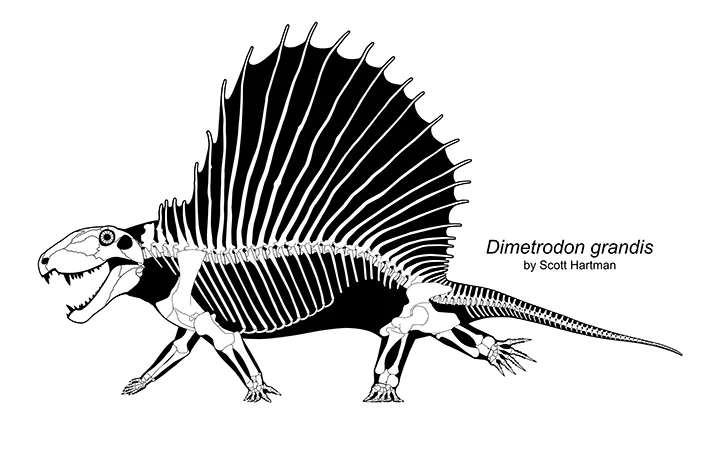
Today I have something I’m excited to share with you: my skeletal reconstruction of Dimetrodon grandis. It looks quite a bit different from existing skeletal reconstructions, so I’m also going to take a more in-depth look at the underlying data. But first, let’s take a look:
Why Dimetrodon? Aside from the fact that it’s awesome?! OK, I admit that without external impetus I would probably not have gotten around to working on any pelycosaur skeletal reconstructions for a fair bit yet. But for the last year I’ve been working with Permia to help them design paleo-themed clothes and merchandise, and one of their early requests was for a skeletal reconstruction of the iconic sail-backed stem-mammal.
So how does the new skeletal differ from past reconstructions? There are quite a few ways, but for now I’ll highlight three of them: The sail with semi-emerging spines, the curvature of the back, and the high-walk pose. Let’s unpack each one:
Sail shape: If you look at recent Dimetrodon paleoart you will see there has been a big increase in the variety of ways in which the sail is being restored. Some have the spines almost entirely protruding while others have the sail covering the entire thing, and almost everything in between. Much of this interest has stemmed from research done by Rega, et al., (2012) that looked at the pathologies found in the tall back spines of Dimetrodon.
The authors observed that some of the neural spines had broken and later healed. This is strongly suggests that at least part of the spine was embedded in a sail (or similar tissue) that kept them in place after breaking so they could heal. But they also observed that the tops of the spines were often bent, sometimes severely, which suggested that the top of the spines were not embedded in a sail. Further confirmation of this “emerging from the sail” configuration comes from the surface texture of the neural spines. The spines shift from a roughened texture where they are embedded in back muscles, to a texture consistent with being in a sail (e.g. impregnated with Sharpey’s fibers), to a smooth texture at the top, where they most likely became spines that stuck out of the sail.
So it appears that Dimetrodon had a serrated, multi-spined sail in life, though exactly how much of the neural spines stuck out isn’t entirely clear - the specimen discussed above came from a different species of Dimetrodon, D. giganhomogenes, and the condition may have varied between species, or possibly even within a species between genders and/or during ontogeny.
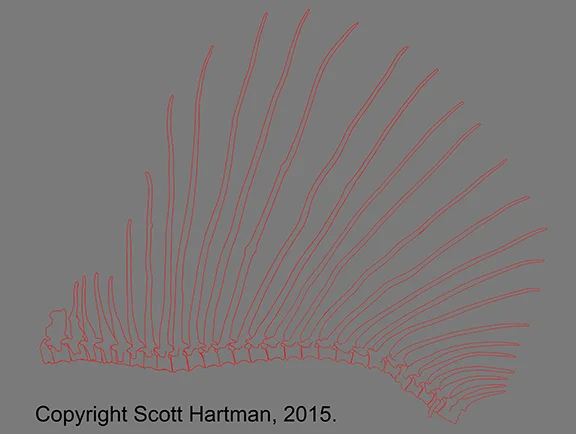
Back curvature: If you want to know what an extinct organism looked like in life, the shape of the vertebral column is one of the most important things to get correct. Based on the many existing skeletals I had assumed that there was no controversy to be found here, as they all showed a generic series of gently arched back vertebrae with a straight neck and tail. But as I worked to restore the backbone of D. grandis I was immediately vexed, as many of the vertebral bodies (the centra) were quite strongly bevelled, which generally indicates curvature in the spine. Moreover, they weren’t curved randomly, they instead curved down in the neck and the posterior part of the back, and up at the transition from the back to the neck - in other words, they were curved in the same manner as seen in more advanced therapsids (and in many mammals). I spent a really long time on the neck and back - coming from a background based on archosaurs, and with every skeletal of Dimetrodon ever done seeming to show something else I triple-checked everything.
A couple of things have made me comfortable with this solution - first was that the neural spines themselves support it. If I forced the backbone to look like other skeletals the neural spines ended up clumping together in the areas that should be curved down. If I let them articulate the way the bones suggest then the spines maintain a reasonable, even spacing down the body. Another thing that helped convince me looking at other specimens; my skeletal is predominantly based on the Smithsonian specimen of D. grandis, but looking at other specimens I saw evidence of these same curves in several other specimens - for example in the AMNH D. incisivus specimen the same curve in the back just ahead of the hips is quite obvious (in some mounts you can see gaps between the vertebrae that were created when the back was straightened out).
The odds seem small that this bevelling of the vertebrae could be diagenetic (that is, deformation caused after burial) since the neural spines would have to also be bent to compensate. The fact that it appears in many other specimens also makes it more likely that this is a real phenomena, and not an artifact from a single specimen. As a final bit of positive reinforcement, I chatted with several Permian synapsid researchers at SVP in October and received only positive feedback. Phew!
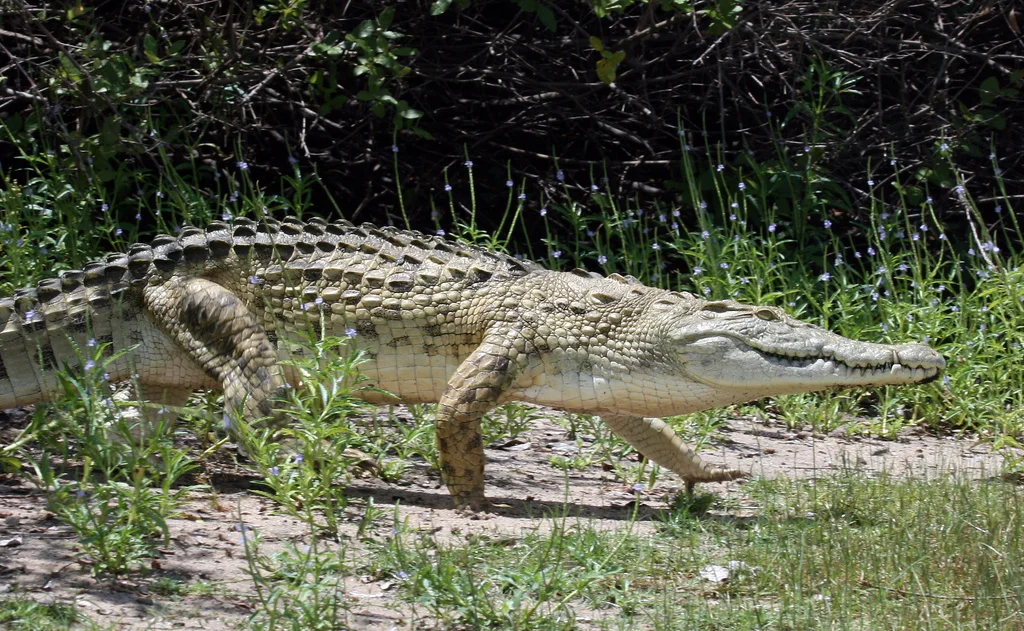
The high walk pose: OK, I admit it, it’s a “high run” pose. By “high walk” I was referring to the semi-sprawled gait we see at times in extant crocodilians. Traditionally Dimetrodon has been portrayed using a lizard-like sprawl, but in the last couple of decades researchers have discovered trackways given the name Dimetropus. These trackways, which appear to have been made by Dimetrodon or a synapsid closely related to Dimetrodon, show an animal moving with a more upright posture, holding its belly and tail well clear of the ground.
It seems clear that Dimetrodon could sprawl when it wanted to (perhaps while at rest, or simply when it wanted to stay close to the ground), but the trackways also attest to frequent use of a more upright (semi-sprawling) posture. And if Dimetrodon was in a hurry, the more upright pose seems like the clear stance to adopt. Keen observers will note that I have actually spent a lot of time reposing my theropod skeletals to make them not be running. I’m not having a change of heart - like other skeletal poses I created for Permia this is a one-off pose for them. It’s a reasonable-yet-dynamic pose that hopefully helps make for desirable clothing and other items, but it is specifically for their merchandise. As soon as time allows I’ll release a more general pose that will be sauntering at a more sedate pace (that is the one I will upload to my galleries).
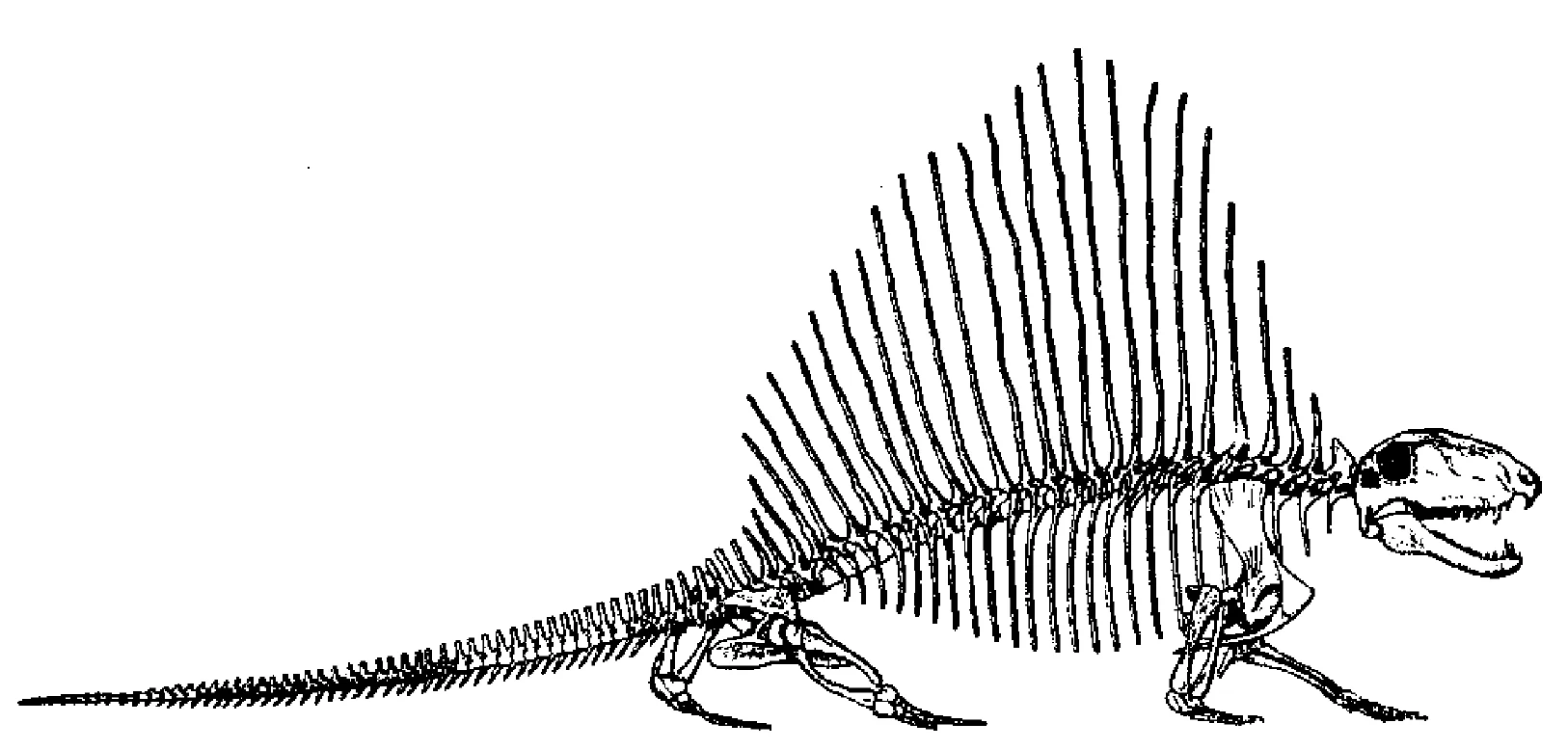
False consensus & other thoughts: When I began this skeletal reconstruction I thought this would be an easy project, since Dimetrodon skeletals up until now have looked more or less the same. Now that I’ve spent a serious chunk of time working on them, it turns out that this similarity wasn’t due to informed consensus, but rather that everyone appears to have more or less recycling Romer’s 1927 skeletal, right down to the limb pose! I don’t want to name names, but you can see Romer’s skeletal below, and if you Google “dimetrodon skeletal” you can see for yourself just how pervasive the habit of “taking direct inspiration” from Romer’s skeletal has been.
I expect people will want to know if this should be the new base-look for all Dimetrodon species, but unfortunately it’s hard to say at this point. Dimetrodon is a genus with a dozen or so valid species (depending on who you ask) spread over 20+ million years. Those species range in length from under a meter to giants more than five meters long! In short, Dimetrodon species could have had a lot of diversity in their backs, sails, etc., and it will take more to find out. But I do feel comfortable saying that at the least Dimetrodon grandis looked quite different from the Romer-cloned version we’ve been using for most of the last century.
Thanks to Permia: I also want to take a moment to thank the team at Permia, as I quite simply would not have tackled this skeletal without their initiative. Their vision for a company that embraces both science and style is more than just glib marketing talk; they’ve been extremely supportive throughout the processes, understanding that restoring extinct animals is hard work, and sharing in the ride when it takes us on surprising twists and turns as to what we think an animal looked like (I certainly didn’t expect to end up with such a different view of Dimetrodon when I started!).
If for no other reason than this I would recommend supporting them. I’ll have more to say about Permia (and their products - I’ve been wearing prototypes of their shirts for a couple of weeks) in another post coming soon, but if you’re interested you can check them out right now on their Kickstarter campaign. It’s well worth a look.
26 comments
now that you've done dimetrodon, now get to the damn utahraptor skeletal everyone's waiting for. The material was published, so do it! I'll understand if it takes some time.
The skeletal has been done literally for years, but there's one last piece of data that has to be published before I can release it.
That'll be a great day, indeed. Will be nice to finally have a complete view of that elusive dromaeosaurine...and to see in full just how weird it'll look compared to the old super-Deinonychus depictions of yesteryear.
Good work as always, Scott. Much better than the "hump" with spines sticking all they way out art I've seen on deviantART.
Thanks - I do think people don't make the axial muscles tall enough on most Dimetrodon skeletals, but I don't see much support for the hump.
Considering what other data's been presented at SVP regarding basal synapsids, such an active pose definitely doesn't seem like a pose Dimetrodon would be in sparingly, I have to admit. It's nice to see more basal synapsid skeletals, though, in any case.
Lol, so...many...double...negatives. But I agree.
5-metre Dimetrodon? Which species reaches that size? Sounds very impressive - much like this skeletal! It looks much more natural than many other Dimetro reconstructions.
It's Dimetrodon angelensis, the last species of the genus, known by an incomplete skull with lower jaw and some vertebrae. The taxonomy of Dimetrodon requires a revision, maybe this giant species belongs to a distinct genus. It was a contemporary of the giant Cotylorhynchus hancocki.
This is interesting.
"Today I have something I’m excited to share with you:"
You're still alive!
"...my skeletal reconstruction of Dimetrodon grandis."
Well that's good too.
Seriously, even if it's just one possible look, it's a great new look. Among the other changes, I'm surprised how short the tail looks, compared to the old Romer reconstruction.
On the Permia kickstarter: I'm very tempted by the ceratosaur shirt, but like most kickstarters I look at I don't know what to make of the included extras, that may or may not drive up costs. Ironically, it's usually a t-shirt. Here, I look at the Permia people rave about their 'collectable' boxes, and, well...
It's a box.
I'm very much alive, I just also have a teaching load and graduate research to publish (and a family to attend to) so I don't get to work on as many skeletals during the school year as I'd otherwise like. I am working on them though, and sometimes they are long done but waiting on publications, so they will continue to trickle out.
I can't really help you either way with your box considerations - I will say that I saw them but don't currently have one (I got some prototypes of the shirts at SVP, but I didn't have room for the boxes in my luggage) and I'd really like one or two, as they are really well made and have the embossed skeletals all over them. I'd personally keep them and use them as gift boxes for birthdays or the holidays (it would seem really appropriate in my family), but that's me and I know for some people it's nothing more than a shipping container so I wouldn't try to convince you either way.
The shirts are really nice though.
Question : What's that bone projecting dorsally from the (?)second (Third?) cervical? It seems a lot thicker than the dorsal neural spines and looks like it's supporting a layer of muscle up there.
It's indeed a neural spine, and it almost certainly was supporting axial musculature.
Thanks for replying, Scott! I had a feeling it was a neural spine but the relative thickness threw me off a bit. Also, I just notice that the dorsal neural process looks like Drogon's cervicodorsal fin from Game of Thrones. https://uploads.disquscdn.c...
Hi Scott. Excellent work, as always. I endorse your use of specimens rather than chimaera recons. Tell me about the extremities. Footprints attributed to Dimetrodon show toes pointing in the direction of travel, but yours seem more lateral. And the length of the tail is always an issue. I understand tails are rarely preserved with the rest.
Yeah, those would (presumably) be at normal walking speed (which was also probably more of a traditional sprawl) and this is at a higher speed (but still a semi-sprawl) - maybe we'll find fast-moving Dimetropus tracks someday to test it. There isn't a complete tail, so I scaled it as best I could from the one of the more complete caudal series (among those figured, at least).
Very cool! I made a model of Dimetrodon grandis a while ago, mostly just so I could use it to highlight the features that we share (temporal fenestra, specialized teeth) - my model was based on the outdated posture and whatnot since it's all I could find, but if I ever get back around to doing it I'll probably try to make it more like yours!
Hi, I just realized that von Huene also mounted his Dimetrodon dorsal vetebral column 1919 in Tübingen (Germany) with a substantial curvature. Before you did this,I always thought it looked funny. But he was a good anatomist and must have made similar observations on the spine as you. Congratualtions on this good work!
Out of curiosity, what are those two notches on the neural spine of the 7th (?) thoracic?
Are you going to do more Non-Mammal Synapsids skeletals?And why Dimetrodon is not on any skeletals lists?(like that of Non-Dinosaurs)
I was wondering why you haven't gotten around to putting the new Dimetrodon skeletal reconstruction in your gallery of Non-Dinosaur skeletal reconstructions?
I wonder why this new skeletal isn't found in your gallery of Non-Dinosaurs?
I like the new skeletal! Could you give more info?
Is there anyone who supports the idea that dimetrodon was a partial swimmer here ? All the media depicts it as a desert dweller or a marshland dweller. But when the species is know to prey on amphibians and marine organisms i find it hard to believe that they couldnt support some kind of underwater traversal. Its a huge organism with a giant mating display on its back, it would probably be difficult to sneak up on smaller quicker organsims without having the strength or speed to compensate. Also i was thinking about the behaviour of crocodiles and how they sort of warble ( forgot the technical name ) or vibrate there diagphram to attract mates. Maybe dimetrodon grandis could have transmitted these vibrations more efficiently with there sails. Although i think that they could swim however, i also feel like they would be more top heavy, although due to the position of there lungs on either side of there body they may have been able to use this to their advantage. Id also like to know more about there large nasal cavities and how that may have helped them in there enviroment.
Hi Joseph - Dimetrodon is basically only found in swamps, so it should rarely, if even be portrayed outside of water. That said, it's not really found in deep-water environments either, so while I'm sure it could swim if necessary (most animals can), I strongly doubt it was an underwater pursuit predator (it simply doesn't show the anatomy for such). I'd guess it either stalked through water, or waited for prey to come to it and snatched them. They not only feasted on amphibians and stem-tetrapods, but freshwater sharks as well.
Join the discussion
Thanks — your comment is in the queue!
It'll appear here in about 5–10 minutes, once I've approved it — you'll need to refresh the page to see it. (Comments don't post instantly anymore.)